

Rosh Hashanah
May the New Year
bring to all our friends
and family
health, joy, prosperity and
everything good in life.
2011
5772
Karen & Jeffrey Kraft
Aimee & Matt Spatzner
Elissa & Chet Evans
& Rachel
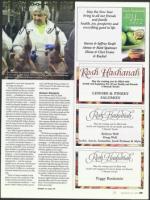
The assembly line at Empire Kosher Poultry's plant in central Pennsylvania
is the largest kosher one of its kind in America, with 240,000 chickens and
27,000 turkeys passing through every week.
appealed for a new trial, arguing that
the judge was biased.)
Second, and perhaps not unrelated,
Empire officials say they are consider-
ing expanding into the kosher meat
market — something the company
once did, albeit without great success.
With plans on the drawing board to go
back into beef within a year — Empire
would buy already-slaughtered cuts of
meat and build a business around pro-
cessing — the company is launching
a public relations campaign to tout its
approach to chicken production, includ-
ing advertisements in the Jewish media.
A private company with annual rev-
enues exceeding $100 million, Empire
says the ways it raises its chickens and
treats its workers are the keys to the
company's success.
Since 2008, Empire's chickens have
been antibiotic-free, and the company
now has an organic line available at
retailers such as Trader Joe's and Whole
Foods. Empire's workers are unionized
— a rarity in the kosher business —
with salaries ranging from $8 to $11.40
per hour, and health, vision and dental
plans. Empire is a graduate of the U.S.
Department of Labor's OSHA Challenge
program — the Occupational Safety
& Health Administration's initiative to
improve workplace safety and health
management — and the company
employs an on-site nurse. Over the past
10 years, the company has invested
more than $2.5 million in a wastewater
treatment facility that recycles its efflu-
ents.
"There is a better standard in that
plant in terms of the conditions of the
workers and the way they're treated
— not just physical conditions — com-
pared to other chicken poultry proces-
sors," said Wendell Young, president of
UFCW Local 1776, the union that repre-
sents Empire's employees.
Humane Standards
In an interview with JTA, Rabbi
Morris Allen, program director of the
Conservative-backed seal of ethical kosher
food production that will be rolled out this
fall, said that Empire's practices appear to
make it a good fit for the Magen Tzedek
seal, which guarantees certain standards
for treatment of workers, animals and the
environment. Allen visited the Empire
plant several months ago.
What has enabled Empire to be profit-
able, company officials say, is its vertically
integrated operation. From conception
to supermarket, Empire approaches its
chicken operation with scientific preci-
sion.
"We hatch our own eggs, feed them
with our own blend of feed from our feed
mill and keep close watch as they grow.
We have control from conception until
packaging — no third parties': said Greg
Rosenbaum, the company's CEO. "We can
say to the world that humane standards
had been applied at every stage."
It all starts with breeding. While com-
panies like Purdue may breed chickens
for large breasts because breast meat is
in highest demand, Empire's chickens are
bred for kashrut. That means large breasts
could add weight that damages the chick-
en's tendons, rendering the chickens treif,
or unkosher, when slaughtered. No growth
hormones are administered; hormone use
for poultry is illegal in the United States.
"We worked over the years to get the
breed just right': Jeff Brown, Empire's chief
operating officer, told JTA over a chicken
lunch. "It was developed specifically for
kosher processing."
May the coming year be filled with
health and happiness for all our family and friends.
liShanah Tovah!
May the coming year be filled with
health and happiness for all our family and friends.
L'Shanah Tovah!
Roberta Wolf
Doug Wolf
Jackie, Aaron, Samantha, Jared Perlman & Mylo
May the coming year be filled with
health and happiness for all my family and friends.
L'Shanah Tovah!
Peggy Bookstein
Empire on page 50
September 22 2011
49