

arts & entertainment
Muslim
Chutzpah
Author Irshad Manji calls on people of all
faiths to summon moral courage in
the face of extremism.
Suzanne Chessler
Contributing Writer
I
rshad Manji's mother had a jar-
ring experience in Michigan, where
she accompanied her daughter on
a promotional tour for the PBS Emmy-
nominated documentary Faith Without
Fear, which chronicled Manji's attempt to
"reconcile her faith in Allah with her love
of freedom."
The program, chronicling Manji's
exploration of individual expression and
reform within Islam, met with anger from
the larger Muslim audience and thanks
from young Muslim women speaking
with her privately.
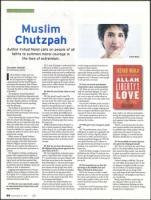
The incident is described in Allah,
Liberty and Love: The Courage to
Reconcile Faith and Freedom (Free Press),
Manji's latest book.
Social networking has connected Manji
with two others from Michigan, one
Muslim and one not. Impressed with their
ideas, she asked them to serve with confi-
dentiality on her nine-member Guidance
Council, established to respond to those
writing the author for advice about devel-
oping moral courage.
Manji, winner of Oprah Winfrey's
Chutzpah Award for boldness, teaches
moral courage at New York University's
Robert F. Wagner Graduate School of
Public Service. Earlier, she held posts in
government and television journalism in
Canada.
The daughter of Indian and Egyptian
parents who emigrated from Uganda to
Canada, Manji has traveled widely, includ-
ing to Israel, and she has asserted that
neither America nor Israel is responsible
for problems faced by Muslims, whom she
advises to look to themselves.
Logging many appearances to discuss
religious issues coming to attention after
the tragedy of 9-11, Manji answered relat-
ed questions posed in a phone interview
with the Detroit Jewish News:
IN: What do you want Jewish readers
to understand about Islam from read-
ing your books?
60
September 8 • 2011
Asi
IM: I want all people to understand that
at the heart of Islam is a personal rela-
tionship with one Creator for us all. That
relationship truly may not be mediated by
a clerical class. By reinterpreting Islam as
a God-conscious faith, I would like young
people in particular to appreciate that we
don't need the approval of imams, theolo-
gians and so-called scholars. We need love
of God and integrity of self.
IN: How do your books relate to each
other?
IM: One doesn't need to read The
Trouble With Islam Today to engage with
the new book. The earlier book came out
almost a decade ago as a why-to. Why
should a new generation try to ignite a
21st-century liberal reform within Islam?
This new book is a how-to. How do
we create new habits that fulfill moral
courage? It is a book for non-Muslims as
well as Muslims because I believe [these
initiatives] will take people from across
the spectrum.
[Rabbi] Abraham Joshua Heschel is a
hero of mine because he joined Martin
Luther King Jr. [in a civil rights march] in
Selma even when told by some Jews that
it would exacerbate anti-Semitism. People
like him have sown the seeds for my own
understanding of how to develop world
courage.
IN: How do you hope that people of
all religious backgrounds approach the
observance of 9-11?
IM: I'm a big believer in honest conver-
sation. I also believe that 10 years after
9-11, moral lessons are more infused with
fear than at any time in the immediate
days following 9-11. My very hard experi-
ences across the country and the world
have shown me that people who define
themselves as open-minded and progres-
sive are afraid to ask questions about
Islam and even more afraid to question
those of us who practice the faith. They
fear being branded bigots.
On the flip side, liberal Muslims are
afraid to discuss beliefs openly. On the
one hand, we fear being declared traitors
by Islam supremacists; on the other hand,
we fear being proclaimed terrorists-in-
waiting by Islam bashers.
The so-called conversation that we're
supposedly having actually is driven by
fear, which really means a profound and
dangerous lack of honesty. I want people
to ask questions out loud.
JN: How can Jewish and Muslim
communities open communication?
IM: When we come to the proverbial
table for interfaith dialogue, we come
with very heavy identities. Why does it
not occur to most of us that when we
come to the table, we are also multi-facet-
ed individuals?
I'm not just a Muslim; you're not just a
Jew. We have much about us that we can
never know until we begin treating each
other as unique individuals rather than as
mascots for this or that community.
God creates uniqueness, and we, as
individual Muslims, would do well to
embrace that notion.
IN: What gives you courage to speak
out?
IM: The predominant source of my
willingness to speak out is gratitude. My
family and I are from Uganda, [where
I was born in 1968], and wound up in
Canada as political refugees in 1972. We
were gifted freedom, and I believe it's
my opportunity and privilege to use that
freedom in as constructive a way as I
know how.
I don't feel that's courage. It comes from
faithfulness for all that I've had and con-
tinue to get through the grace of God and
the pluralism that we learn in this part of
the world.
JN: How hopeful are you that the
uprisings in the Middle East and
Africa will lead to democracy?
IM: In this country, we had a couple
hundred years to work out the more per-
fect union and continue to evolve it. We
need to give people in other parts of the
world at least the amount of time that
we've had.
I've heard a flood of questions about
interfaith marriage, and that tells me
IRSHAD MANJI
Alittm o! OE: Ne4
Th7le5 t!estEeiliog
THE TROUBLE WITH ISLAM TODAY
ALLAH,
LIBERTY!
LOVE
THE COURAGE TO RECONCILE
FAITH AND FREEDOM
there really is an embrace of pluralism
among the young generation and a need
to understand how to secure resources
and organize to give Islamists a run for
their money.
There's a real intention, but the ques-
tion remains whether that intention can
be solidified into viable politics. Nobody
really knows the answer to that. An
Egyptian colleague is worried that the
Islamists already have so much power.
IN: Do you think it's ironic that you
were given the Chutzpah Award?
IM: I love it, and I love the word "chutz-
pah" as I do many Yiddish words because
they mean how they sound. I am proud to
be given an award for audacity in a world
that is so steeped in moral and cultural
relativism.
Cultural change is difficult. The mod-
em civil rights movement in the U.S. did
not happen overnight and did not come
out of nowhere. If [cultural change] is
what people like me are doing at this
very early stage of the liberal reformation
within Islam, I will happily accept that as
my contribution.
Many young Muslims contacting me
are asking for advice on how to start
clubs of independent thinking on their
university campuses. This kind of change,
though slow, is happening.