

r0
Portraits Of Survivors from page 8
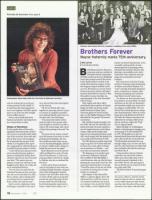
Gammas and Gamma Girls at a member's wedding in the early 1950s.
Brothers Forever
Wayne fraternity marks 75th anniversary.
Bill Carroll
Contributing Writer
B
Photographer Monni Must holds her first book on Holocaust survivors.
with her husband Jerry, are the pre-
senting sponsors for the exhibit. "It
is imperative that what happened is
never, ever forgotten. We hold a special
space in our hearts for their stren
and incredible journey"
Norris, whose family hails from
Finland, had relatives who helped save
Jews and get them to safety.
Voices of Survivors
By this month, Must will have pho-
tographed, interviewed and recorded
350 survivors around the world. Audio
clips of the survivors' voices and snip-
pets of their stories will accompany
the 50 portraits that are part of this
exhibit. It is the gallery's first experi-
ence using guide-by-cell technology in
an exhibit to present audio to viewers.
"I can't tell you how many survivors
we've met who had never spoken to
anyone, including their family, about
what they experienced and witnessed,"
says Must. "This project gives me
purpose, it keeps me connected to my
daughter, and it allows me to help oth-
ers be remembered forever.
"For survivors, not only from the
Holocaust, but any survivor, even par-
ents who survive the death of a child,
there is always a piece missing. After
you tell your story to someone else,
there is relief, even with the tears:'
Must's creative collaborator, Linda
Schlesinger, is grateful for the experi-
10 September 1 2011
ences she and Must have had together
on this journey.
"We are two friends who came
together six years ago, drawn to a proj-
ect because of a tragedy so painful I
never believed Monni would come out
the other side says Schlesinger.
"This journey has taken us thou-
sands of miles. Doors opened where
most thought we would not be able to
walk in. We created magic with a force
of Miya Must pushing us forward;' she
says.
"The power of two women, commit-
ted to the journey of survivors, is stron-
ger than most friendships. The trea-
sures in life are not the riches we pos-
sess, it's that lone photograph, clutched
in a hand or hidden under a bunk, of a
family that most never saw again:"
Must's Holocaust survivor portraits
will be published in a series of books
titled Living Witnesses 2, with accom-
panying profiles written by her daugh-
ter Sabrina, who also co-authored the
first book.
A Dime and A Penny Foundation
seeks to aid people in other ways, too,
including through Heartfelt, a program
where Must photographs Neonatal
Intensive Care Unit babies before they
are taken off life-support, giving their
parents the only living image of their
precious child. She also helps fami-
lies find photographic opportunities
before a relative enters hospice care.
erol Robinson lived in France for
many years and was a member of
the French Nuclear Commission.
Sol Weller worked on the secret Manhattan
Project that created America's first atomic
bomb. Sheldon Ellison worked on the
Apollo Moon Mission program. Aviator
Ben Fingeroot helped establish Israel's
Air Force. Ben Paolucci is now the Detroit
Pistons' team doctor. Martin Abel helped
found the Shul-Chabad Lubavitch in West
Bloomfield. Seymour Gretchko was
superintendent of the West Bloomfield
School District.
Their exploits and others will be
remembered when members of Gamma
Kappa Chi (GKC), the former, mostly
Jewish fraternity at Wayne (State)
University, gather for brunch Sunday,
Sept. 4, at the Fiddler Restaurant in West
Bloomfield for the group's 75th anniver-
sary reunion.
GKC members bonded strongly in the
late 1930s, '40s and '50s when they com-
prised more than 100 active members a
year, the largest fraternity on the Wayne
campus. Many Jewish students had
bypassed two national Jewish frats to join
GKC, which merged with Tau Epsilon Pi, a
new, mostly Jewish fraternity in 1958.
The GKC alumni are mostly retired and
range in age from 70-90. Many still meet
for lunch every week, either in Detroit-
area restaurants or in Florida — and
never miss an anniversary milestone.
"It's shaping up to be another great
anniversary celebration',' enthused
Harvey Miller of West Bloomfield, a
retired furniture sales rep, who has been
planning the event almost since the 70th
anniversary bash that drew 156 people.
"There'll be plenty of time for our broth-
ers and the surviving wives of other
brothers to reminisce."
Allen Halper of West Bloomfield,
Miller's co-planner, figures about 100
will attend Sept. 4. GKC has a base of
250 members worldwide, and several
are coming in from around the United
States. Halper, a retired Highland Park
teacher and school administrator, writes
a monthly email newsletter to keep
alumni apprised of upcoming events,
simchahs and members' illnesses. He's
planning a memorabilia room, with a
continuous video, old photos and clip-
pings, and a memorial to deceased
members.
GKC was known as the frat of "jocks
and docs," boasting a large membership
of athletes and medical students. The
"jocks" annually dominated intramural
sports competition on campus, often
outdoing and gaining more notoriety
than Wayne's woeful varsity teams.
The alumni say they're proud to have
been pioneers on many fronts. "It wasn't
well known at the time, but fraternities
and sororities usually were restricted to
one religion:' recalled Miller. "We were
the first frat to break the barrier and go
inter-denominational." When the nation
began observing Brotherhood Week in
the 1940s, the Gammas introduced the
celebration by inviting a little-known
African-American singer, Nat "King"
Cole, to sing and speak.
Sidney Zirulnik, 91, of Huntington
Woods, a retired property manager, was
in the group of 15 who founded GKC
in 1936. "We decided not to join the
national Jewish fraternities because they
were a bit too elite for us," he reflected.
"We all had jobs and worked our way
through college. And, of course, the dues
were less. The Depression was still in full
force and didn't end until the nation got
into World War II.
"Some members, like me, finished
school first and entered the military.
Others quit school right away, went to
war, and returned to graduate in the
mid-1940s. We lost a few great guys in
the war. But the rest of us kept the frater-
nity going until 1958.
"It's hard to believe 75 years have gone
by."
The reunion of Wayne U. fraternity Gamma
Kappa Chi begins at 11:30 a.m. Sunday, Sept.
4, at the Fiddler Restaurant, 6676 Orchard
Lake Road, West Bloomfield. $25 per person.
Information: Allen Halper, (248) 682-4986.