
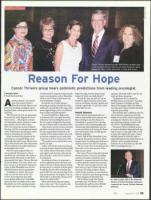

Cancer Thrivers Network founder Patti Nemer, founders and
event co-chairs Michelle Passon and Sandy Schwartz, quest
speaker Dr. Allen Lichter and event co-chair Rita Sitron.
Reason For Hope
Cancer Thrivers group hears optimistic predictions from leading oncologist.
Ronelle Grier
Contributing Writer
A
positive attitude is the founda-
tion of the Cancer Thrivers
Network for Jewish Women, and
news from a leading oncological expert
has given these women good reason to be
optimistic.
"The five-year survival rate approaches
90 percent for newly diagnosed cases of
breast cancer ... the progress is steady
and inexorable, and we continue to make
great strides': said Dr. Allen Lichter,
CEO of the American Society of Clinical
Oncology (ASCO), an international organi-
zation of physicians specializing in cancer
research, prevention and treatment.
Lichter attributed this progress to the
increasing use of targeted drugs and to
technology that allows more efficient shar-
ing of research data and other information
between patients and medical profession-
als throughout the world.
"Have we made progress? Have we
over-promised? The answer to both is
absolutely yes:' said Lichter, who spoke to
approximately 240 people at a luncheon
sponsored by the Cancer Thrivers Network
for Jewish Women. The event, which took
place on July 22 at the Jewish Community
Center in West Bloomfield, was the first
official fundraiser for the organization.
"In Judaism, we believe that to save
a life is to save the entire world. This
is never more important than when
we are dealing with cancer': said Rabbi
Marla Hornsten of Temple Israel in West
Bloomfield, one of the opening speakers.
Lichter said cancer treatment is being
revolutionized by drugs that target specific
cancer-causing agents, such as Tamoxifen,
which is used to treat certain breast can-
cers by binding to estrogen.
He said the cost of cancer drugs is
increasing at a greater rate than any other
health care cost, and that while many of the
newer targeted drugs can be very effective,
they are often extremely expensive.
"It costs $120,000 for a single course
of treatment with a new agent that treats
melanoma;' he said, adding that some of
the cost could be mitigated by increasing
the use of clinical trials and predictive tests.
"Only about 3 percent of cancer patients
partake in clinical trials for new drugs:'
he said, citing pediatric leukemia as an
example of how patient studies were used
to increase treatment success rates from
35 percent in 1970 to 70 percent in 1990.
"We studied and we learned from every
patient': he said.
Lichter said that the medical profession
is moving toward a Rapid Learning Health
Care system, which will include a central
case registry and electronic data sharing
that will make it easier for test results to
be maximized.
According to Lichter, it is important to
note the significant strides that have been
made in the area of human genome testing,
because cancer is a disease of altered genes.
He said the first time this technology was
used in 2003, the cost was more than $1 bil-
lion, and the process was lengthy. "Soon, we
will be able to perform this testing in a few
days for less than $1,000."
When asked about yoga and organic
diets, Lichter said, "There is pretty solid
evidence that stress and anxiety are
helped by yoga. If you're doing it, keep
doing it; if you're not, think about it."
He said the "jury was still out" on the
benefit of organic foods for cancer treat-
ment or prevention, but that a healthy diet
is always a good idea. "It can't hurt, and it
might help:' he said.
Health Reforms
Lichter said the upcoming health care
reforms may benefit cancer patients and
those wishing to avoid the disease by
eliminating co-payments for screening
procedures such as mammography and
colonoscopy, removing lifetime caps for
certain procedures and closing the "donut
hole" prescription drug coverage gap for
Medicare recipients.
Marcie Paul of West Bloomfield is part
of a group that spreads awareness about
ovarian cancer by making presentations to
medical students and other local groups.
"We try to put a face to the disease said
Paul, who is a two-year survivor of late-
stage ovarian cancer.
The Cancer Thrivers Network for Jewish
Women provides a venue for friendship,
activities, education and humor and is
designed to empower and enrich the lives
of cancer patients beyond mere survival.
"We don't want any `shiva voices':' said
Patti Nemer, a Cancer Thriver and one of
the group's founding members. Nemer
said it became necessary to raise funds in
order to continue to provide programming
without charging membership dues.
"We feel these people have already
paid their dues': said Nemer of West
Bloomfield. She said that about $30,000
was raised from the luncheon, after
expenses. The funds will be used for out-
reach and future programs.
The luncheon was co-chaired by
Michelle Passon of Commerce Township,
Sandy Schwartz of Franklin and Rita
Sitron of Farmington Hills. The Barbara
Ann Karmanos Cancer Institute provided
corporate sponsorship.
Shira Yechieli, who is affiliated with The
Cancer Resource Connection at Jewish
Family Service (JFS), said the organization
is looking for volunteers for its one-on-
one mentoring program. Contact (248)
592-3963 or syechieli@jfsdetroit.org .
The Cancer Thrivers Network is open
to Jewish individuals diagnosed with any
kind of cancer at any stage of life as well
as those who support the cause. Contact
Michelle Passon at (248) 895-2664 or
smp1543@comcast.net, Sandy Schwartz at
(248) 851-4616 or sandyschwartz@
hotmail.com, or Rita Sitron at (248) 489-
8985 or sitron@gmail.com .
Dr. Allen Lichter, CEO of the American
Society of Clinical Oncology, addresses
a group at the Cancer Thrivers Network
luncheon.
August 25 2011
35