

t;
COMMUNITY
JEWFRO
Fine Art Appraisers and Auctioneers — Since 1927
Vac4
.5c4exae
By Ben Falik
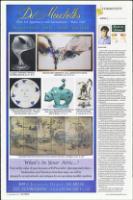
LALIQUE 1TROPHEE• CRYSTAL
OLYMPIC SKATER, H is", W 9"
PABLO PICASSO (SPANISH 1881-1973),
EARTHENWARE PLATE, "VISAGE
AUX FEUILLES", DIA 16 1/2"
CHUANG CHE (CHINESE B. 1934), ACRYLIC ON CANVAS,
ABSTRACT, 49 1/2" X 75"
MARSHALL FREDERICKS (AMERICAN, GORHAM PURE COIN
SILVER PITCHER,
1908-1998), BRONZE SCULPTURE,
C. 1855-60, H 10 1/2"
BOY & BEAR, ii" X ii"
JAPANESE PAINTED PAPER SIX-PANEL SCREEN, SIGNED, ANTIQUE, H 60" X 122"
AVh,at's in Your Attic...?
Find out the value of your treasures at DuMouchelle's free appraisal clinics -
Wednesdays and Saturdays from llam-iipm, we will b
13#1eased to accept artwork and antiques for our upcoming monthly auctions.
409 EJE:FFEkoN, DETRon- , Ml 48226
T EL 313.963.625$ \\ w.DUMOART.coNi
8 September 2011'
RED THREAD
I just couldn't stay away. After four years of
college, four in graduate school, a summer
spent studying for the bar exam at Potbelly
Sandwich Shop (live music lunchtime and
free refills!), I'm dusting off my pencil box and
going back to school.
Why the education addiction? Am I still
trying to work out the sting of bygone near-
victory — after narrowly losing Homecoming
Prince to Mormon superman John Wirthlin?
Perhaps it's just arrested development. (I
did return to high school between college
and grad school — taking a year off to
substitute-teach at Frankel Jewish Academy,
where I also coached the school's Lady Jag-
uars to volleyball dominance in the Catholic
League.)
This latest matriculation is different. I have
the huge honor (and high hurdle) of teach-
ing "Topics in Public Policy: Volunteerism," an
undergraduate course of my own creation,
at the University of Michigan's Gerald R. Ford
School of Public Policy. Here's an excerpt
from the course description:
Americans volunteer — at least they purport
and aspire to. From de Tocqueville to Obama,
volunteerism has always been a central,
evolving part of the American identity. We
perform community service through nonprofit
organizations, government programs, schools,
businesses, faith-based initiatives — even the
penal system.
We have put a lot of stock in volunteerism
as an engine for positive social change, and
we derive a strong sense of optimism from
community service; but it is not always clear
whether the rhetoric resembles the reality. Does
community service produce stronger, safer,
healthier people and communities or, instead,
college essays, corporate newsletters and politi-
cal photo opportunities? Or some symbiotic
combination of the two?
The fall term is upon us, and I'm nervous as
hell. No amount of corduroy-elbow-padded
armor can protect me from those 20 nimble
young minds who are primed for an intellec-
tual sparring match. I know from experience.
In Making of the Modern American Land-
scape, a history course I took freshman year
at Columbia, the professor showed the class
a slide of a statue depicting people in down-
town Detroit and opined, "There are no real
people left in Detroit, so they've replaced
them with metal people who can't leave."
I bit my lip, but when that picture showed
up as a prompt on the final exam, I wrote:
"Have you ever been to Detroit? It's an easy
target when you're sitting pretty in Manhat-
tan, but Detroit is not just a history lesson.
It has a real present and a viable future. I'll
take some pictures for you when I am home
this summer." And I did, and was invited back
to his class my senior year to give a guest
lecture on Detroit's non-metallic people.
I suppose that's the magnetism of school
for me: ideas — and the audacity to assert
them — as a currency all their own. It's more
tempting than ever to look for easy answers
to hard questions, especially when we have
unlimited information at our fingertips.
But there's a subtle, substantive benefit
we derive when we take it upon ourselves
to think hard, dig deep and ask questions —
usually answering those questions with more
questions. As Robert Frost described it, pre-
sumably while on some lesser-traveled road,
"College is a refuge from hasty judgment."
In a way, being a volunteer and a student
have shared appeal — and anxiety: both
induce productive discomfort as a means
to personal growth, with the hope that we
might effect some positive social change
along the way.
In each case, when we manage to get
comfortable outside our comfort zones,
there's no telling what we can do. RI-
www.redthreadmagazine.com