

points of view
EDITORIAL BOARD:
Publisher: Arthur M. Horwitz
Chief Operating Officer: F. Kevin Browett
Contributing Editor: Robert Sklar
Editorial
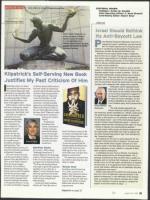
Award to ouis Farrak h
in a way t rnished this
storied, be oved statue, located
out
oung
Municipal Building.
N,
Kilpatrick's Self-Serving New Book
Justifies My Past Criticism Of Him
I
didn't like what I saw when I
searched the JN archives to see
how Kwame Kilpatrick's staff
responded to my September 2005
call-out of the then-Detroit mayor
for embracing Nation of Islam
leader Louis Farrakhan, a Jew-
hater of the highest order.
Staff members rushed to defend
their boss, claiming my column
misrepresented the mayor. But,
looking back, I don't think I did.
Especially not in light of a
contention in his just-
released autobiography
Surrendered: The Rise,
Fall & Revelation of
Kwame Kilpatrick. The
disgraced ex-mayor
claims that Metro
Detroit's Jewish com-
munity was offended
by, among other things,
his warmth toward
Farrakhan during his
administration. That
friendship helped nurture a cli-
mate that eventually contributed
to Kilpatrick's downfall.
The event cited in the book
was the annual Nation of Islam
Saviours' Day rally held Feb. 25,
2007, at Ford Field in Detroit,
where the mayor hugged
Farrakhan. In Surrendered,
Kilpatrick acknowledged deep
Jewish concern about Farrakhan
and that the preacher might
alienate "some powerful people"
in the Jewish community. But
Kilpatrick defended Farrakhan
on the grounds that he is "a mas-
ter orator and defender of people
of African descent whose rhetoric
has been a thorn in mainstream
society's side for decades, and this
[Saviours' Day] event provided a
very large platform:' Kilpatrick
writes that Farrakhan "is still
considered a hero by African
Americans" and that his public
appearance would help generate
badly needed business traffic in
the city. "Especially after hosting
the Super Bowl," Kilpatrick writes,
"it was important to continue to
welcome the world to
Detroit."
He dismissed
Farrakhan's anti-
Semitic comments as
"critical comments
about Jewish people
almost 20 years ago."
A reality check shows
Farrakhan has never
wavered in his slurs
toward Jews.
Spiritless Choice
In my Sept. 1, 2005, column
"Snubbing Detroit Jewry," I
rebuked Kilpatrick for bestowing
a Spirit of Detroit Award and a key
to the city on the minister during
an August visit to Detroit that year.
"The honor besmirched Detroit
and people of good will in general,
regardless of race, ethnicity or
religion:' I wrote. Surely, the honor
obscured what black and Jewish
groups had been doing to improve
racial harmony and galvanize
understanding.
I pointed out that Farrakhan
ridicules the "Nazi-like State of
K IN
RISE, 01.1.
FIVELATICN
AME KILPAiniCK
Israel" and blames America's ills
on Jewish-controlled halls of gov-
ernment, business, finance, enter-
tainment and the press.
I described Farrakhan as
a man who preaches that the
Talmud teaches that blacks were
cursed"; that "poor Jews died
while big Jews were at the root
of the Holocaust"; and that "Jews
plotted to crucify Jesus."
"His defamatory speeches have
succeeded in alienating Jews and
whites," I added.
"
'Greedy Ones'
Farrakhan visited Detroit Aug.
15-16, 2005, to promote his
Millions More Movement and an
October 2005 Washington inter-
faith rally marking the 10th anni-
versary of the Nation of Islam's
Million Man March for black
empowerment.
Israel Should Rethink
Its Anti-Boycott Law
rime Minister Benjamin Netanyahu wasn't shy in
supporting Israel's contentious, new anti-boycott
law. The Israeli Supreme Court should be just as
zealous in considering and disqualifying this affront to
democracy, formally the Boycott Prohibition Law.
Whether the law stains Israel's image is subjective.
But let there be no doubt: The law seems undemocratic
and totally inappropriate for the Middle East's only true
democracy. Stifling buying power or the freedom to asso-
ciate to advance political goals undercuts what Israel and
any open society stands for.
The law, approved by the Knesset on July 11, permits
people or organizations to be sanctioned if they promote
boycotts against Israel or areas it controls — such as
West Bank settlements, whose products are a common
boycott target. Those who feel they are damaged by
boycotts can sue the boycotters in civil cases, under the
law. The law further forces the government to stop doing
business with companies that comply with a boycott.
Netanyahu said he opposed boycot-
ting Arabs, haredi or any other Israeli.
That points up the random selectiveness
of his and the Likud party's support of
the Boycott Prohibition Law, intended
to repel anti-Israel campaigns. On this
political battlefield, we side with Tzipi
Livni's Kadima party, which blistered the
Prime Minister law.
Netanyahu
The wide-ranging opposition by
diverse American Jewish groups, from
the American Jewish Committee to J Street, underscores
the belief that the law abridges freedom of expression
in Israel, a land known for rich diversity of thought. Even
the European Union — part of the international Quartet
trying to broker Israeli-Palestinian peace — shared its
concern about the law's infringing of the rights "of Israeli
citizens to express non-violent political opinions."
Israeli human rights groups and liberal nongovernmen-
tal organizations predictably have lined up against the
law. Even Knesset legal adviser Eyal Yinon branded the
law "borderline illegal."
The impetus for the law is a weak argument for the
Knesset's testing the limits of freedom. The law arose
after some Israeli artists sought a boycott of a new
cultural center in the West Bank city of Ariel and some
Israeli academics, in turn, called for a boycott of West
Bank academic institutions.
In defending the law, Finance Minister Yval Steinitz
of Likud declared during the Knesset debate: "It's a
principle of democracy that you don't shun a public you
disagree with by harming their livelihood. A boycott on a
certain sector is not the proper manifestation of freedom
of expression. It is an aggressive move meant to force a
sector that thinks a different way to capitulate. Boycotts
are aggressive and wrong."
Indeed, many boycotts are abhorrent and tenuous. But
they are a form of legitimate organized protest in the
sphere of democracy. In the aftermath of the Knesset
vote, a Jerusalem Post editorial comment got it right:
"Boycott initiatives should be allowed to compete for
support in the free market of ideas." II
Kilpatrick on page 32
August 18 2011
31