

metro >> on the cover
Aqi and Zoli
Rubin's love is
still strong at
60 years.
A
Two Holocaust survivors prepare to celebrate 60 years of marriage.
Arnie Goldman I Special to the Jewish News
CONTINUED FROM
PAGE 1
his extended family died;
but fortunately, he was
able to save a remarkable
photo album from his
Czechoslovakian home
and bring it to America.
The album contains a
treasure trove of photos
and letters from his fam-
ily's past.
Pho to s by Ju dy Go ldman
and raised a family.
They've never forgot-
ten the losses they suf-
fered during the war.
"We survivors are
bundles of contradic-
tions," Agi Rubin wrote
in her 2006 book,
Reflections, Auschwitz,
Agi's Heartache
Memory and a Life
Agi Rubin's Holocaust
Recreated (written
experiences were very
with Henry Greenspan,
different. Agi says she was
Paragon Books). "We
"fortunate" to have 15 out
push away the past,
of 60 family members
and we are constantly
survive. But being trans-
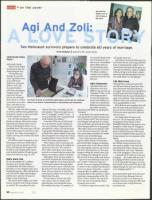
drawn back to it. When Zoli looks through an old family photo album saved from his childhood
ported from Munkacs in
we are here, we are also home in the former Czechoslovakia as Agi watches and remembers.
a cattle car to Auschwitz/
there. And when we are
Birkenau and barely exist-
there, we are also here."
ing amidst starvation,
Still, the couple was able to prosper
seder in his home, a beautiful, sad, dis-
devastation and death was anything but
in America and have been grateful they
tant memory. "There must have been at
"fortunate:'
were given a chance to meet each other
least 35-40 people:' he said. "It was ... it
At Auschwitz, she and her family were
and live together for 60 years.
was just beautiful. Kids running around,
lined up and shoved while Germans mut-
Zoli, who had immigrated to Canada
small children, big children."
tered, "Schnell, schnell" (fast in German).
thanks to a farmer who had once been
In the late 1930s, two of Zoli's broth-
Josef Mengele took Agi from her mother,
helped by Zoli's father, found work in
ers were deported, but his wealthy par-
aunt and brother. Agi ran back three times
Detroit at the Midwest Woolen Co. on
ents were considered "important" and
before Mengele threw her to the ground.
Randolph Street. The owner gave Zoli $50 exempted for a while. Zoli was fortunate
"My mother said, let my child go!' Then
the first day because he saw what a hard
to get gentile identification papers from
to me, 'I'll see you tomorrow:" said Agi,
worker he was. When an opening for a
a friend; these papers helped to keep him who would always remember her mother
cashier came up, Zoli convinced his boss
alive. His parents were desperate for their with the wave of her little finger.
to hire Agi.
youngest child to survive, but they didn't
In her book, Agi writes about sort-
Zoli said he wanted to propose to her.
want to live under gentile papers.
ing the clothes of those who had been
Marrying an American would make it
When soldiers came to his house, his
gassed and killed. Imagine recognizing
easier to become an American citizen.
father told Zoli to hide in the sulckah set
your aunt's jacket in the leftover clothes
Today, Zoli still calls his longtime wife
up between the roofs. "Kim nisht her-
and knowing that someone you love has
his "green care Despite protest from
inter" (don't come down) were the last
just been exterminated a few feet away.
some in their families, Zoli and Agi got
words he ever heard from his mother. His Imagine sorting the jewelry, shoes, hair
married in Detroit on Aug. 18, 1951.
parents were taken to Zilina in Slovakia.
and clothing and realizing this was all
Although he tried, Zoli was unable to
that was left of your brother and mother.
Zoli's Early Life
save them. He joined the Slovak uprising
Agi wrote about Birkenau in the sum-
He was the youngest of 11 children
in 1944 to fight the evil he had witnessed. mer of 1944: "I will never forget the
who grew up in a small village in
The Germans captured him and others
sounds. There was singing, Ani Maanim'
Czechoslovakia. His father, whom he
and forced them to march. Zoli held onto
CI believe in the coming of the Messiah').
describes as a very "religious man," ran a
the protective socks his mother gave him
There were shouts of farewell — parents
flourishing large farm, flour mill and saw-
before she was captured; to Zoli, those
saying goodbye to children, old people
mill. Zoli said his father, like Abraham,
socks kept his mother close to him and
saying goodbye to their families, a whole
kept his doors open for everyone, for
helped keep him alive.
community saying goodbye to life. The
people to pray in his house.
It's been almost 70 years, but Zoli's
Sh'ma, (`Hear, 0 Israel'). The end of the
Zoli says he had an idyllic, nice child-
voice quivers when he speaks of the
Sh'ma. The end of everything. Silence
hood, a Jewish life with "all the freedom
agonizing days and unbearable losses.
screaming just as loud.
we wanted." He remembered the last
He estimates that about 70 members of
"I will never forget these sounds. They
10 August 18 2011
will always haunt me."
Agi's father survived the Holocaust, but
her mother did not. And so Agi ended her
book, remembering her mother "as she
looked across the mud and the agony, try-
ing to get my attention, trying to imagine
a future, trying to invoke hope, trying to
bestow the only blessing that, in the end,
this world allows: 'Go, my child, go.'
Life Well Lived
Although those memories haunt Zoli
and Agi more than 66 years later, they
have persevered with little bitterness
and anger. They say they are thankful for
the gifts their lives have brought them:
their family and the many friends they've
made over a lifetime. They raised three
children, Vicki, Amy and Randy, and have
seven grandchildren as well.
After all those years together, they still
talk and share and aren't afraid to face
the past horrors of their lives together.
Zoli worries when Agi doesn't feel well
and vice versa.
Zoli smiles when he says he will
live to be 100. He frequently attends
Congregation B'nai Moshe in West
Bloomfield and often leads prayers, even
though he is older than 90. Though he
lived through some of the most horrific
years in Jewish history, he still believes
in God and faithfully marks yahrtzeits in
loving memory for every member of his
family.
Today, Agi rarely attends services
but still has strong memories of her
time spent in prayer. In her book, she
remembered her father when he sang
"Ein Keloheinu" and wrote, "Whenever
I am at the synagogue, I hear his voice
... I remember how much joy he got out
of singing ... He is again with me, and I
am singing with him. It is the harmony
of voices that makes the legacy, the way I
tune myself to him and feel his spirit still
singing through my own voice. Even now,
we are singing together:' l I
Agi and Zoli Rubin spoke about their pasts
for the Voice/Vision Holocaust Survivor
Oral History Project at the University of
Michigan-Dearborn during the 1980s. Both
can be found online at http://holocaust.
umd.umich.edut