

{
cover story/health
Genetic
Research
Jewish-Chaldean study takes aim
at inflammatory bowel disease.
Ruthan Brodskyl Contributing Writer
It makes sense that Metro
Detroit was selected as the
site for the Jewish-Chaldean
clinical research study led by
Ann Silverman, M.D., at the
time director of gastroenter-
ology research for the Henry
Ford Health System (HFHS).
The numbers of Jews living in
the Detroit area is substantial,
72,000, and the Chaldean pop-
ulation, 125,000, is the largest
outside of the Middle East.
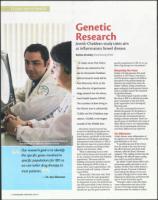
Dr. Silverman, right, who is Jewish, with Johnathon Markus of
West Bloomfield, her assistant of Chaldean descent.
Our research goal is to identify
the specific genes involved in
specific populations for IBD so
we can tailor drug therapy to
treat patients.
— Dr. Ann Silverman
6 CHALDEAN NEWS I JEWISH NEWS August 2011
Silverman's clinical research has
focused on identifying the genetic fac-
tors that contribute to inflammatory
bowel disease, specifically in the Jewish
Ashkenazi and Chaldean populations.
Inflammatory bowel disease, or IBD, is
the collective name for several chronic
digestive disorders, including Crohn's
disease and ulcerative colitis.
"What is interesting to me is that
both Crohn's disease and ulcerative coli-
tis are common in Jewish and Chaldean
populations:' Silverman told the
Building Community Initiative shortly
before leaving the HFHS in July to
pursue other career opportunities. The
research study will remain at Detroit-
based HFHS.
"Historically," Silverman said, "both
groups are from the same geographic
area and remained as distinct groups
for thousands of years. We already know
that IBD, particularly Crohn's disease, is
inherited. Our research goal has been to
identify the specific genes involved in
specific populations for IBD so we can
tailor drug therapy to treat patients."
Sharpening The Focus
Studies of Jewish genomes first made
headlines in 1997 when it was discov-
ered that genetics supports the biblical
description of the priestly family, the
Kohanim, descended from Aaron, the
brother of Moses. Today, scientists are
again reading the Jewish genome history
book to possibly improve the treatment
of inherited diseases.
"The primary goal of genetic studies
like these in IBD is to identify the patho-
genic mechanism so that new thera-
peutic approaches can be developed:'
Silverman said.
She said a second goal has been to
identify the genetics for the disease so
people at high risk can be followed to
determine the environmental factors
leading to disease activation. There's no
specific gene yet identified as the cause of
either disease even as our understanding
of the role of environment risk factors
and ethnic differences has improved.
The Differences
Crohn's disease causes inflammation of
the digestive tract, often referred to as the
gastrointestinal, or GI, tract.
"It can affect any area of the GI tract,
from the mouth to the anus, but it usu-
ally affects the lower part of the small
intestine, called the ileum',' Silverman
explained. "The swelling extends deep into
the lining of the affected organ, causing
pain. And it can result in diarrhea."
She added: "Crohn's disease affects men
and women equally and tends to run in
families. We know that Crohn's disease is
genetic because 37 percent of identical
twins both get the disease. It can occur
in people of all ages; but it is more often
diagnosed in adolescence and between the
ages of 20 and 30 and after age 65.
"Ulcerative colitis, on the other hand,
causes inflammation and ulcers in the
top layer of the large intestine lining,"
Silverman noted. It is similar to Crohn's