
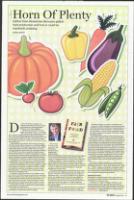

Horn Of Plen
Author Oran Hesterman discusses global
food production and how it could be
mankind's undoing.
By Brett Callwood
1
D
r. Oran Hesterman may have the
ultimate green thumb. The Ann Arbor
agronomist has a backyard garden
that's the envy of his neighbors.
"Whatever he plants is four times
larger than anyone else's — it's mysteri-
ous," says his wife, Lucinda Kurtz. "His
kale, collards and Swiss chard are giant. His tomatoes
grow Jack and the Beanstalk-like. The garden feeds us all
summer and into fall, and we have greens until Chanu-
kah. We give food away to everyone on our street; it's way
too much for us."
Seems fitting for the author of Fair Food: Growing A
Healthy, Sustainable Food System For All (PublicAffairs),
a book that offers a thorough examination of the world's
broken food system as well as a plan to fix it. A former
university professor, Hesterman, 59, is founder, president
and CEO of the Ann Arbor-based Fair Food Network,
which he describes as "a national nonprofit that works at
the intersection of food systems, sustainability and social
equity to guarantee access to healthy, fresh and sustain-
ably grown food, especially in underserved communities."
Sustainability, or a variation of it, is of key importance
to Hesterman, who is touring extensively with his book
— he'll travel in August to Davis, Calif., to speak at a food
conference hosted by Hazon, a group founded to support
the Jewish environmental movement in North America
and Israel that stands at the forefront of a new Jewish
Food Movement — and that is part of what makes Fair
Food such a compulsive read.
Hesterman doesn't just point out the problems with
the current world food system, he points out in stark and
blunt, yet realistic, terms what needs to be done to create
a sustainable food system. Even Gov. Rick Snyder was
inspired enough to say that "Oran Hesterman convinc-
ingly argues that reinventing our food system is crucial
for improving the health of our cities and our economy
— policymakers are wise to spend time considering the
ideas he lays out in this book."
Inspiration for the mission that has been such an im-
portant part of his life came from two places.
www.redthreadmagazine.com
rt
i
D
•
• •
CAOWING i 14ZikilifY,
rood t
rittlIt 70A 11LY
OPIIN B. RES7'Enallihr Ph.D.
"One comes
from very early
in my life," says
Hesterman,
who grew up at
Temple Beth
El in Berkeley,
Calif, participating in North Pacific Coast Young Judaea.
"I was 21 years old. I had just returned from a year in
Israel [on Young Judaea Year Course], where I had been
working on a kibbutz. I started university at the Univer-
sity of California-Santa Cruz, working on the student
organic farm. It was the first one in the country. This was
back in the early '70s. I just got captivated by it and spent
a couple of years full-time learning how to farm and
learning how to grow food.
"The other inspiration that really deepened my experi-
ence and took it in a different direction was when I was
36 years old and I had been diagnosed with an illness,"
Hesterman says. "I was in the hospital and my digestive
system was nonfunctional. The doctor was telling me
that surgery was an option. When I could finally eat a
few days later, they gave me roast beef, mashed potatoes
and a big piece of cake made out of white sugar and
white flour. I knew that this was not the food I needed to
get myself healthy."
Today, Hesterman is a poster boy for his own solutions.
Fit and trim, he exercises regularly, practices yoga and
meditates each morning. He and Lucinda are members
of Pardes Hannah, Ann Arbor's Jewish Renewal
community, which emphasizes Jewish mystical and
meditative practices as well as environmentalism. At
home, he's the cook in the family — they have three
grown children — and he uses produce from his gar-
den, often making morning eggs with freshly cut kale
and collard greens.
Yet he knows the problems in the food system inti-
mately. In Fair Food, he points out that food quality is
declining, food safety is compromised, the concerns over
animal welfare, the issues of soil erosion and depletion,
water pollution, loss of farmland, greenhouse gas pro-
duction, problems with food access, diet-related illnesses
including (though not restricted to) obesity, worker ex-
ploitation and the aging farmer population. You could be
forgiven for thinking that he is a pessimist, but he's not.
He provides a very clear roadmap to make things better.
He says stores like Whole Foods Market provide a better
quality of food, and just shopping there is a good start.
Kate Klotz, corporate public-relations manager for
Austin-based Whole Foods, feels the company echoes
many of Hesterman's concerns and helps to address
them.
"We are the world's leading grocery of natural and
organic products," Klotz said. "Everything we sell is free
of anything artificial — colors, flavor, preservatives, trans
fats — and we emphasize foods that are organic and/or
local. We are experts at helping people with special di-
etary needs and at working with local producers at using
more sustainable food-growing methodsf
GREEN DETROIT
Hesterman is a realist though, and he knows that not
everybody can afford to shop at a specialty store. Fortu-
nately, there are other answers.
"I think about a couple of things," Hesterman says.
"Detroit is known as the city with the most extensive
urban gardening and small-scale farming in the country.
Greening of Detroit is supporting more than 1,600 com-
munity gardens, backyard gardens and street gardens.
HORN OF PLENTY SEE PAGE 21
IUD TillitilD
August 2011 19