

points of view
EDITORIAL BOARD:
Publisher: Arthur M. Horwitz
Chief Operating Officer: F. Kevin Browett
Contributing Editor: Robert Sklar
>> Send letters to: letters@thejewishnews.com
Guest Column
Editorial
Staying Alert: A Key To
Improving Our Security
T
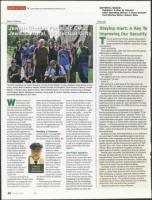
The EMU contingent at Terezin Memorial, Terezin, Czech Republic in May. Standing: Emily Barnes of Ann
Arbor, Jordan Rizer of Madison Heights, Michael Eisinger of Laingsburg, Paulo Pereira of Brazil, Jennifer
Rokakis of Canton, Kerry Gould of Solon, Ohio, Kathleen Garner of Ann Arbor, Professor Carla Damiano
and Professor Martin Shichtman. Kneeling: Lauren Inglis of Livonia, Christina Stevens of Richmond, Ky.,
and David Washington of Ann Arbor.
W
hat does it mean to
visit Europe today
as an American, to
view the Holocaust through film,
literature, museums and histori-
cal monuments that are meant to
keep alive the unthinkable?
That was the question posed to
10 Eastern Michigan University
students by a new study
abroad class, "Representing the
Holocaust," that moved through
several of Europe's most beautiful
and historically important cit-
ies. The class retraced the stages
of Nazi Germany terror, from
the serene lakeside setting of
Berlin-Wannsee, where
Reinhard Heydrich met
with 15 high-ranking
Nazi officials to draft the
Final Solution intended
to exterminate the entire
Jewish population of
Europe — an estimated
11 million persons —
to the Auschwitz death
camp near Krakow,
Poland, where the mass
murder of 1.1 million
people was ultimately
carried out.
I have just returned from
teaching this class. Though often
difficult, it was among the most
gratifying experiences I have
encountered as an educator. I
witnessed students break down
before stacks of suitcases and piles
of hair collected at Auschwitz. But
I also saw their joy in the Klezmer
music driving Krakow's Jewish
revival. I felt their pride in the
wreath left by President Obama at
the Warsaw ghetto memorial just
a few hours prior to our arrival.
Several students told me that this
was a life-changing experience for
them. It certainly was for me.
Building A Program
Last November I was appointed
Eastern Michigan University's
first director of Jewish Studies. My
charge is to develop
programming that
will provide a gather-
ing place for EMU's
numerous ethnic
communities to learn
more about Jews
and Judaism, a space
to build bridges, to
open and engage in
discourse, to create
new understand-
ings between Jews
and the many other
groups that comprise
the diverse culture of Southeast
Michigan.
"Representing the Holocaust"
is one small part of our Jewish
Studies program. The primary
intent of Jewish Studies at Eastern
is not to create specialists at the
doctoral level. Rather, we want to
inform all of our students, all of
our various communities — Jews
and non-Jews alike — about the
significance of Judaism, about
how this faith and those who
practice it have changed the
world. We have developed courses
concerned with the history of the
Jewish people, a story of survival
under extraordinary circumstanc-
es. EMU Jewish Studies focuses
on the cultural and intellectual
gifts Jews have given the world. It
considers the Jewish faith, its rich-
ness, its intricacy and its demands
as well as its complex and fasci-
nating relationships with other
religions.
Top-Flight Speakers
As part of its Jewish Studies
Lecture Series, Eastern has spon-
sored presentations by Ilan Troen,
director of Brandeis University's
Schusterman Center for Israel
Studies; Aaron Lansky, founder
and president of the National
Yiddish Book Center; Israeli schol-
ar and statesman Elie Rekhess;
Sharon Pomerantz, winner of the
Foundation for Jewish Culture's
Goldberg Prize for Outstanding
Debut Fiction for her novel Rich
Boy; and New York Times bestsell-
Guest Column on page 33
32
July 21 2011
JN
he U.S. government chose Jewish organizations
in its first-ever foray into partnering with a faith-
based community to heighten awareness of suspi-
cious behavior.
That's no surprise.
Since biblical times, Jews have had to fend off enemies
determined to eradicate us.
At a June 10 meeting at the White House announc-
ing the new partnership and how Jews can elevate
vigilance, Department of Homeland Security Secretary
Janet Napolitano pointed to the threat posed by far-right
extremist groups and radical Islamists (Muslims who have
mangled Islam to justify terror). She described what linked
those two forces against Jews as "deep-rooted hatred,"
American Jewish Committee Executive Director David
Harris told JTA.
"It's logical to go to the Jewish community and say,
'Let's partner," he said.
And it is.
Our community is well aware of the rising risk in the
aftermath of the U.S. takeout of Osama bin Laden. We know
what it means to be on the lookout, but not overly fearful.
And we've been brazenly targeted over the past few years.
Mumbai and Sderot are the best-known places where
Jews have been openly attacked. But think about the
attempts against U.S. Jews: the alleged May plot to
blow up Manhattan synagogues; the two packages of
explosives found on cargo jets and intended for Chicago
synagogues last October; the 2009 plot to blow up syna-
gogues in the Bronx.
The Department of Homeland Security-Jewish com-
munity partnership marks the start of the federal "If You
See Something, Say Something" campaign. Posters and
other awareness builders will come to synagogues, JCCs,
Jewish federations and other Jewish agencies across the
country. The idea is to inform what constitutes suspicious
behavior - a strangely parked car, an unknown person tak-
ing pictures, an abandoned backpack boasting a Magen
David - and to elicit observers to convey concerns to local
law enforcement.
Certainly, we Jews know what belongs in our community
and what doesn't. When something appears out of sync
with where Jews congregate, we must have the resolve
to alert authorities. We must embrace the importance of
greater security and feel empowered to seek terror-fight-
ing help. Says John Cohen, a senior Homeland Security
official: "We're not looking for the public to make the
determination of whether something is terrorist-related."
Beyond public education, the Department of Homeland
Security will keep security forces in step with the lat-
est precautions. Future faith-based community partners
include evangelical Christians and Mormons. Outside faith-
based communities, partners already include operators of
Amtrak, local transit lines and federal buildings.
Campaign content tailored to the Jewish community
features input from the Secure Community Network
(SCN), a Jewish Federations of North America initiative.
Paul Goldenberg, a real pro, leads SCN. When he exalts
"See Something, Say Something," we listen. He succinct-
ly captures its value: "This program focuses on better
protecting places where Jewish people come to worship,
where they meet and where they socialize."
Vigilance could prove a mass lifesaver. Li