

obituaries
Obituaries from page 76
Perry Mason Composer
JTA
H
ollywood composer Fred Steiner,
whose work ranged from the
gritty and unforgettable opening
theme of Perry Mason to scholarly studies
and a doctorate in musicology, died June
23, 2011, at his home in Mexico at 88.
Steiner's work over four decades in
Hollywood was composed of scores of
themes and incidental music for classic
TV shows such as Gunsmoke, The Twilight
Zone, Star Trek, Have Gun Will Travel,
Rawhide, Hogan's Heroes, The Bullwinkle
Show and others.
When asked to develop the music for
Perry Mason, one of TV's first lawyer
shows, Steiner said he wanted to highlight
"two key facets of his personality: suave
sophistication and the underlying tough-
ness" of the character.
The music, now titled "Park Avenue
Beat;' Steiner said, "pulsed with the
power of the big city and the swagger of
a beefy hero played to perfection by actor
Raymond Burr."
Steiner's daughter, pop music com-
poser and singer Wendy Waldman,
wrote that her father "was the last man
standing from what is really the golden
age of film and television music. His
crowd all came of age together and
remained close for their entire lives:
Elmer Bernstein, Jerry Goldsmith, my
dad, Bernard Herrmann, Henry Mancini,
Hugo Friedhofer, Alfred Newman and a
host of others who defined the world's
idea of what movie and television music
is supposed to be."
Steiner, a New York City native, was
the son of George Steiner, a Hungary-
born composer whose work included the
score of the Chrysler Show at the 1939
New York World's Fair. Fred began play-
ing piano at 6 and cello at 13. He studied
at the Oberlin Conservatory of Music
in Ohio and many years later received
his doctorate from the University of
Southern California.
He worked on New York City-based
radio shows in the 1940s and became
musical director for the ABC radio
series This Is Your FBI, which featured
many up-and-coming Hollywood stars,
before moving to the West Coast in the
late 1940s, where he worked in film
and television.
Waldman said her father and the
other Hollywood composers, many of
them Jewish, played chamber music in
her house when she was growing up.
After a two-year stint in Mexico
directing an independent record
company beginning in 1958, Steiner
returned to Hollywood and picked
up where he had left off. He provided
music for Return of the Jedi in 1983,
although he was not credited, and two
years later was nominated, along with
others, for an Academy Award for the
score of The Color Purple.
Steiner, who is survived by his wife
of 64 years, was "notable for his even
temper and affable nature:' film histo-
rian Tony Thomas wrote in 1991. It is no
exaggeration to claim him as one of the
best-liked men in the film music com-
munity.
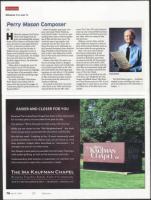
Fred Steiner
The Fred Steiner papers — including
original scores, recordings and notes —
are in the collection at the University of
Oregon.
EASIER AND CLOSER FOR YOU
Because The Ira Kaufman Chap& has been in the same place
for so many years, we are asked if we plan to stay.
The answer: "We're focused on improving, not moving."
While we are closer to the "Old Neighborhood" the facts
show we are more convenient for the entire community.
We did the math. Looking at the 10 most commonly used
Jewish cemeteries in the Metro area, we are twice as close
than another chapel often described as "convenient." On
average, we are just six miles away.
iRA
UjIMAN
Our Chapel is also easily accessible from all major freeways,
with ample parking, as well as five entrances and exits.
Understanding that location is important, we maintain one
that continues to meet this community's needs.
THE IRA KAUFMAN CHAPEL
Bringing Together Fanlib. -, Faith &Community
18325 W. 9 Mile Rd Southfield, MI 48075 • 248.569.0020 • IraKaufman.com
78 July 14 • 2011
Obituaries
s r:
pa
. 1..
INC.
...wk.' •