

home
Keep Cool Save Money
Curb your air conditioning costs this summer.
C
ooling a home during the sum-
mer with a window air condition-
ing unit can account for nearly 50
percent of an average homeowner's utility
bill. And in the hottest regions of the coun-
try, cooling off with central air can generate
up to 70 percent of your home's utility bill.
But not to fear: There are several ways to
curb your electricity use this summer. One
simple way is to turn up the thermostat by
one degree during warm weather. The U.S.
Department of Energy estimates that you
can save up to 3 percent on your summer
energy bill for every degree you raise your
thermostat for 24 hours. Set your ther-
mostat between 72 and 78 degrees. Each
degree setting below 78 will increase your
electricity use by as much as 4 percent —
and that's sure to add up to several hundred
dollars over many hot summer days.
Other ways to reduce your home's
cooling costs include making sure your
air conditioning unit is running at peak
performance, replacing the HVAC filter
at least every three months or as needed,
turning on ceiling fans and making sure
they are blowing down (not up), opening
windows during cooler evening hours,
closing curtains and blinds where sunlight
radiates heat into the home and sealing all
air leaks that let cool air escape outside.
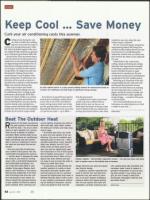
An attic radiant barrier is a safe, proven building material for reducing the strain on
a home's air conditioner, and that leads to significant energy savings.
If you like do-it-yourself home improve-
ment projects, installing a radiant barrier
in your attic is one of the most effective
energy-saving projects that's sure to help
you save precious dollars on your air con-
ditioning bill. What's more, you can receive
a 10 percent tax credit — up to $500 —
from the government.
A radiant barrier works in your home
similar to the way a reflective foil car
shade works in your car. Just as a car
shade keeps the interior of an auto cooler
when it's parked in the sun, radiant barri-
ers keep your home's interior cooler when
installed in your attic, where the sun's
radiant energy is absorbed.
New do-it-yourself energy-saving home
improvement products like Energy Star-
certified Enerflex Radiant Barrier are easy
for homeowners to install themselves,
without the need for tools, as it flexes into
place between the rafters on the underside
of a roof.
Professionals in the construction,
roofing, energy and heating and cooling
industries have long known the benefits
of installing a radiant barrier, says Rick
Jordan of EcoRite Products, a major
radiant barrier manufacturer. But only
recently have products been manufactured
specifically for the DIY installer market.
Reflecting up to 96 percent of the sun's
energy Radiant barriers reduce the radi-
ant heat gain that permeates a home
when the sun beats down on it, reducing
the attic temperature by as much as 30
degrees during the summer months and
helping homeowners' realize significant
energy savings — as much as 20 percent
on electrical bills.
Visit www.Enerflexfolcom for more
information on radiant barriers or to find
a retailer in your area.
ARAcontent
Beat The Outdoor Heat
elaxing on the patio, lounging by
the pool, playing in the backyard
with the kids – for all our antici-
pation of warm weather fun, summer
heat can put a damper on outdoor
activities. When extreme heat forces
us back inside where air conditioning
keeps everything cool and comfort-
able, it can be a challenge to remem-
ber what we love about the warmer
months.
Here are some tips to help keep
your outdoor living spaces cool and
comfortable throughout the summer:
•Interior decor is designed to make
the inside of your home an inviting
space, with a controlled temperature
and comfortable furnishings. You
can create the same effect in your
outdoor living space. Replace hard
plastic resin furniture or iron pieces
that become griddle-like in the heat
with furnishings that echo the corn-
fort and beauty of your indoor fur-
niture. Elevate the luxurious feeling
of your outdoor furniture by adding
plush cushions, floor coverings and
R
52
July 14 2011
accent lighting. Draping your patio or
deck with light, sheer fabric evokes
the feeling of curtains and helps keep
insects away.
•Scorching days drive you inside
to savor the cool comfort of air con-
ditioning. You can air condition your
backyard, patio or deck, too – with a
portable evaporative cooler. KuulAire
offers two models, the KA77 and
KA55, which are both rated for out-
door use and can significantly lower
the temperature in 150 to 600 square
feet of outdoor living space – and use
less electricity than it takes to run a
typical hair dryer. Wheels and cast-
ers make it easy to move the units to
where you need them most.
•Accessories can help elevate the
comfort quotient of a patio or deck.
Decorative citronella candles smell
and look great and serve a practical
purpose by helping keep bugs away. A
tabletop fountain adds a lovely sound
to your outdoor environment, enhanc-
ing the feeling of relaxation. Choose
colors and patterns that echo the
Outdoor updates — like portable evaporative coolers — can help you enjoy your patio,
deck or garden even on the hottest days of summer.
design elements you most love about
your interior design.
•Cooking is another important ele-
ment of summer fun, but when tem-
peratures soar, who wants to slave
over a hot grill? Replace traditional
barbecue foods that require grilling
with no-cook options like fruits and
vegetables. Consider preparing natu-
rally cooling foods, like smoothies and
cucumber salad. Invest in coolers or
portable refrigerators if you'll be stor-
ing food outside. If you simply must
grill, be sure to keep it away from
furnishings, flammable materials and
perishable foods. II
ARAcontent