

Japanese from page 24
Commentary
and hospital staff died. Newspapers
reported that the Israeli medical
team returned home and left all the
equipment and temporary hospital.
By April 18, the town started using
the equipment for internal examina-
tions, surgery, ophthalmology, dental,
dermatology and more. Bono-san
said the residents welcomed the
new hospital and the ability to be
examined by good doctors and staff.
He described it as a nice symbol of
friendship between Israel and Japan
— and how such support from other
countries will help Japan overcome
the terrible natural disaster.
Will Arab Spring Bring
Dark Clouds To Israel?
Special Memory
As Israel helped Japan, Bono-
san recalled the story of Chiune
Sugihara (en.wikipedia.org/wild/
Chiune_Sugihara). He was a Japanese
diplomat in Lithuania during the
war. Sugihara-san risked his career
by getting visas to rescue 6,000 to
10,000 Jews, who traveled for days
across Siberia to the port of Tsuruga,
then to Kobe and Yokohama. He was
honored by Israel as a Righteous
Among the Nations; a park in
Jerusalem is named for him.
In 1991, Sugihara-san's home-
town honored him with a memorial
foundation and also with the Hill
of Humanity Park. In 2008, Tsuruga
Port opened the Port of Humanity
Museum with documents, photos
and articles relating to Sugihara-san.
Close Ties
Mitsuo Bono is not only a friend, but
also a man intensely proud of his
country and its achievements, par-
ticularly since the end of the war.
Just as I gained greater apprecia-
tion for Japanese culture with each
visit (egreninsights.wordpress.
com/2010/02/03/things-i-enjoy-
about-japan/), years of travel to the
U.S. and Europe have made Bono-san
very westernized for his generation.
Not many Japanese business peo-
ple would call me in the middle of
the night to tell me that they will be
at Detroit Metropolitan Airport the
next day, and that they hope we could
meet. He has witnessed and learned
a lot, and has great knowledge from
which we all can learn.
A lasting image I have of Mitsuo
Bono-san is seeing him from behind
and hoping not to lose sight as I and
others at least 20 years younger try to
keep up with him on the stairs and
crowded pathways to the trains.
Michael Egren is a Bloomfield Hills
resident.
T
Ambassador Menha Bakhoum,
spokeswoman for Egypt's foreign
ministry, was quoted in the New York
Times as stating: "We are opening a
new page. Egypt is resuming its role
that was once abdicated." She made it
clear: Egypt does not view Iran as an
enemy.
Regrettably, she was not
asked to define the "new
page" nor was the ambas-
sador asked to explain what
role Egypt had abdicated
under Egypt's former presi-
dent, Hosni Mubarak, who at
least showed a modicum of
interest in peace with Israel.
(After Rep. Steve Chabot,
chairman of the U.S. House
Foreign Affairs subcom-
mittee on the Middle East
and South Asia, met with Egyptian
Foreign Minister Nabil al-Araby, he
said the new transitional government
was a "wolf in sheep's clothing.")
The Arab Spring continues with
protests in Bahrain, Yemen and
Syria; and while we don't know the
outcome, with Egypt creating a prec-
edent, the future does not bode well
for Israel.
Consider this
exchange (which
occurred before the
END
new Egyptian policy
became public)
IS IT A
between NBC Nightly
DIABOLICAL
News Anchor Brian
AMERICAN PLAN
Williams
and the
OR A DEVILISH
station's
chief for-
ISLAMIST
eign correspondent,
SCHEME?
Richard Engel:
Williams: Richard,
where does this
all end, the whole
movement in the
Middle East?
Engel: I am wor-
ried about it because
while people in the
region deserve more
IT'LL BE
rights, they want
BLAMED
more rights. They
ON THE
are embracing more
JEWS.
the will of the Arab
street. Well, the will
of the Arab Spring is
also ferociously anti-
Israel, against Israel.
There are many peo-
ple who believe that
he question throughout the
"Arab Spring" has been: What
does it mean for Israel?
Well, we did not have to wait long for
at least a partial answer – and it isn't
good.
Egypt, which has had a peace treaty
with Israel, although hardly a warm
relationship, already under
the new transitional govern-
ment, has wasted no time in
changing its foreign policy.
It plans to open the border
between Egypt and Gaza,
which means Hamas will no
longer have to use its maze
of tunnels to bring in weap-
ons and other contraband.
In addition, Egypt is work-
ing to improve its relation-
ship with Hamas and Iran,
and, most importantly, it helped broker
a deal that brought reconciliation
between the Palestinian factions –
Fatah, which controls the West Bank,
and Hamas, the terrorist organization
that administers Gaza.
So much for supporting a democ-
racy in Egypt that, at almost break-
neck speed, decided to ally itself with
Israel's most bitter enemies.
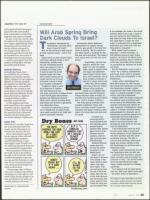
Dry Bones
THE RIOTS -\
SWEEPING THE ARAB
WORLD ARE PART
OF A GREAT
CONSPIRACY,
NOBODY
KNOWS, BUT
IF IT GOES
WRONG
Game
if you empower the Arabs in the street
and they want to see a war or want to
see more justice for the Palestinians,
that down the road, three to five years,
this could lead to a major war with
Israel. It could also force a negotiated
settlement; but I think over time, the
thing ends in Jerusalem."
What makes Engel's analysis
important – almost shocking – is
that Williams posed an open-ended
question. He did not ask about Israel.
Engel had countless ways in which he
could have responded yet he focused
on a potential war between the Arabs
and Israel.
But the Palestinian cause is just a
"cover" for a military confrontation
with Israel. Egypt, when it occupied
Gaza, hardly was sympathetic to the
Palestinians.
Jordan, which administered the
West Bank before the 1967 Six-Day
War, feared the Palestinians and when
the Palestinians revolted, Jordan
crushed them with tanks, killing thou-
sands, in a brutal onslaught in what
history calls Black September.
Indeed, before the Arabs recognized
the political value of blaming Israel
for the fate of the Palestinians, they
severely criticized Arab nations for
their treatment of Palestinians. Some
called it "criminal" and they readily
acknowledged the inhumane use of
Palestinians as political pawns in the
complicated world of Arab politics.
Even the United Nations, long
before it turned anti-Israel, con-
demned the Arab world for its treat-
ment of Palestinians.
If the Palestinians were the Arab
street's cause celeb, it could have
forced integration of the Palestinians
into their societies and offer other
assistance long ago. The fact is,
none of Arab countries, particularly
Egypt and Jordan, wanted to help
the Palestinians nor did they want a
Palestinian state.
Indeed, Israel improved the lives of
the Palestinians after the 1967 war
– improved their education, reduced
infant mortality rates and raised the
standard of living – but all that ended
when the late Palestinian leader
Yasser Arafat launched his intifadas
(uprisings).
So it appears that the Arab Spring
may very well (most likely?) lead sadly
– to Israel's winter of discontent.
Berl Falbaum of West Bloomfield is an author
and a public relations executive who teaches
journalism at Wayne State University, Detroit.
He is a former political reporter.
DryBones.com
iN
June 2 2011
25