

points of view
EDITORIAL BOARD:
Publisher: Arthur M. Horwitz
Chief Operating Officer: F. Kevin Browett
Interim Editor: Man Hitsky
Contributing Editor: Robert Sklar
>> Send letters to: Ietters®thejewishnews.com
Guest Columnist
Editorial
Iranian Danger
Remains Grave
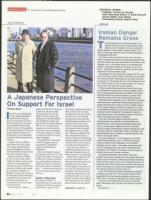
Mitsuo Bono is not
only a friend, burn so
a man intensely proud
of his country and its
achievemen
since the en
Mitsuo Bond-bnd
_
'Michael Eqrpn in
Tokyo ._-_'
A Japanese Perspective
On Support For Israel
MIchael Egren
I
spent 35 years helping build
an auto-supply manufactur-
ing business. During my
years in the industry, one of the
things I enjoyed most was meet-
ing wonderful and interesting
people. Because of the reputation
of Foamade Industries for its great
people, facilities, products and
technologies, we were frequently
visited by related businesses from
overseas.
Around 1976, I met Mitsuo
Bono (Bono-san) as he visited
with a group organized by his
company, Bridgestone. We have
remained friends and have visited
each other numerous times.
Bono-san was born in Tokyo
in 1929. In 1942, along with all
students, he had to work five days
a week at an armaments plant
with only one day for school. That
same year, his father, who worked
in accounting for Hitachi, was
drafted at the age of 39 and sent to
the Philippines. The day President
Franklin Roosevelt died in April
1945, Bono-san's home was
destroyed as the fire from bombs
raced up their hill.
After the Aug. 14, 1945, sur-
24
render in World War II, Bono-san
returned to school; but sadly,
he learned later that year his
father had died in May in the
Philippines. He had the difficult
task of telling his mother and
grandmother. No official informa-
tion was ever received and no
remains were ever returned to
honor. Bono-san was reminded
of this lack of dignity in relation
to people who died in the recent
Japan earthquake.
Eventually, Bono-san became
a chemical engineer and was
responsible for building the
urethane foam business at
Bridgestone.
Bono-san frequently spoke of
an important memory of U.S. Gen.
Douglas MacArthur. During one of
my first trips to Japan, I recall his
story about millions of Japanese
children saved from starvation by
MacArthur's efforts to distribute
milk — and Bono-san's sadness at
how few younger Japanese knew
this story.
Quake's Aftermath
Early this past March 11, I
received the first of several email
messages from Bono-san describ-
ing the historic quake. He was
safe living in Yokohama 50 meters
above sea level, but eventually
was affected by the loss of power
for three hours every day and
the growing concern about the
Fukushima plant meltdown.Area
residents had to stay in their
homes to avoid potential radia-
tion exposure, which remained
their biggest concern a month
later. Like many residents, Bono-
san is worried about the hot
summer without air conditioning;
being an engineer, he has proudly
converted a fan so it can be pow-
ered with automotive batteries.
Bono-san wrote about the
wonderful help from U.S. troops
following the quake and how it
demonstrates our true friendship.
He also told me about the sup-
port from Israel, which sent a
well-prepared medical team and
equipment, and most impres-
sively, brought its own generators
so as not to be affected by power
disruptions. The Israelis erected
a temporary hospital next to the
destroyed hospital in the town of
Minami-Sanrniku, which suffered
major damage from the tsunami.
About 25 percent of the patients
Japanese on page 25
T
he peril posed by Iran's nuclear pursuit to U.S.
national security as well as the interests of our
allies is acute. To dawdle in trying to halt Iran's
atomic ambitions could produce somber results in the
West, in Israel and anywhere else the Islamic Republic is
at ideological odds with.
The time is now for America to not only close loop-
holes in energy and financial sanctions laws against Iran,
but also increase the type and number of sanctions to be
imposed. Iran – a Holocaust denier, a civil protest sup-
pressor, a sanctions evader and a master at terror by
proxy – must feel an economic squeeze from its contin-
ued pursuit of illicit nuclear power.
We applaud U.S. Rep. Ileana Ros-Lehtinen (R-Fla.), who
chairs the House Foreign Affairs Committee, and commit-
tee ranking member Howard Berman (D-Calif.), the lead
co-sponsor, for introducing the Iran Threat Reduction Act
(H.R.1905) on May 13. The bill would make it U.S. policy
to stop Iran from securing nuclear weapons.
The bill would extend sanctions to human rights abus-
ers, facilitate aid to democracy activists, tighten enforce-
ment of existing sanctions laws, and reduce to $5 million
from $20 million the minimum amount in annual trade
with Iran's energy sector that would trigger sanctions.
Politically driven loopholes in U.S. law allow the Obama
administration to avoid fully implementing sanctions to
compel Iran not just to cease, but also verifiably disman-
tle its nuclear weapons program and abandon its other
unconventional weapons pursuits and state-sponsorship
of global terrorist networks. The loopholes create the
impression we don't mean business and have made our
allies, especially Israel, more vulnerable.
Last July, President Obama signed into law the
Comprehensive Iran Sanctions, Accountability and
Divestment Act, which imposed stronger Iranian sanc-
tions. A month earlier, Obama led the U.N. Security
Council to adopt international sanctions against Iran. But
even the American Israel Public Affairs Committee chal-
lenges Obama's lack of urgency in applying Iranian sanc-
tions to the fullest extent.
Only nine companies – from Singapore, the United
Arab Emirates, Monaco, Iran (2), Venezuela, Belarus,
Jersey (a British crown dependency in the English
Channel) and yes, Israel – have been sanctioned under
the U.S. law passed last year and the underlying Iran
Sanctions Act of 1996 for investing in Iran's energy sec-
tor. But why not any Chinese company?
The new bill eliminates some waivers that have
enabled Iran to receive materials, technologies and other
help in pursuit of nuclear, chemical and missile programs.
Under the bill, before he can waive energy sanctions, the
president must notify Congress and certify that failure to
waive would pose an unusual and extraordinary threat to
the national security interests of the U.S.
Israeli Prime Minister Benjamin Netanyahu reminded
Congress last week how "the ayatollah regime briefly
suspended its nuclear weapons program only once, in
2003, when it feared the possibility of military action."
"The more Iran believes that all options are on the
table," Netanyahu said, "the less the chance of confron-
tation."
So right he is. Li