

world >> on the cover
continued from front cover
1967 Borders
Is Obama charting a new course on Israeli-Palestinian issues?
Uriel Heilman I Jewish Telegraphic Agency
Palestinians' plan to obtain recognition
of statehood at the United Nations in
September.
"There is a reason why the Palestinians
are pursuing their interests at the United
Nations:' Obama said. "They recognize
that there is an impatience with the peace
process — or the absence of one. Not just
in the Arab world but in Latin America,
in Europe and in Asia. That impatience is
growing, and is already manifesting itself
in capitals around the world.
"The march to isolate Israel internation-
ally — and the impulse of the Palestinians
to abandon negotiations — will continue
to gain momentum in the absence of a
credible peace process and alternative,'
the president added. "So in advance of
a five-day trip to Europe in which the
Middle East will be a topic of acute inter-
est, I chose to speak about what peace will
require:'
It's unclear if Obama's maneuvering will
do anything to staunch the Palestinian
statehood effort or the campaign to isolate
Israel. But either way, Obama said, Israel
and its supporters should not be alarmed
by his remarks about the 1967 lines: All he
did was go public with a well-established
formula, he said, one that "by definition"
means "the parties themselves — Israelis
and Palestinians — will negotiate" a new
border taking into account "new demo-
graphic realities on the ground and the
needs of both sides."
However, a close reading of what Obama
said and left unsaid in his two speeches
hints at a few significant ways that
Obama's approach to resolving the conflict
may differ from that of his predecessors.
But scant on details, his remarks also raise
more questions than they answer.
Land Swaps
First, Obama's call for an Israeli-
Palestinian settlement based on the pre-
1967 lines with mutually agreed swaps
endorses the principle that Israel compen-
sate any annexation of West Bank settle-
ments with territory from Israel proper.
While prior administrations had raised
the possibility of certain land exchanges,
Obama was more public and clear in
endorsing that approach as a basis for
negotiations.
That's good news and bad news for
Israelis. On one hand, the position
assumes Israel will annex parts of the
West Bank; Obama made clear on Sunday
that he believes the final border will be
"different than the one that existed on
June 4, 1967."
On the other hand, it implicitly
embraces the principle that the West Bank
belongs to the Palestinians by requiring
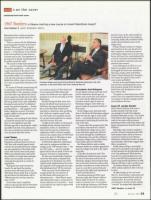
President Obama and Israeli Prime Minister Benjamin Netanyahu talk with
reporters in the Oval Office after their meeting May 20.
any Israeli annexation of West Bank land
to be compensated. What Obama left
unclear was whether he sees rightful com-
pensation as a one-for-one swap, as do the
Palestinians.
President George W. Bush never went
this far. He offered Israel assurances in a
2004 letter that large Jewish settlement
blocs in the West Bank would not be
uprooted in a final peace deal, specifying
that "a full and complete return" to the
pre-1967 border was unrealistic. He did
not say that Israel would have to compen-
sate with territory of its own.
"In light of new realities on the ground,
including already existing major Israeli
populations centers, it is unrealistic to
expect that the outcome of final status
negotiations will be a full and complete
return to the armistice lines of 1949:' Bush
wrote in his April 14, 2004, letter to then-
Israeli Prime Minister Ariel Sharon.
In 2005, Bush added that a Palestinian
state must be contiguous and that any
changes to the 1949 armistice lines — the
pre-1967 border — must be mutually
agreed. But he did not speak of Israel ced-
ing parts of its land as compensation.
For their part, Israeli leaders long have
viewed the West Bank as disputed land,
arguing that U.N. Resolution 242, which
requires Israeli withdrawal from the territo-
ries captured in 1967, purposely never spec-
ified withdrawal from "all" the territories.
While successive Israeli leaders have
recognized that the vast majority of
the West Bank will become part of a
Palestinian state — Ehud Olmert report-
edly offered land swaps to compensate for
Israeli settlements to be annexed — Israel
in principle has not ceded its right to West
Bank territory.
Jerusalem And Refugees
Second, Obama said last week that Israel
and the Palestinians should agree on
borders and security first, and only later
try to deal with the difficult issues of
Jerusalem and the right of return for
Palestinian refugees. In his follow-up
speech Sunday, he mentioned neither of
those issues.
On the refugee issue, Bush had made
clear in '04 that he felt Palestinian refugees
would not have the right to settle inside
Israel — something that Israel views as
tantamount to destroying the Jewish char-
acter of the state.
"It seems clear that an agreed, just, fair,
and realistic framework for a solution
to the Palestinian refugee issue as part
of any final status agreement will need
to be found through the establishment
of a Palestinian state, and the settling of
Palestinian refugees there, rather than in
Israel:' Bush said in his 2004 letter.
But Obama failed to make a similar
statement. Rather, his remarks appeared to
move the refugee issue back to the negoti-
ating table.
In his May 19 speech, he said, "Two
wrenching and emotional issues remain:
the future of Jerusalem and the fate of
Palestinian refugees. But moving forward
now on the basis of territory and security
provides a foundation to resolve those two
issues in a way that is just and fair, and
that respects the rights and aspirations of
Israelis and Palestinians."
Speculating during an AIPAC panel
discussion right after Obama's address,
Martin Indyk, the former U.S. ambas-
sador to Israel and now a vice president
at the Brookings Institution, said Obama
did not talk about Jerusalem because he
knew his views on the matter would not
be welcomed by the pro-Israel audience.
Conversely, Indyk said, he believed AIPAC
would welcome Obama's views on the
refugee issue.
Perhaps Obama's mention of refugees
and Jerusalem in the same breath in his
May 19 speech is a hint that he believes
resolving the refugee issue to Israel's satis-
faction will have to be counterbalanced by
an Israeli concession on Jerusalem. Here,
too, the president's omissions raise more
questions than answers.
In his 2008 speech at AIPAC as a can-
didate for president, shortly after he
had bagged the Democratic nomination
following a tough contest with Hillary
Clinton, Obama declared that "Jerusalem
will remain the capital of Israel, and it
must remain undivided."
But later in the week Obama dialed back
that assertion, clarifying that he meant
that Jerusalem should not be divided by
barbed wire and checkpoints as it was
from 1948 to 1967.
"Jerusalem is a final-status issue, which
means it has to be negotiated between the
two parties," an Obama campaign spokes-
man clarified at the time.
Issue Of Jordan Border
Third, Obama both last week and on
Sunday repeated a line that surely
was grating for Israeli Prime Minister
Benjamin Netanyahu to hear: "The United
States believes that negotiations should
result in two states, with permanent
Palestinian borders with Israel, Jordan and
Egypt, and permanent Israeli borders with
Palestine."
Netanyahu wants Israel to maintain a
corridor of Israeli control along the West
Bank-Jordan border, which he views as
essential to Israel's security. Obama's
delineation of Palestine's borders as shar-
ing a boundary with Jordan suggests that
idea is a nonstarter.
Finally, Obama did go a step further
than any U.S. president in his explicit call
in both speeches for the Palestinian state
to be "non-militarized." While that has
been the U.S. understanding from as far
back as the Bill Clinton parameters dur-
ing the Camp David negotiations of 2000,
Obama is the first to say so on the record.
On Sunday, Obama also offered the
AIPAC audience plenty of other red meat
to cheer.
He talked tough on Iran and noted
that U.S.-Israeli military cooperation had
reached unprecedented levels under his
administration. He said that America's
commitment to Israel's security remains
"ironclad." He pledged that September's
1967 Borders on page 24
May 26
a
2011
23