

will not go to waste. Their blood was
spilled for the freedom of our Palestinian
people and for its rights."
Netanyahu, speaking at the beginning
of the weekly Cabinet meeting Sunday
morning, said that "I regret that there are
extremists among Israeli Arabs and in
neighboring countries who have turned
the day on which the State of Israel was
established, the day on which the Israeli
democracy was established, into a day of
incitement, violence and rage. There is no
place for this, for denying the existence of
the State of Israel. No to extremism and no
to violence. The opposite is true
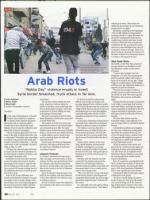
Stone-throwing Palestinians
. Clash with Israeli troops near the
alandiya checkpoint between
, mailah and Jerusalempn Sun -
Arab Riots
"Nakba Day" violence erupts in Israel:
Syria border breached, truck attack in Tel Aviv.
Uriel Heilman
Marcy Oster
Dina Kraft
Jewish Telegraphic Agency
Jerusalem
I
n the wake of disturbances on Israel's
borders that resulted in as many as
14 deaths, Prime Minister Benjamin
Netanyahu said in a national address
Sunday that he has ordered the Israel
Defense Forces to stop the infiltration and
defend the country's sovereignty.
"This is an appeal against the very exis-
tence of the State of Israel, which they call
a catastrophe Netanyahu said, responding
to massive Arab protests both inside and
outside of Israel for Nakba Day — the day
Arabs mark as the "catastrophe" of Israel's
birth on May 15, 1948.
"We hope the calm and quiet will quick-
ly return, but let nobody be mistaken, we
are determined to defend our borders and
sovereignty," Netanyahu said.
Hundreds of Arabs from Syria stormed
across the border into Israel on Sunday,
prompting Israeli troops to respond with
live fire killing up to four people, accord-
ing to reports. By Sunday evening, most of
the infiltrators had been rounded up and
returned to Syria.
Some of the Syrian infiltrators told
Israeli media that they wanted to be grant-
ed asylum to live in Israel, calling it safer
than living in the current uprising against
the Syrian government. Others said they
were there to liberate the Golan Heights
36
May 19
c
2011
from Israel.
The incident, which marked the first
major eruption of violence along the
border in decades, came on the same day
that an Israeli Arab rammed a truck into
pedestrians in Tel Aviv, killing one man
and injuring a dozen people.
Elsewhere around Israel and the West
Bank, thousands of Palestinians protested
to mark Nakba Day.
The number of Arabs from Syria who
breached the border on the Golan Heights
was estimated at up to 400. The Israel
Defense Forces declared the area of Majdal
Shams, a Druze town near Mount Hermon,
a closed military zone as Israeli troops
tried to round up those who had infil-
trated the border.
Israeli troops also fired on Palestinian
protesters who approached Israel's bor-
der with Gaza, wounding several teens,
according to reports.
Lebanon Protests
In Lebanon, thousands of Arabs report-
edly converged on Israel's border to dem-
onstrate, but they were pushed back when
the Lebanese army fired warning shots
into the air. Israeli soldiers also reportedly
shot in the air and at the feet of Lebanese
demonstrators.
Up to 10 Lebanese demonstrators were
killed in the incident, with most believed
to have been killed by the Lebanese army,
according to reports.
At least 10 Israeli troops were injured in
the incidents on the Syrian and Lebanese
borders.
In Tel Aviv, Israeli law enforcement
officials said Sunday morning's truck
rampage appeared to be a terrorist attack.
The 22-year-old man from the Israeli Arab
village of Kafr Kassem who drove into cars
and pedestrians on a busy thoroughfare
reportedly told police that his tire had
exploded, causing him to lose control of
his truck.
In Jerusalem, Palestinian demonstrators
reportedly threw firebombs at Hadassah
Hospital on Mount Scopus in Jerusalem.
The violence came two days after a
Palestinian teen was killed during a pro-
test in eastern Jerusalem. The boy may
have been shot by a security guard work-
ing for several Jewish families who live in
the area.
Hamas' prime minister in the Gaza
Strip, Ismail Haniyeh, told thousands
of Muslim worshippers in a mosque
Sunday morning that Nakba Day should
be observed this year "with great hope of
bringing to an end the Zionist project in
Palestine:'
Haniyeh made the remarks less than
a week after his Islamist party and the
Fatah Party of Palestinian Authority
President Mahmoud Abbas reconciled and
announced plans to form a unity govern-
ment in the coming weeks.
"This is the first year crowds will march
to Palestinian borders, annulling the old
saying that elderly people die and younger
generations forget the past:' Haniyeh told
the crowd.
In a nationally televised address, Abbas
said of the killed protestors, "Their blood
West Bank Riots
Meanwhile, in the West Bank, clouds of
tear gas hovered over hundreds of riot-
ing Palestinian youths on the road to
Jerusalem.
"I want a third intifada," said Ala
Barghouti, a 21-year-old accounting stu-
dent, his nostrils stuffed with tissues to
keep out the sting of the tear gas. "I hope
things do escalate today. A third intifada
will help move the Palestinian Authority to
improve our political situation.
"We need more support out here, a
stronger presence to get everyone out on
the streets',' he said. "We need to get the
Palestinian cause back on world radar
again:'
Energized by the uprisings sweeping the
Arab world, a recent unity deal between
Fatah and Hamas, and hopes for interna-
tional recognition of statehood by the U.N.
General Assembly in September, unusu-
ally large crowds turned to the streets on
Sunday.
The West Bank clashes near the
Kalandiya refugee camp appeared to be
part of a larger effort to overwhelm Israel's
borders.
In Ramallah, hundreds came together
for what was a relatively peaceful gather-
ing within the confines of the city, out
of view of Israeli troops. A mixed crowd
of young and old mingled and spoke of
the hopes the so-called Arab Spring has
aroused Palestinian society.
"All of the nations in the world, and
especially the countries in this region, are
looking for freedom and independence
said Zaki Attari, 45, an employee of the
Palestinian Finance Ministry, as he made
his way through thick crowds and the
sound of drumbeats.
Rows of young boys wearing black held
black wooden keys symbolic of the homes
Palestinian families lost during the fight-
ing in 1948, when hundreds of thousands
fled or were expelled from their homes.
Loudspeakers blared nationalist slogans
invoking the Arab Spring.
"It's time to be like Egypt. It's time to
be like Tunisia. It's time to be like Libya;'
said a man leading one of the chants in
flag-draped Manara Square in the center
of Ramallah. "No more talking; it's time to