
world
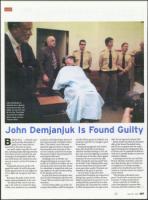
John Demjanjuk is
wheeled into a Munich
courtroom on Nov. 30,
2009, for the first day
of his trial. The photo
was taken by Sobibor
death camp survivor
Thomas Blatt.
John Demjanjuk Is Found Guilty
B
ERLIN (JTA) — A Munich court
has found John Demjanjuk, 91,
guilty of war crimes and sen-
tenced him to five years in prison.
Last week's verdict came after 93 court
days, including deeply affecting testimony
from Dutch survivors and their kin, and
monologues by Demjanjuk's chief attor-
ney, Ulrich Busch, who claimed his client
was just as much a victim of Germany as
any Jew.
Demjanjuk's attorneys say they will
appeal the verdict. He will be free pend-
ing the appeal because he was judged not
to be a flight risk. An appeal could take a
year.
Reacting to the guilty verdict, Jewish
leaders expressed gratitude to the court.
"The Munich State Court's clear mes-
sage to the world is no matter how long
it takes, mass murderers are accountable
to justice said Deidre Berger, director of
the American Jewish Committee's Berlin
office. "The verdict is one of the most
important legal precedents in decades for
the prosecution and conviction of Nazi-
era war criminals, and should encourage
the pursuit of others who participated in
executing the Holocaust."
Demjanjuk, born in Ukraine, was
charged with being an accessory to the
murder of 27,900 Jews in Sobibor. He was
present at nearly every court date, always
in a wheelchair or hospital bed, and wear-
ing sunglasses. He said virtually nothing
for the duration of the trial.
In April 2010, Busch read aloud a state-
ment in which Demjanjuk called the trial
"torture" that was relieved only by his care
attendants.
Survivor Thomas Blatt, one of the rare
escapees from Sobibor, told JTA during the
trial that "All the guards [at Sobibor] were
murderers" and that "it is enough to prove
he was there."
Demjanjuk immigrated to the United
States after World War II and lived in
suburban Cleveland starting in 1952. His
later years were spent fighting accusations
of involvement in wartime crimes against
humanity: He was accused in the early
1980s of being the notorious guard "Ivan
the Terrible" at the Treblinka death camp,
but was released from jail in Israel after
seven years when another Ukrainian was
identified as the guard in question.
The U.S. Justice Department later
reported that Demjanjuk was suspected of
having been a guard at Sobibor and was
liable for deportation because his U.S. citi-
zenship had been granted based on false
information. His citizenship was revoked
in 2002, and deportation was approved in
2005. He was deported in March 2009.
Efraim Zuroff, who heads the Jerusalem
office of the Simon Wiesenthal Center,
told JTA he was pleased with the verdict
against Demjanjuk but disappointed that
a German court in Ingolstadt decided last
week not to extradite another accused war
criminal to Holland.
A spokesperson for the court said that
88-year-old Klaas Carel Faber, convicted
more than 60 years ago by a Dutch court
of complicity in 22 wartime murders,
would not be extradited because Faber's
consent as a German citizen was required
and he refused.
"This decision is absolutely outra-
geous',' Zuroff said in an interview from
Jerusalem. "It makes my blood boil."
Kramer noted that of 150,000 war
crimes investigations in postwar West
Germany, only 6,500 resulted in trials. Li
May 19 2011107
Scanned image of the page. Keyboard directions: use + to zoom in, - to zoom out, arrow keys to pan inside the viewer.
May 19, 2011 - Image 111
- Resource type:
- Text
- Publication:
- The Detroit Jewish News, 2011-05-19
Disclaimer: Computer generated plain text may have errors. Read more about this.