
Layered Land
Israel: Where everything old is new again.
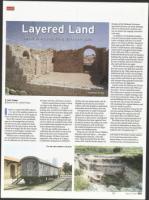
A Nobatean building
Julie Cooper
Special to the Jewish News
srael is a country that defies physics
– it is one of the smallest countries in
terms of size, but one of the largest in
terms of density of sites and landmarks.
One of the country's most remarkable
aspects is the juxtaposition of ancient,
old and new in such a small area. Israel
certainly isn't the only country where the
old and new mingle. But the sheer density
of history in Israel makes it unique even
among countries with long histories.
Whether you're a history buff or not,
you can't help but be amazed by the num-
ber of millennia you can traverse in just a
few days, and even a few hours, in Israel.
Visitors' ancient history lesson in Israel
can begin at the biblical tels of Hazor,
Megiddo and Beersheva — all world
heritage sites. Located in the Galilee or the
Negev, the tels have structures dating back
to the Bronze and Iron Ages — around
4,000 years ago. Among the highlights of
all three tels are their underground water
cisterns, which are considered some of the
most sophisticated examples of water col-
lection systems from that period.
The sites also exhibit many layers of
civilization that were built on top of each
other as the areas were conquered by
different groups. Tel Hazor is the most
impressive, with evidence of 22 layers
of inhabitants dating back to 2000 BCE.
All three sites are national parks, and Tel
Megiddo in particular has an extensive
visitors' center that includes an audiovisual
presentation about the history of the site.
Coming forward a couple of thousand
years, Israel was the site of one of the
region's most important trade routes —
the Incense, or Spice, Route. Controlled by
the Nabateans from their capital of Petra
(located in modern-day Jordan), the route
ferried frankincense and myrrh from
the Arabian Peninsula across the Negev
Desert to the Mediterranean.
Today, one can visit the towns of Haluza,
Mamshit, Avdat and Shivta — the major
stopping points along the 1,200-mile
route, which functioned from the third
century BCE until the fourth century CE.
Remains of the Nabateans' fortresses,
agricultural systems and urban planning
attest to a vibrant desert existence, and
one can witness the ongoing excavations
at the sites.
In addition to its abundant examples
of ancient history, Israel's modern history
is also on display, and there is no better
place to see it than in Tel Aviv. Among the
city's gems are the White City — its col-
lection of 4,000 Bauhaus-style buildings,
constructed by immigrants from Europe
in the 1920s and 1930s. A walk down
Rothschild Boulevard reveals one Bauhaus
building after another, with their rounded
terraces and light-colored facades. Tel Aviv
has also reclaimed some of its historical
sites and made them new again.
The Tel Aviv Port was built in 1938 after
Jews lost access to the Jaffa Port, and then
abandoned in the 1960s when the port in
Ashdod was built. In 2001, the city began
to transform the port into a venue for lei-
sure activities, and today the port is lined
with boutique shops, gourmet restaurants
and trendy bars and nightclubs.
Further south, the Tachana was Tel Aviv-
Jaffa's main train station until 1948. Last
year, after a 10-year restoration project,
the station was re-opened as an entertain-
ment and leisure complex boasting a vari-
ety of stores and eateries. Many of the his-
torical buildings have been restored, and
two old train cars sit near the entrance,
still containing their original interiors and
open for visitors to peek in.
All the sites listed above (except the Tel
Aviv Port and the Tachana) are UNESCO
World Heritage Sites, and you can read
more about them on UNESCO's Israel
page: whc.unesco.org/en/statesparties/il.
The biblical tels and the Spice Route
cities are also national parks, and you
can find out information on hours, loca-
tions and entrance fees at the Israel Parks
Authority site: www.parks.org.il . fl
Julie Cooper is the director of public relations
for the Israel Government Tourist Office -
Midwest Region. For more information on
traveling to Israel, visit www.goisrael.com .
The old train station in Tel Aviv
May 19
a
2011
101
Scanned image of the page. Keyboard directions: use + to zoom in, - to zoom out, arrow keys to pan inside the viewer.
May 19, 2011 - Image 105
- Resource type:
- Text
- Publication:
- The Detroit Jewish News, 2011-05-19
Disclaimer: Computer generated plain text may have errors. Read more about this.