

oints of view
>> Send letters to: letters@thejewishnews.com
Contributing Editor
EDITORIAL BOARD:
Publisher: Arthur M. Horwitz
Chief Operating Officer: F. Kevin Browett
Interim Editor: Alan Hitsky
Contributing Editor: Robert Sklar
Editorial
•,t3.0.c1 Stronwor
Jewish
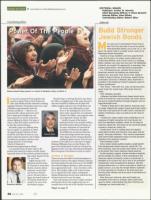
Women attend Friday prayers in a street in Benghazi, Libya, on March 4.
Winnick's logic is sobering. Recall, he says, that in
I t's easy to be enamored by the populist-style
the 1980s, we supplied some of the same characters
protests in Egypt, Yemen, Libya, Tunisia and
who later founded the Taliban and Al Qaida with
other Arab nations and the sometimes-resulting
military supplies and know-how to help them oust
toppling of dictators. The protests seem to be a sign
the Soviets from Afghanistan, a major
of Muslims expressing their desire for
factor in the disintegration of the Soviet
freedom and liberty — almost a very
Union. Only a decade later, our newfound
American-like, valiant, grassroots rebel-
"friends," the Taliban, were using this same
lion to make good triumph over evil.
Some observers are in awe of the brave
4 aid to fight their "enemy," the West.
Notably, the goals of the Muslim
citizens fighting for liberty. The hope, of
Brotherhood and its ilk, Al Qaida, Taliban,
course, is that new leaders would be bet-
Hezbollah, Islamic Jihad and Hamas, are
ter than the current dictators.
the same: elimination of Israel and the
But reality points in a different direc-
installation of Sharia law throughout
tion. So argues U.S. professor of chemi-
the Middle East and beyond. Sharia law
cal engineering Jack Winnick. He has
Robert Sklar
is the ancient legal system that, among
served for more than 40 years as a con-
other things, permits stoning and genital
sultant within the industry and to NASA.
mutilation against women. Even the most
Currently, he's professor emeritus at the
moderate of the leaders set to take power in Egypt,
Georgia Institute of Technology
Mohamed ElBaradei, does not deny Sharia or the
School of Chemical &
goals of the Brotherhood; he states he will open the
Biomolecular Engineering in Atlanta.
Egyptian border into Gaza, effectively permitting the
In a powerful essay, he stakes claim to the
flow of weapons to the Hamas terrorists in control.
position that historical evidence and the clearly
expressed desires of the protestors portend a poten-
tial nuclear disaster for the opttirm If Strafoillf
There are many who believe Israeli intransigence is
U.S. and Israel.
the barrier to peace in the region, Winnick continues.
Eighty percent of all
But Israel remains the only democracy in the Middle
Egyptians and the major-
ity of people in many other East with full religious freedom as well as participa-
tion in government by all — Jews, Christians, Arabs,
Muslim countries harbor
Druze. This freedom, right on the Arabs' doorstep,
animosity toward Israel
has so angered theocratic zealots, including the
and America, Winnick
Muslim Brotherhood, that they have stoked the fires
asserts. We know that in
Egypt, the brutal leaders of of hatred and revolt across the region.
That Arabs living in Israel have a higher standard
the Muslim Brotherhood
of
living than those in the neighboring states is a
would
be
far
worse
than
Lta
Professor Winnick
constant thorn in the side of the Islamists (terrorists).
the Mubarak regime.
Power on page 27
26
May 12 2011
ore Jews live in metropolitan Tel Aviv than in
New York City; and Israel is one of the world's
most-developed nations, just as the U.S. is. The
point: The Jewish state is no longer a poor cousin to the
Washington-based superpower.
America is larger, wealthier and more powerful than
Israel. But the gap is no longer canyon sized; so the
relationship between Jews in each country is changing.
Better relations can come none too soon: The Palestinian
Authority has sought U.N. approval for a sovereign, inde-
pendent government in the West Bank by September.
In a JTA-released essay, Jonathan Sarna and Jay
Ruderman examine the budding new relationship
between U.S. and Israeli Jews. Sarna is the Joseph H.
& Belle R. Braun Professor of American Jewish History
at Brandeis University in Waltham, Mass. Ruderman is
president of the Ruderman Family Foundation, based in
Boston and Rehovot.
Their thesis – that while U.S. Jews are learning much
about Israeli life, Israelis learn little about American
Jewry.
Their examples resonate:
• Whereas charitable funds once flowed almost exclu-
sively from American Jewry to Israel, now Israel returns
the acts of chesed (kindness) through programs such as
Taglit-Birthright Israel.
• Thanks in large part to the Internet, American Jews
no longer categorically support Israeli government policy.
They hear a full spectrum of Israeli voices, meaning the
opinion of American Jews is as diverse as the views of
Israelis.
• Centers for Judaic studies have proliferated on U.S.
campuses of higher education, but Israel boasts not
even one significant academic center for the study of
American Jewish life. And there are few university-based
courses on American Jewish life.
Israelis know "next to nothing about the deepest
issues which Israelis and American Jews agree and dis-
agree," the essay maintains. "They cannot comprehend
what church-state separation means and how pluralism
operates in the American context."
How troubling is that?
Every Israeli, notably political leaders, would benefit
from knowing more about American Jewish life. The
more American Jews and Israelis learn about one anoth-
er, the better their future dealings indeed would be.
As the essayists suggest, Knesset members would do
well to consider the impact of their lawmaking on the
American Jewish community. Israel as a democracy is
beholden to its citizens first. But it also is the ancestral
homeland for Jews throughout the diaspora. How the
Knesset defines who is a Jew for marriage or aliyah is a
global concern, as is how the Foreign Ministry responds
to street uprisings for freedom in the Arab world and
how the prime minister and army react in self-defense to
Islamist terror.
More than ever, American Jews and Israelis can
strengthen their bond as strategic allies 6,000 miles
apart by better understanding how their interests and
challenges are inextricably tied. II