

Farmer, rabbi and
maple syrup maker
Shmuel Simenowitz
melds Torah and
environmentalism.
boiled down from 4,000 gallons of raw
sap, which is collected from buckets he
hangs from his tapped trees. He taps the
trees in a pattern, he explains — a little
higher or lower each year so as not to
damage the tree. The sap is pumped into
an evaporator inside the sugar shack,
where the water is boiled off to leave
behind the syrup, which is about 60 per-
cent sugar.
The operation is kosher certified. There
are two major kosher concerns with
pure maple syrup." First, an observant
Jew is required to turn on the evaporator
because only an observant Jew is allowed
to "light the fire" that cooks a kosher food
item.
Second, while the sap is boiling, farm-
ers drip animal fat into the mixture to
keep it from foaming over the top of its
container.
"Traditionally, they'd take a piece of
pork fat, suspend it from a string and the
foam would rise, touch it and go down:'
says Simenowitz, who instead uses olive
oil, pouring in a drop or two at a time.
Simenowitz, who sells all his maple
syrup himself either in person or by mail
order, says he sells out every year.
He makes his living as a traveling
scholar-in-residence, lecturing about
farming in Orthodox venues and teach-
ing Torah to Jewish environmentalists
and foodies through Ya'aleh v'Yavo, the
Jewish environmentalist project he
directs. He also picks up the occasional
legal case, to keep the bills paid, and has
been tapped by the city of Baltimore
to do a comprehensive energy audit on
a new Orthodox-friendly commercial
building, including designing some of its
energy-efficient infrastructure.
Simenowitz doesn't attend Jewish
food conferences anymore, saying he is
"tired of being the poster child for the
Orthodox:' Jewish environmentalists and
eco-foodies need to ground their work in
Torah, he says, if they want the Orthodox
world to take them seriously.
"The Orthodox are late to the parade,"
he acknowledges, but that's understand-
able.
"The environmental agenda is often
grafted onto a liberal social justice agen-
da that the Orthodox community can't
accept," he says. "Part of my program is
to fill that breach."
Simenowitz works closely with Kayam
Farm, an organic farm and Jewish
educational initiative at the Pearlstone
Conference and Retreat Center just out-
side Baltimore. When he first visited sev-
eral years ago, he learned that Kayam was
based on his farm in Vermont, which the
general manager's daughter had visited
as part of a group from the 92nd Street Y
in New York City.
"That was really validating,"
Simenowitz says, "to see the seeds I
planted take root." F1
"
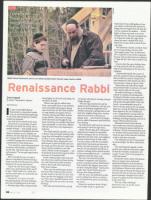
Rabbi Shmuel Simenowitz and his son Shlomo building their Vermont sugar shack in 2005.
Renaissance Rabbi
Sue Fishkoff
Jewish Telegraphic Agency
living lightly on the earth and doing it in
everybody what they're missing, trying to
the name of Torah.
bridge that gap!'
Fifteen years ago, he walked away
Two years ago, Simenowitz and his
San Francisco
from a successful career as an entertain-
family moved to Baltimore, and they now
ment and intellectual property lawyer
live in an Orthodox neighborhood of
t's easy to spot Rabbi Shmuel
and moved from the New York suburbs
families interested in getting back to the
Simenowitz at a Jewish food confer-
of Long Island to an organic farm in
land. One neighbor keeps bees. Another
ence, an environmentalist gathering
Vermont with his wife, Rivki, and two
spins her own wool. A third has an
or any of the other progressive-minded
young children. They were becoming
organic farm — just the kind of integra-
confabs he frequents.
newly observant and thought the big
tion for which Simenowitz and Rivki had
Just look for the Chasid in the room.
house and fancy cars wouldn't help them
been looking.
Simenowitz is an anomaly: a haredi
grow spiritually" or raise their children
But Simenowitz still travels to Vermont
Orthodox Jew, black hat and all, who is
with the values they were beginning to
each spring to work his sugar farm.
equally at home — and equally uneasy
hold dear.
About a decade ago, after a disastrous
— in a roomful of dreadlocked 20-some-
The couple planted vegetables, set up
maple harvest season, the sap finally
thing eco-hipsters as at a Chasidic cel-
a chicken coop and began making maple
started running on the eve of Passover,
ebration. He takes flak from the Orthodox syrup from the hundreds of maple trees
right before the first seder, and neighbors
for "wasting time" with the foodies and
on their 14 acres, calling their project
poured in from all over to help collect
is chided by progressive activists for his
Sweet Whisper Farm. Simenowitz used
it as fast as they could. But as sundown
commitment to ritual observance.
draft horses to plow the fields and carry
approached, Simenowitz put down his
"I see myself as a post-denominational the maple sap from the trees to his sugar
bucket and said work had to stop. By the
Torah Jew with Chasidic sensibilities,"
shack, which is modeled on an 18th-
time he was permitted by Jewish law to
he tells JTA, with more than a trace of
century Polish wooden synagogue — one continue working, all the sap had spoiled
self-mockery. "I'm an equal-opportunity
of hundreds destroyed by pogroms, Nazis in the unseasonably hot sun — hundreds
offender."
and years of Communist rule.
of gallons, nearly his entire crop.
More seriously, he says, not only is
Jewish student groups, observant and
The story was featured in Oprah
there no contradiction between living a
non-observant, would visit from the big
Winfrey's 0 magazine, and "Someone
Torah-true life and reducing one's carbon city, and Simenowitz would introduce
passed a comment, saying, 'What kind of
footprint, the two are intertwined.
them to farm work while imparting a
God would let that happen when you're
"I grow my own food, I grow organi-
little Torah wisdom.
out there doing His thing?'" Simenowitz
cally, I am a good steward of the earth,"
"When I get the yeshiva guys up here,
recalls. "And I said, 'Bottom line, you
he says. "That's Torah. I'm a Torah Jew,
they know their Torah but they need to
don't get hurt doing mitzvahs:"
and my world values are seamlessly inte-
get their hands in the dirt," he says. "And
After the story was published, people
grated into that."
when I get the tree-hugging crowd, they
started calling from all over to adopt a
Simenowitz, 53, is part of a small
say, 'Wow, what a beautiful sunset, and I
tree in Simenowitz's grove; his business
but growing group of strictly Orthodox
say, 'That's great, but we need to do some
was saved.
Jews who are getting back to the land
learning.'
Simenowitz produces about 100 gal-
— farming organically, raising animals,
"We're like spiritual dietitians, giving
lons of maple syrup in a good year,
I
((
38
: