

metro
Still In Crisis from page 11
Restarting A Company
EDUCATIONAL
SCHOLARSHIPS:
Akiva Hebrew Day School:
• 2008: $470,000 in tuition subsidies;
30-plus percent of families received
tuition assistance
• 2010-11: $1 million in tuition
subsidies or 50 percent of the
school's 140 families receive
tuition assistance
Frankel Jewish Academy:
• 2008: $1.2 million; 40 percent
of 226 students received tuition
assistance
• 2010-11: $1.49 million; 53 percent
of 209 students received tuition
assistance
Hillel Day School:
• 2003: 36 percent of families
receive tuition subsidies of varying
amounts
• 2010: 50 percent of families
receive tuition subsidies of varying
amounts
The school has subsidized families to the tune of $2
million plus for the last few years.
Yeshiva Beth Yehudah:
• In 2006, 65 percent of YBY families
received scholarships covering
more than half of the tuition costs.
• For the 2010-11 school year,
more than 80 percent received
scholarships covering more than
half of the tuition costs.
Today, tuition at YBY accounts for 24 percent of
the institution's budget compared to 2006, when it
accounted for 40 percent of the budget.
12
May 5 e 2011
For 10 years, Moshe Serour of Southfield
operated a successful Papa Romano's
pizza store in Birmingham. Business
was good — not great — but profits went
to pay the high rent.
Serour, 39, and his wife, Anna, were
working 80-hour weeks and they still
couldn't convince the landlord to rene-
gotiate the lease, so they decided to
look for a new space.
It took several rejections before
Serour found a bank that would lend
him enough to set up shop in a different
location. But the bank needed a guaran-
tor.
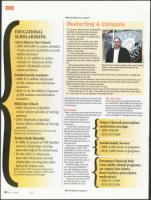
Serour approached Hebrew Free
Moshe Serour turned to Hebrew Free Loan to help
Loan, which had helped them with a
finance a new, less-expensive location for his
Papa Romano's pizza.
down payment on their first home.
HFL agreed to collateralize the loan,
enabling the Serours to open a Papa Romano's further west in Birmingham, at Maple and
Cranbrook roads, a year ago.
While some of his old customers won't drive far for pizza, many will, and Serour has cul-
tivated new customers. He projects that receipts will be in the $1 million range by 2013 —
where they were before the economy tanked.
"It's a better location; it's a new store," he said.
If not for the loan guarantee, Serour says, he would have been forced into bankruptcy.
"I mean, that was it," he said. "I was ready to go to the lawyer. Hebrew Free Loan saved
us — my house, my car, my business. They saved our life."
Jewish Fund grants, emergency allocations from
the Federation and private donations, Yoskowitz
said. Program staff grew from five to nine in the
last three years.
Food Needs
There is some good news mixed in with the bad.
The number of families and individuals who
use Yad Ezra, the Berkley-based
kosher food pantry, appears to
have stabilized after several years
of increases.
"It looks like it's plateaued, and
that the need will go down:' said
Elaine Ryke, operations director.
"People are moving out of town,
so maybe they got jobs. Hopefully,
there will be more jobs here. I
think everything will work out. It
has in the past."
Yad Ezra serves approximately
1,600 families, or about 3,700
individuals, an increase of nearly
400 families since 2009. The
majority of clients are between
55 and 65 years old, and most
are working. About 40 percent of
them require kosher food.
Yad Ezra's budget of $1.5 mil-
lion is growing by $200,000 a
year, said development director
Lea Luger. United Way provides
$50,000 per year and the remain-
der comes from private donations.
"People are aware there is need
there and that food is a basic
need. It's solvable she said.
The Job Front
JVS saw its numbers jump from 1,682 job seek-
ers in 2007-08 to 3,466 in 2008-09, and expects to
serve more than 4,300 individuals in the 2010/11
calendar year, some of them holdovers from the
previous year, said Leah Rosenbaum.
Like other agencies under the Jewish Assistance
Project umbrella, JVS is seeing many more young
Project Chessed: prescription
medication coverage:
•2008: $98,000
•2010: $213,000
{
Jewish Family Service:
• 2009: 3,300 clients in programs
• 2010: 3,800 clients in programs
Emergency financial help
(rent, utility shutoff programs,
car repairs, bus tickets,
food vouchers, prescription
medication):
•2008: $513,000
•2010: $815,000
Still In Crisis on page 14