

titiwzrzigiasumga
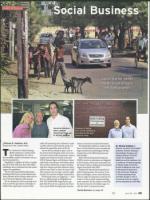
Local doctor seeks
medical volunteers
for Bangladesh.
rickshaw outside
the Patific Hotel
in Bangladesh.
OSI-FLOWEk
MIGRATED PRE-SCHOOL
FOR
HEA RN 1,1IRE43.1112/2111
r
Michael D. Seidman, M.D.
Special to the Jewish News
T
he Coalition for Global Hearing
Health organized a medical relief
trip to Bangladesh. Our visit to
this incredible country in November was too
short, but productive.
Bangladesh, a neighbor of India, is roughly
the size of Iowa with more than 160 million
inhabitants and an infrastructure that cannot
support the population.
We met with many health professionals,
including Nobel Prize Laureate Muhammad
Yunus, founder of the Grameen Bank and cre-
ator of the Social Business (SB) concept.
SBs are designed to solve a pressing need
such as poverty, agriculture, technology or
health. Each organization must be finan-
Samantha Caccamo,
Professor M. Nurual
Nobel Laureate
Amin and Dr. Seidman at
Muhammad Yunls an
the school for the deaf
Dr. Michael Seidan
started by Amin
cially self-sustaining and is allowed to make
a profit, with the caveat that the profit is re-
invested to expand the reach of the SB.
Several SBs are already in place, such as
the Grameen Eye Hospital, which serves the
rural poor and provides inexpensive cataract
surgery, and Grameen Danone, where the
CEO of Dannon Yogurt and Professor Yunus
collectively serve the poor and malnourished.
They produce Shokti Doi, a yogurt fortified
with iron, calcium and other nutrients, which
sells for seven "taka," or about 10 cents. If chil-
dren consume two servings a week for eight
months, the nutrients mitigate malnutrition.
The hearing issues are staggering — more
than 11 million people in Bangladesh are
deaf. The World Health Organization sug-
gests that 80 percent is acquired and 50 per-
cent is preventable through proper immuni-
zations, education and early intervention.
Preventing these problems would save bil-
lions in lost productivity, not to mention the
huge emotional and psychological toll this
situation has on the affected persons and
their families.
Most with sensorineural hearing loss
(SNHL) receive no education, are relegated
to their homes and become ostracized and
the target of abuse, further perpetuating the
stigma associated with SNHL.
Professor M. Nurual Amin started a hos-
pital for hearing issues. He now has 16 sur-
geons, audiologists, nurses and technicians.
They are eager for surgeons to come for two
weeks at a time to share surgical and diag-
nostic expertise. He also started a school for
the deaf and teaches 220 children ages 3-6
with the intent to mainstream them.
Dr. Michael Seidman is
director of Henry Ford Health
System's Division Otologic/
Neurotologic Surgery and
medical director of Ford's
Center for Integrative
Medicine and for wellness. He
is professor of otolaryngology
at Wayne State University
School of Medicine and chair
of the board of governors
of the American Academy
of Otolaryngology-Head
and Neck Surgery. This is
an excerpt from an original
article published by AAO-HNS.
Social Business on page 30
April 28 g 2 011 29