
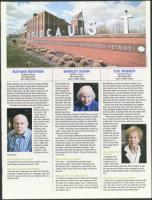

-** 4 ea& EGENE KRAFT
MAO HAPLAYTAII ORGANIZATION
NATHAN ROSTKER
OF
METROPOLITAA
SHIRLEY RADIN
DETROIT
EVA WIMMER
Portrait of Honor
West Bloomfield
Born 1928, Poland
Portrait of Honor
West Bloomfield
Born in 1928, Poland
Portrait of Honor
West Bloomfield
Born in 1926, Poland
Nathan Rostker was the only one of eight siblings
to survive World War II, along with his father, who
was killed six months later by an anti-Semitic
Polish organization. Rostker wears a tattoo on his
forearm to commemorate his father. During the
war, he fled the Lomza ghetto and hid in the for-
est before joining the Partisans. He lived in Israel
and later in New York before moving to the Detroit
area. He has three sons and seven grandchildren.
"The Nazis were taking Jews out of their homes,"
he said. "My
mother told me to
run, which I did.
I never saw my
mother again. I
was later captured.
Me and other Jews
were put into a
cattle car. As the
Germans were
closing the door
of the cattle car,
I ran out. I fled
to the forest and
was in hiding since
Nov. 2,1942, the
liquidation of the
Lomza ghetto.
I joined up with
Partisans while in
the woods."
Shirley Radin was
one of the many
"hidden children"
who escaped the
Nazis with the help
of non-Jews who
gave them housing
and protected their
identities. She was
the only one of five
siblings to survive,
along with her
parents and a few
cousins. She came to Detroit in 1947 to join an aunt
and uncle living here. Radin had blond hair and blue
eyes, which enabled her to pass as a Gentile. She
was confronted by German soldiers on three differ-
ent occasions, and each time she was allowed to go
free. She has two children and two grandchildren.
"In 1942, my brother was rounded up to work in a
'labor' camp, which turned out to be Auschwitz. He
was never heard from again.
"One of my teachers offered to hide me in her
home for money. She later denounced my family. I
then went to a children's home for disadvantaged
children for safety. One day the Germans came
looking for Jewish children. I had blond hair and
blue eyes. I was sent to answer the door. I was
standing next to the Gestapo, but stayed calm as
they spoke with the director. The war finally came
to an end."
Eva Wimmer and her five sisters started out in
the Lodz ghetto, where they were separated from
their parents, who did not survive the war. When
they were taken to Auschwitz in 1944, the sisters
were allowed to remain together instead of being
killed or separated because the Germans were
unaware they were siblings. They were moments
away from the gas chamber when they were sent to
Ravensbruck to work in an ammunition factory.
By the time they were liberated by the Swedish
Red Cross, they were little more than skeletons.
Their youngest brother, Bendet, who also survived,
met his sisters in Sweden after the war, where they
lived for nine years before coming to the U.S.
"There were moments suffering, no warm cloth-
ing, no food, day after day. We worked 12 hours
a day, from 6 a.m. to 6 p.m., with only a piece of
bread in the morn-
ing and a little bit
of soup at night.
Sometimes we
would find a potato
in the soup. For six
years, we suffered.
How did we sur-
vive? It must have
been some kind of
miracle."
! ,414- fr-,-. 1ped him suri'
"I wanted to live to see the end of Hitler and see
the Germans lose the war, which I did."
What helped her 7°qrvivo
Message for future generations,
"Don't go easy. They broke our spirit, but still take
someone or others with you if it happens again. But
I can't tell anyone what to do; everybody works in a
different way."
"My looks — I had blond hair and blue eyes. I
was able to walk in the streets of Brussels and
the Gestapo never stopped me, suspecting I was
Jewish. Also, it was 'in me' to be calm, in order to
survive."
Message for future general'
"If someone reminds you of a Hitler, don't let them
get to the point where Hitler got. Always be mind-
ful. Never let it happen again, never. It affects your
life if you think about it too much. I lost my 19-year-
old brother. He was a nice, healthy and good-looking
boy. What a loss."
What helped he
survive?
"I hoped to find
my relatives, and
I hoped to live in
a free country. We
said to ourselves at the time, there must be a rea-
son why we are still here, why we weren't sent to
the gas chamber. Maybe there is something to live
for.
Message for fut— --nerations -
"i hope that no generation experiences what we did.
All people should live in a free country such as we
do in the USA. It hurts me to see that there are the
KKK and people who deny the Holocaust. How can
they say such ignorant and painful things?"