

WAS YOUR
FAMILY'S
PROPERTY
TAKEN DURING
THE HOLOCAUST?
If you or your family owned
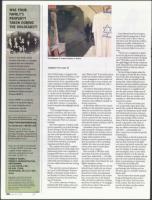
The Museum of Jewish History in Girona
movable, immovable, or intangible
property that was confiscated,
looted or forcibly sold in
Judaism from page 32
countries governed or occupied
by the Nazi forces or Axis
powers during the Holocaust era,
and you or your relatives
received no restitution for that
property after the Holocaust era,
you may be eligible to participate
in the Holocaust Era Asset
Restitution Taskforce project
(Project HEART).
Project HEART is a nonprofit
initiative of the Jewish Agency
for Israel, funded by and in
cooperation with the
Government of Israel.
For more information or to
download the Questionnaire, visit
http://www.heartwebsite.org
or call to11-free 1-800-584-1559
between 9 a.m. and 6 p.m.,
Eastern Standard Time, Sunday
through Thursday, except.Jewish
Holidays, and the Questionnaire
will be mailed to you.
If you do not wish to be included
in Project HEART, you must send
a signed written request for
exclusion postmarked no later
than June 1 5, 201 I, to
PROJECT HEART,
PROJECT ADMINISTRATOR,
EXCLUSIONS,
ao A.B. DATA, LTD.,
PO BOX 170700,
MILWAUKEE, WI 53217-8091,
U.S.A.
Photographs: Gift of Ruth Mermelstein,
Yaffa Eliach Collection donated by the
Center for Holocaust Studies, Museum of
Jewish Heritage, New York, U.S.A. Gift of
Eric S. Morley, Museum of Jewish Heritage,
New York, U.S.A. Gift of Ronnie Hamburger
Burrows, Museum of Jewish Heritage,
New York, U.S.A.
1668800
34
April 21 2011
B'nai B'rith Europe co-organizes the
European Day of Jewish Culture, is run
in the typical manner of European
bureaucracies. It has a presidency that
rotates among its members and glossy,
full-color brochures printed on heavy
stock. The network encompasses large
cities such as Toledo, which already
is a major tourist destination, and
smaller towns like Besalu and Caceres,
which aspire to be. More recently it
established a tourist brand, Rasgo,
to help direct visitors to restaurants,
hotels and guides that highlight Jewish
heritage.
"That heritage belongs to every
citizen:' said Hosta, who also is the
general secretary of Red de Juderias.
"It doesn't belong to a single part of
the community. That's our common
heritage."
But some segments of Spain's small
Jewish community say Jewish heritage
doesn't belong to the descendants of
those who expelled the Jews 500 years
ago, but to the Spanish Jewish com-
munity of today — even if the bulk of
the country's Jews are relatively recent
arrivals from elsewhere, principally
Argentina and North Africa.
They contend that Spain is exploit-
ing Jewish history for profit while often
minimizing Spain's own culpability in
bringing that history to an abrupt end.
The museums and conferences and
concerts and cooking demonstrations
collectively present Judaism as a kind
of ersatz culture divorced from a living
faith.
"The way they represent Judaism is
very poor," said Dominique Tomasov
Blinder, a Barcelona-based architect
and founder of Urban Cultours, a tour
company focused on the Jewish heri-
tage of Catalonia.
"It's a sterile collection of objects,
displayed like little trophies, that were
rescued from the flood of the expul-
sion," Blinder said. "If we had not been
kicked out, all these objects would be
in our synagogues, in our yeshivot, in
our study centers, in our schools, our
homes. And they would have a life, a
purpose to be."
As evidence that Spain's priorities
are misplaced, critics of the country's
approach to Jewish heritage note that
while much enthusiasm exists for cul-
tural festivals and the like, local gov-
ernments seem willing to trample on
Jewish cemeteries.
In Barcelona, efforts to erect tourist
facilities on the old Jewish cemetery on
Mont Juic were halted, but only after
a battle. In Toledo, once the epicenter
of Jewish life in Spain, the construc-
tion of a school over the remains of a
medieval Jewish cemetery sparked an
international uproar, leading in 2009 to
an uneasy compromise.
Meanwhile, surveys show that Spain
ranks among the European countries
with the highest anti-Semitic metrics.
A 2002 study by the Anti-Defamation
League asked residents of five
European countries questions about
their perceptions of Jews, including
whether Jews have too much power
and are more loyal to Israel. Spain
topped in every category.
More recently, a 2008 Pew study
found that 46 percent of Spaniards
viewed Jews unfavorably — the high-
est number in Europe and 10 percent-
age points higher than Poland, the next
highest European country.
Diego de Ojeda, the director of Casa
Sefarad-Israel, chalks this up to basic
ignorance: Because there are so few
Spanish Jews today, most Spaniards
have never encountered a Jew in their
lives. In an interview in his Madrid
office, de Ojeda recalled once asking a
taxi driver to take him to "la sinagoga,"
and the driver asked if that was the
name of a new restaurant.
Casa-Sefarad Israel has brought a
popular Spanish pop group to Israel
for a concert and to film a video in
the desert near the Dead Sea and has
helped start public celebrations of
Chanukah in Madrid, something the
local community failed to do on its
own.
"There's not a conspiracy in Spain
to say let's dig out our Jewish past so
we can milk Jewish tourists:' de Ojeda
said. "That's also a part of it. But it's
the right thing to do. We do it with our
Arab culture. We do it with our Roman
remains. We do it with any archaeo-
logical remains."
For Jews living in Spain today, the
few vestiges of Jewish life that remain
are of more than archaeological sig-
nificance. They are tangible manifes-
tations that a vital community once
lived here and help establish continuity
between that community and the one
that has begun to re-establish itself
over the past century. Today, most of
the country's Jews live in Barcelona or
Madrid, and there are smaller com-
munities in a half-dozen other spots
around the country.
Critics of Girona and similar proj-
ects are generally vague about what
exactly they would do differently. They
recognize the limitations under which
well-intentioned non-Jews seeking to
preserve Jewish heritage are operating,
given that virtually all the member
cities of Red de Juderias have no local
Jewish communities with which to
consult. And they acknowledge that
they are relative newcomers to Spain,
with little — and arguably less —
direct connection to medieval Spanish
communities.
David Stoleru, a French-Israeli archi-
tect living in Spain for nearly 15 years
who has been involved in the fights
over preserving Jewish cemeteries, says
the real question is not who owns his-
tory, but whether it is made relevant
and meaningful. And at a time when
European identity is in flux and the
continent continues to grapple with the
place of restive minority populations,
Spain is squandering an opportunity
to learn from its Jewish past.
"When Spaniards tell you it's their
own heritage after kicking out Jews
500 years ago, it's a complex situation:'
Stoleru said.
"But of course those Jewish people
living and dying here, they weren't
living on the moon. They were part
of this context. The idea is how to re-
inscribe this history in this context.
That is the challenge." L