

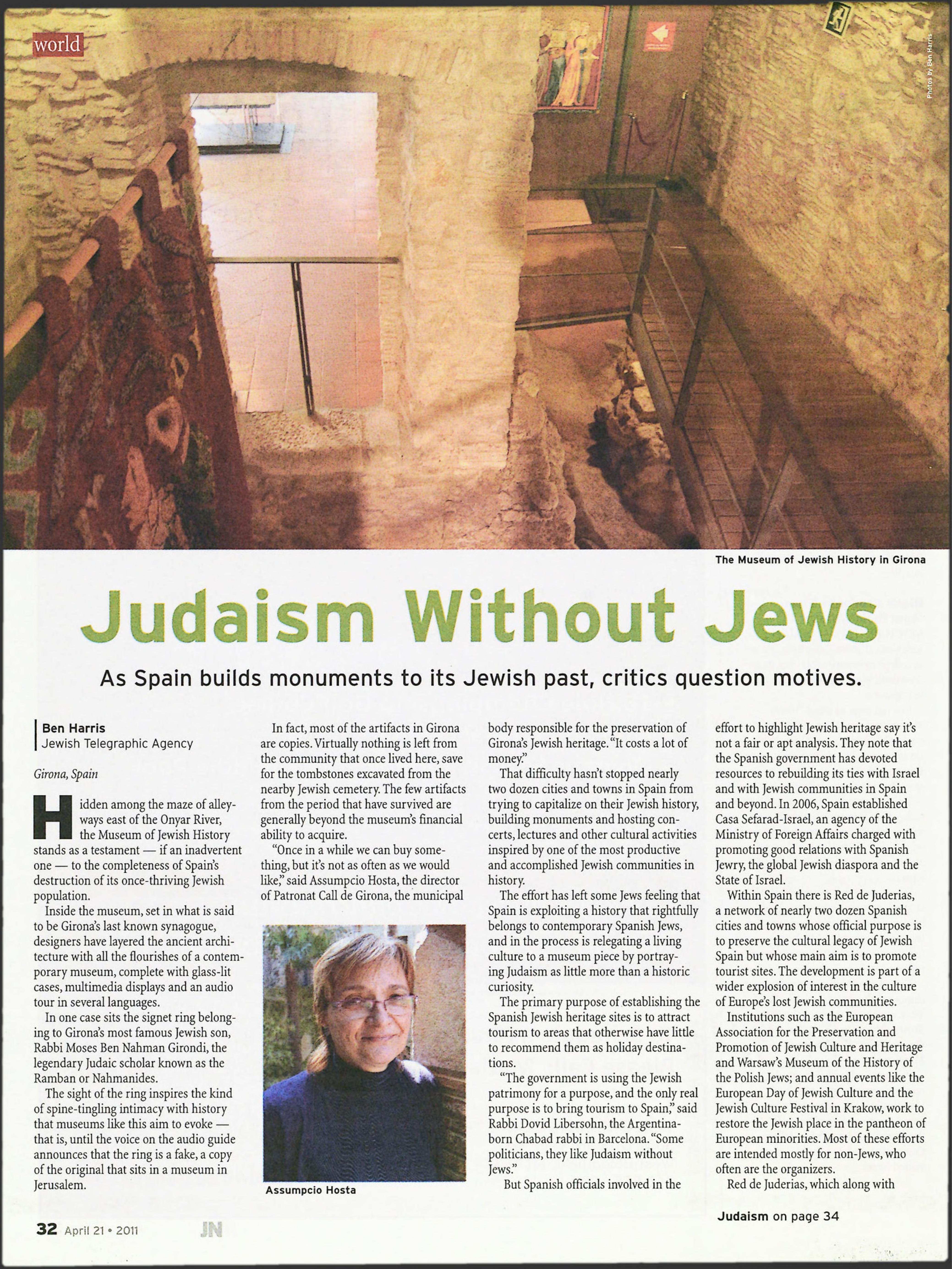
The Museum of Jewish History in Girona
Judaism Without Jews
As Spain builds monuments to its Jewish past, critics question motives.
Ben Harris
Jewish Telegraphic Agency
Girona, Spain
H
idden among the maze of alley-
ways east of the Onyar River,
the Museum of Jewish History
stands as a testament — if an inadvertent
one — to the completeness of Spain's
destruction of its once-thriving Jewish
population.
Inside the museum, set in what is said
to be Girona's last known synagogue,
designers have layered the ancient archi-
tecture with all the flourishes of a contem-
porary museum, complete with glass-lit
cases, multimedia displays and an audio
tour in several languages.
In one case sits the signet ring belong-
ing to Girona's most famous Jewish son,
Rabbi Moses Ben Nahman Girondi, the
legendary Judaic scholar known as the
Ramban or Nahmanides.
The sight of the ring inspires the kind
of spine-tingling intimacy with history
that museums like this aim to evoke —
that is, until the voice on the audio guide
announces that the ring is a fake, a copy
of the original that sits in a museum in
Jerusalem.
32
In fact, most of the artifacts in Girona
are copies. Virtually nothing is left from
the community that once lived here, save
for the tombstones excavated from the
nearby Jewish cemetery. The few artifacts
from the period that have survived are
generally beyond the museum's financial
ability to acquire.
"Once in a while we can buy some-
thing, but it's not as often as we would
like," said Assumpcio Hosta, the director
of Patronat Call de Girona, the municipal
Assumpcio Hosta
body responsible for the preservation of
Girona's Jewish heritage. "It costs a lot of
money."
That difficulty hasn't stopped nearly
two dozen cities and towns in Spain from
trying to capitalize on their Jewish history,
building monuments and hosting con-
certs, lectures and other cultural activities
inspired by one of the most productive
and accomplished Jewish communities in
history.
The effort has left some Jews feeling that
Spain is exploiting a history that rightfully
belongs to contemporary Spanish Jews,
and in the process is relegating a living
culture to a museum piece by portray-
ing Judaism as little more than a historic
curiosity.
The primary purpose of establishing the
Spanish Jewish heritage sites is to attract
tourism to areas that otherwise have little
to recommend them as holiday destina-
tions.
"The government is using the Jewish
patrimony for a purpose, and the only real
purpose is to bring tourism to Spain," said
Rabbi Dovid Libersohn, the Argentina-
born Chabad rabbi in Barcelona. "Some
politicians, they like Judaism without
Jews."
But Spanish officials involved in the
effort to highlight Jewish heritage say it's
not a fair or apt analysis. They note that
the Spanish government has devoted
resources to rebuilding its ties with Israel
and with Jewish communities in Spain
and beyond. In 2006, Spain established
Casa Sefarad-Israel, an agency of the
Ministry of Foreign Affairs charged with
promoting good relations with Spanish
Jewry, the global Jewish diaspora and the
State of Israel.
Within Spain there is Red de Juderias,
a network of nearly two dozen Spanish
cities and towns whose official purpose is
to preserve the cultural legacy of Jewish
Spain but whose main aim is to promote
tourist sites. The development is part of a
wider explosion of interest in the culture
of Europe's lost Jewish communities.
Institutions such as the European
Association for the Preservation and
Promotion of Jewish Culture and Heritage
and Warsaw's Museum of the History of
the Polish Jews; and annual events like the
European Day of Jewish Culture and the
Jewish Culture Festival in Krakow, work to
restore the Jewish place in the pantheon of
European minorities. Most of these efforts
are intended mostly for non-Jews, who
often are the organizers.
Red de Juderias, which along with
Judaism on page 34
April 21 . 2011