

World
Single-Minded
Wasserman Schultz brings Jewish identity to top party role.
Ron Kampeas
Jewish Telegraphic Agency
-
Washington
D
ebbie Wasserman Schultz's first
day as a sophomore in the U.S.
House of Representatives, on
Jan. 8, 2007, was marked by a number of
extraordinary achievements for a woman
barely out of her first term:
• Named to the Democratic caucus lead-
ership.
• Named to the all-powerful
Appropriations Committee.
• Named as a major fundraiser — $17
million — for the party's breakthrough
2006 election.
• Named by a tabloid as one of the 50
most beautiful people on Capitol Hill.
Yet dominating her victory party were
blow-ups of headlines from Jewish news-
papers: Wasserman Schultz had led the
passage of the act establishing Jewish
American Heritage Month.
President Obama this month named
Wasserman Schultz, D-Fla., 44, to the most
powerful party position, chairwoman of
the Democratic National Committee. Even
before she has formally assumed the job,
the question of her Jewish identity has
stirred speculation.
Jewish Democrats say Obama's choice
of a successor to former Virginia Gov. Tim
Kaine in the top party fundraising spot is
a signal of Obama's commitment to a loyal
constituency: the Jews.
"I guarantee you that her being a
woman played a role in the choice. I guar-
antee you that her being from Florida
played a role," said David Harris, presi-
dent of the National Jewish Democratic
Council. "But I also guarantee you that her
being Jewish played a role."
The question remains open of what role,
if any, Wasserman Schultz's Judaism will
play as she leads the Democratic Party
into the 2012 elections, when it hopes to
re-elect Obama, maintain the majority
in the Senate and erode the Republican
majority in the House. Wasserman Schultz
declined to be interviewed for this story.
"She is so, so excited to be Jewish," said
Shelley Rood, who worked as a legislative
assistant in Wasserman Schultz's office
and is now a senior legislative associate at
the Jewish Federations of North America.
"She really enjoys working with Jewish
organizations because she believes their
priorities for America are right on."
Wasserman Schultz arrived at politics
through Jewish activism, which has been
a centerpiece of her career. The same year
26
April 21
2011
Wasserman Schultz from the American
-" , 0 Israel Public Affairs Committee and from
the Jewish Federations of North America.
Neither organization is prone to praise
promotions to hyperpolitical jobs, so the
C: mere issuance of the statements was a
12 clear establishment message to the RJC to
pipe down.
As for Wasserman Schultz, she's not
afraid to take hard shots. Last October,
appearing on "Fox News Sunday" with
Rep. Eric Cantor (R-Va.), then the minor-
ity whip and the only Republican Jewish
lawmaker in Congress, she chided him for
not repudiating a Republican candidate in
Ohio who had dressed up in Nazi regalia
for SS re-enactments.
Cantor repudiated the candidate, and
then Wasserman Schultz suggested he was
succumbing to her on-air pressure.
"You know good and well that I don't
support anything like that',' an annoyed
Cantor said.
Off the record, Jewish leaders say
Wasserman Schultz will ratchet up the
pressure on the Jewish establishment
to back Democratic initiatives. Eric
Golub, a Jewish blogger for the conser-
vative Washington Times, calls her the
Democrats' "Jew shrew" because of her
partisanship.
Rood, her former staffer, ridicules such
slurs.
"She enjoys working with the other
side," she said. "But she's in the leadership,
so, of course, she's going to be partisan."
Carusone, Rood and others also cited
Wasserman Schultz as an example of a
lawmaker able to balance a career with a
young family. Wasserman Schultz often
can be seen walking around Capitol Hill,
one of her three young children by her
side, chatting animatedly. She has said
many times that she would not be able to
pull it off without her husband.
Wasserman Schultz's frankness about
the difficulties of juggling parenthood and
a career made her a natural party spokes-
man for women in the 2008 and 2010 cam-
paigns, and she often refers to her children
in explaining her support for reforming
health care and attacking poverty
"She's a mother of young children, so
she gets the balancing:' said Carol Brick
Turin, the director of the Miami-area
Jewish Community Relations Council.
That openness made it all the more
shocking when she revealed in March
2009 that she had battled, and defeated,
breast cancer. Associates say that's typical
of a woman who has managed a highly
public career while maintaining an intense
privacy around her family. 1_i
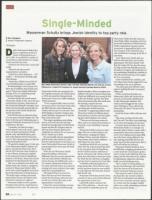
Rep. Debbie Wasserman Schultz, right, with Rep. Gabrielle Giffords, left, and Sen. Kirsten
Gillibrand at a Capitol Hill reception for Jewish American Heritage Month in 2009.
Wasserman Schultz was running for her
first legislative position, the Florida House
in 1992, she joined the National Jewish
Democratic Council as a staffer leading its
Florida operation.
"It was a regional office where you had
one person on her own:' Steve Gutow, then
the NJDC director, said of Wasserman
Schultz, who was just 25 at the time. "But
all the things we wanted to happen, hap-
pened. She had a strong sense of self; she
had a mind of her own."
That single-mindedness and willing-
ness to work with what she had shep-
herded her through stints in both Florida
houses and then for Congress after her
old boss, Peter Deutsch, quit his Fort
Lauderdale-area district for an unsuccess-
ful U.S. Senate run in 2004.
She won handily and was immediately
picked by Rep. Nancy Pelosi (D-Calif.),
then the minority leader in the House, as a
leader. Pelosi asked Wasserman Schultz to
push potential first-timers past the finish
line in 2006.
That's the year Wasserman Schultz
formed friendships with Kirsten
Gillibrand, who won a seat in upstate New
York, and with Gabrielle Giffords, who
won an Arizona seat (Gillibrand is now a
U.S. senator). Wasserman Schultz's tire-
less work with both women was critical to
winning both races in districts that might
easily have swung Republican.
That helped Democrats sweep the
House that year and won Wasserman
Schultz the chief deputy whip job in her
second term and the plum spot on the
Appropriations Committee.
It also led to close friendships and regu-
lar lunches for the three relatively young
female lawmakers. When an assailant shot
Giffords in the head in January, Wasserman
Schultz and Gillibrand were among the first
to fly to her bedside, and they were there
when she pronounced her first words since
the shooting: a request for toast.
Giffords' chief of staff, Pia Carusone,
says Wasserman Schultz has been
"invaluable" in supporting Gifford's staff.
Wasserman Schulz and Giffords shared
many interests, Carusone said, but explor-
ing their shared Judaism was critical.
"There are not that many women in
office, and not so many Jewish women, so
it has been a nice friendship," Carusone
told JTA.
Wasserman Schultz is seen as a team
player. She was a strident leader in the
2008 primary campaign for Hillary
Rodham Clinton, and easily shifted to
Team Obama when Clinton withdrew — a
shift Obama has now repaid.
Republicans deride her as a partisan.
Hours after the announcement that she'd
be the next party chair, the Republican
Jewish Coalition issued a statement cit-
ing her connection with J Street, a liberal
group that calls itself pro-Israel, pro-peace
but which the RJC describes as marginal
and anti-Israel, to question her bona fides.
"In blindly conferring legitimacy on
fringe groups like J Street, she has raised
serious questions about her own credibil-
ity and judgment:' RJC Executive Director
Matt Brooks said.
Wasserman Schultz has praised J Street
a handful of times, and she had addressed
the organization at least once.
Capitol Hill insiders dismissed the
flap as RJC politicking — Brooks' state-
ment resulted in immediate praise for