

•
metro
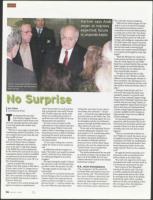
Kurtzer says Arab
anger at regimes
expected; future
is unpredictable.
Former Ambassador Daniel Kurtzer
answers questions from Detroiters
after his talk.
No Surpr sot
Don Cohen
Contributing Writer
T
hey happened because they
were bound to happen," former
Ambassador Daniel Kurtzer said
about the uprisings that have taken place
in one Arab nation after another since
January 2010.
"We knew it was a region of some kind
of simmering cauldron of problems. It was
not a surprise that at some time this caul-
dron would boil over."
Speaking to almost 500 people on his
first visit to Detroit, Kurtzer displayed
considerable diplomatic and academic
savvy in his April 14 talk about changes
in the Middle East and the implications
for the United States and Israel. His talk at
Congregation Shaarey Zedek in Southfield
was sponsored by the Jewish Federation
of Metropolitan Detroit as a kick-off to its
2011 Annual Campaign.
Kurtzer, a former dean of Yeshiva
College in New York, retired in 2005 after a
29-year career in the U.S. Foreign Service
that included serving as U.S. ambassador
to Israel (2001-2005) and Egypt (1997-
2001). He is currently a lecturer and pro-
fessor in Middle Eastern policy studies at
Princeton University.
One reason for the turmoil among Arab
regimes is resistance to globalization,
14
21 2011
aiN
which "has provided so much economic
and social growth to the world:' Kurtzer
said. "Outside of gas and oil, the world
doesn't use anything they produce." A
result has been a lack of jobs for the rap-
idly growing Arab population.
He cited a series of studies in 2005
undertaken by Arab academics that iden-
tified three major "deficits" in the Arab
world: a deficit of knowledge due to poor
educational practices, a deficit of freedom
preventing free speech and association
and "political space and a deficit of wom-
en's empowerment.
"It's not a glass ceiling, but a concrete
ceiling" for women in Arab countries, he
said.
He added that with the exception of
Egypt, "the borders were made by colonial
powers:' which has led to family dynas-
ties and being "plagued by succession
struggles."
The anger among the people is "almost
like a pressure cooker, but there has been
no valve to relieve the pressure he said.
"The angry people are also angry edu-
cated people:'
He said they've seen China develop and
host the Olympics; they've seen how Israel
"involves itself in the world and how its
leaders are held accountable in a society
governed by law" — and they wonder why
they can't. While the Arab nations have
declined for more than 30 years, they've
seen Turkey, Iran and Israel — all non-
Arab — become the most influential and
powerful nations in the Middle East. This
has resulted in declining support for secu-
lar nationalism and the rise of Islamism
expressed through Hezbollah, Hamas and
other radical non-state actors.
"We are only at the beginning:' Kurtzer
cautioned, likening the situation to the
early rounds of a 15-round boxing match.
He said the contestants in Egypt are
the military, the Muslim Brotherhood,
the remnants of Mubarak's National
Democratic Party and the Tahrir Square
protesters who were the catalyst but who
"haven't found a way to marshal their
resources into a movement:'
"The Muslim Brotherhood has one goal:
to establish an Islamic state in Egypt and
then in all of the Middle East:' he said.
"Hamas calls itself a branch of the Muslim
Brotherhood of Egypt."
U.S., Israel Consequences
"The consequences [of the unrest] for
the United States and Israel are very, very
severe Kurtzer said. "The United States
has a sense of being on a democratic mis-
sion. We want to be a model, and even a
catalyst, for what people do elsewhere
But, he added, U.S. support for democrati-
zation is in tension, some would say con-
fl ict, with other American interests.
While Kurtzer believes Egypt will con-
clude it is not in its interest to abrogate
it, the Egyptian-Israeli peace treaty, a
cornerstone of American Mideast policy,
is in play. Also at risk is the "very impor-
tant role" Egypt has played in the Israel-
Palestinian peace process as well as the
strategic and intelligence cooperation with
the United States that impacts American
troops in Afghanistan and Iraq. Progress
also has been made in moving Egypt
towards a free market economy though it
is "corrupted and besieged by crony capi-
talism."
"That's the dilemma our country has
to deal with in just this one situation, let
alone the whole region:' he said. While
Egypt has a national identity that can help
keep it together, he noted that Bahrain,
Syria and Libya do not, making for even
more unpredictable outcomes.
"Our past involvement has no influ-
ence today:' he said. "We have very little
influence in determining the outcome of
these revolutions. The uprisings are very
nationalistic in orientation and they won't
take kindly to American dictates, ideas or
plans."
Turning to Israel, Kurtzer said, "It is
never truer than today that Israel is sur-
rounded by enemies." As proof, he cited
Hamas in Gaza, Lebanon's "puppet strings
being pulled by Hezbollah," and Syria's close
relations with Iran and using "Lebanon as
a proxy battlefront" against Israel. On top of
that, he said, Iran is an "existential threat"
to Israel, seeking "regional hegemony and
a nuclear capability,' and the situation in
Egypt presents "some very, very difficult
security challenges:'
He expressed understanding, but not
agreement, with the position that "in the
environment of uncertainty, and the envi-
ronment of threat, it is time [for Israel]
to hunker down and wait and see what
happens."
"There is a second side of debate he
said. "Maybe it is exactly the time to try to
accomplish the partition of Eretz Yisrael,"
saying that even before the establishment
of Israel, Zionist and Israeli leaders "have
found [sharing the land] to be the only
viable solution if there is to be a solution
at all."
He urged the Jewish community to be
informed in order to be involved in the
political debate in the United States.
"You need to be supportive of the types
of programs that make Israel feel secure in
a very unsecure environment:' he said.
Patty Ceresnie of West Bloomfield,
reacting to the speech, said, "The issue
is terribly complicated with all the dif-
ferent opinions and options. But I think
he underplayed the threat of the Muslim
Brotherhood, which will be a problem
whatever role they end up playing. If they
take over Egypt, where does that leave
Israel and the peace accords?"
•