

metro >> on the cover
In The Rough from page 1
tax court, to appeal for a reduction
in their property tax assessments.
According to the tribunal's chief clerk,
Peter Kopke, there's no record of Franklin
Hills filing a similar appeal.
Tarn-O-Shanter, recently purchased by
Sheldon Yellen of West Bloomfield, won a
consent judgment dated Feb. 14; it ordered
West Bloomfield Township to significantly
lower the club's tax bill. Yellen, chief execu-
tive officer of Birmingham-based
Belfor
-
USA Group Inc., part of the world's larg-
est disaster restoration company, did not
respond to our request for an interview;
but according to Michigan Tax Tribunal
documents, Tam-O-Shanter's assessed
value was lowered from $5.6 million to
$3.3 million for 2008; $4.8 million to $2
million for 2009; and $4.7 million to $1.75
million for 2010. Those figures represent
50 percent of what's considered the club's
"true cash value," which now sits at $3.5
million.
"The Township of West Bloomfield has
been so off base with these Jewish clubs
that it's abominable," says Myles Hoffert,
a tax attorney with the Farmington Hills-
based firm Hoffert & Associates. He's also
a longtime Knollwood member.
Hoffert is representing Knollwood in
front of the tax tribunal in a dispute that
has dragged on for at least 10 years. The
club is challenging its assessments all the
way back to 2001.
"There are improprieties — and that's
for homeowners, too:' Hoffert continued.
"[The township] can set any number
they want based on formulas they think
are reasonable and then, when you go to
trial, it ain't so reasonable. They're not
being fair in my opinion."
Hoffert believes Knollwood's assessed
value (about $5.75 million for 2010) is
"five times too high" and should be closer
to $1.4 million. In court filings, he wrote,
"Present economic conditions in the state
of Michigan have created a multitude of
appeals by golf courses. This reflects the
dour financial condition of these entities
in Michigan."
West Bloomfield Township attorney
Dirk Beckerleg and assessor Lisa Hobart
declined to comment "because of pend-
ing litigation."
On top of the ongoing legal battle,
Hoffert says a paperwork error led to
Knollwood's name being published on a
list of "delinquent tax parcels subject to
foreclosure" in a December edition of the
Oakland Press. Because of Knollwood's
pending tax case, the club should not
have been on that list.
"We withdrew the certificate of forfei-
ture as soon as we were advised they'd
been taken up by the Tax Tribunal:' said
Oakland County Treasurer Andy Meisner.
"It's under appeal. So if the Tax Tribunal
does not agree with them and does not
accommodate their request, any delin-
quent taxes would be owed."
10
April 21 . 2011
JN
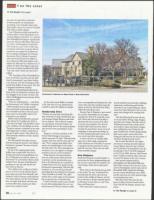
Knollwood's clubhouse on Maple Road in West Bloomfield
On the other hand, Hoffert contends
if the club wins its case, Knollwood is
entitled to about $1 million in refunds.
Membership Drive
"It blows me away that something like
this could take so long:' Knollwood's gen-
eral manager Randy Burgess said about
the tax dispute. "But it doesn't hamper
our operations; it doesn't hamper our
membership drive or the many programs
and services we're providing for mem-
bers?'
Burgess is a former president of the
Detroit Club Managers Association,
which represents 53 clubs. "Nobody today
charges what they did five years ago:' he
said. "We've changed and added more
variety of memberships for the under-
40s and under-30s. Those strategies are
necessary so we can appeal to younger
members and our current members?'
While Burgess and representatives
from the other private clubs declined
to provide current membership num-
bers or fee information, he is quoted in
a 2009 Detroit Free Press article saying
Knollwood's membership "fell from 400
members to 310 over the past decade"
and added that the initiation fee dropped
"from $55,000 to $15,000." The club's
website lists a wide range of fees depend-
ing on age and type of membership.
A Tam-O-Shanter insider says monthly
fees for full memberships there are cur-
rently frozen at $750 per month, in addi-
tion to an unpublicized initiation fee. The
source also says Tam members have the
option to buy the club back from Yellen
within the next three years.
Because Tam-O-Shanter is now owned
by a private shareholder, it's no longer
considered a 501(c)(7) nonprofit social
club. That's why Tam has been able to
advertise this year as part of its effort
to recruit new members. The club on
Orchard Lake Road has been closed
recently for renovations. In its recent ad
campaign, it touts gourmet dining, an
18-hole championship golf course, a fit-
ness center and other amenities.
A source with ties to Franklin Hills
says even in this tough economy, the
club's initiation fee is $65,000; 10 percent
is required up front and the fee can be
paid off over time. There also are addi-
tional monthly charges.
New Ballgame
Knollwood has gone to great lengths to
restructure its hours, programming and
the services it provides for members. It's
a fact Burgess talks about enthusiasti-
cally.
"Most clubs in the Detroit area go dark
in the winter:' he says. "Knollwood has
basically kept the doors open all year
round. In the middle of January, we had
bocce ball and an Italian-themed dinner;
in February, we had what we call, 'Wine,
Dine and Wintertime.
"We've also had a steady stream of
private member functions like weddings,
anniversary celebrations and bar/bat
mitzvahs in our Grand Ballroom, which
seats more than 500 guests. We try to do
more, even though we're working with
less?'
The club offered golf lessons all win-
ter on an indoor driving range. Burgess
says there are women who play cards at
Knollwood several days a week, the fit-
ness center is open, and there's a happy
hour celebration every Friday for the
guys. Knollwood's 18-hole championship
golf course, tennis courts and swim-
ming pool will soon be the focal point of
activities during the peak season.
But it seems the hits for our region
just keep on coming. Recently released
census figures show the city of Detroit
lost 25 percent of its population over the
last decade (713,777 in 2010 compared
to 951,270 in 2000). Back in 1950, Detroit
had 1.8 million residents. More than one
in every five homes in the city is vacant.
Even upscale suburbs such as
Birmingham and Bloomfield Hills saw
their home vacancy rates rise (to 9.4 per-
cent for Birmingham and 10.2 percent for
Bloomfield Hills). Statewide, Michigan
has lost nearly 860,000 jobs since 2000;
and the state has one of the nation's high-
est unemployment rates.
What does all of this mean for the
future of Metro Detroit's Jewish clubs?
Time will tell; but Burgess remains opti-
mistic.
In The Rough on page 12