
MEP On The Cover
Passover Of Freedom from page 10
managed to do it because of a connection I
had. But then I never saw the money."
In his first few years in America, Kebede
worked at various jobs — for a while on a
GM assembly line — all the while attending
college, graduating from Oakland University
with a degree in business in 1977. While in
graduate school there, he was offered a job
selling insurance.
"That was 33 years ago:' he said. "I became
their biggest producer and am licensed in 30
states:'
He now is an independent broker and
financial consultant in Bingham Farms. His
younger daughter, Ellene, joined him in the
business this past June.
During the years Kebede was in college,
small groups of Jews were beginning to flee
to refugee villages in Sudan, which borders
Ethiopia.
Government officials confiscated Hebrew
books, closed Jewish schools and syna-
gogues and forbade the practice of Judaism.
In 1984, mass famine spurred the
Ethiopian government to request aid from
other countries, including Israel, who
allowed the immigration of Ethiopian Jews
— also referred to as Beta Israel — if they
could get there.
Israeli operatives arranged to smuggle out
Jews who could make their way to Sudan.
Thousands of Ethiopians journeyed by foot
to refugee villages in deplorable conditions
in hopes of being transported to Israel. It is
estimated as many as 4,000 died along the
way or in the camps, of disease or hunger or
were killed by bandits.
About 8,000 of those who arrived in
the Sudan were taken to Israel between
November 1984 and January 1985 during
"Operation Moses:' a cooperative effort of
Israel, the United States and the Sudanese
State Security Forces.
In 1985, Operation Joshua, a CIA-
sponsored mission, brought out 800
more Jews and, in 1991, during Operation
Solomon, more than 14,000 Jews came to
Israel in a day-and-a-half on continuous
flights provided by Israeli Air Force and El
Al airplanes.
Ethiopian Jewish Population
"There are an estimated 125,000 Ethiopian
Jews in Israel, which includes those who
migrated and those who were born there
said Dr. Teshome Wagaw, professor emeritus
of education and AfroAmerican and African
Studies at University of Michigan.
Although not Jewish, Wagaw came from
an area of the country populated by many
Jews.
"Most Ethiopian Jews are in Israel," said
Wagaw, author of For Our Soul: Ethiopian
Jews in Israel.
Those who live in Israel reside under the
country's Law of Return, giving Jews and
those with Jewish parents or grandparents
and all of their spouses the right to settle
there and obtain citizenship.
Merely 1,000 Ethiopian Jews are thought
12
to live in America.
"There is a very small community of
Ethiopian Jews living in the United States,
and a very, very small one in Metro Detroit:'
Wagaw said.
In fact, Kebede knows of none, other than
his own brother, Wondwossen, who lives in
Farmington Hills.
"Outside of Israel, the group tends to not
identify as Ethiopian Jews, just as Ethiopian:'
said Wagaw of Ann Arbor. "So the exact
numbers are unknown."
In Ethiopia, there are an estimated 20,000-
26,000 Falash Mura, descendants of Beta
Israel, who do not observe Jewish law or
have converted to Christianity.
This include Kebede's two sisters and their
families.
Falash Mura who have converted to
Christianity but want to return to following
Jewish law are permitted to immigrate to
Israel, although not as Jews. This enables the
Israeli government to set quotas and make
citizenship dependent on Orthodox conver-
sion.
Rooted In Judaism
"My mother's mother was a practicing Jew,"
Kebede said. "My grandfather's side was a
mix of religions. I remember how my grand-
mother prepared for Shabbat before sunset
every week.
"My mother went to Israel, to Jerusalem.
The most important thing in the lifetime of
Ethiopian Jews is to go to the land of David:'
Kebede also saw Israel.
"In 1971, before coming to America I
went:' he said. "When I got there I asked God
for forgiveness for leaving my uncle and his
business?'
In his home and office are books about
Judaism.
"I have religious books that talk about
Passover and the New Year and other Jewish
observances;' he said.
"Some explain the traditions and what
God says and about Israel."
Most of Kebede's extended family
remained in Ethiopia.
"I also had a brother there;' he said. "He
was killed by the military because they
thought he was involved with a group who
was against them."
Wondwossen came to Michigan on a
student visa in 1974. The divorced father of
two and grandfather of two remembers his
grandmother reading the Bible and praying
when he was young. Since living in America,
he has converted to Greek Orthodox. "But
my underlying belief is in the Jewish reli-
gion," he said.
Gathering On Passover
As they have done for the past 10 years or
more, Kebede and his family will attend
a Passover celebration sponsored by the
Lathrup Village-based Sholem Aleichem
Institute.
"They are beautiful people and add so
much to our organization's reason for being;'
said Alva Dworkin, president of the Secular
Humanistic group.
The casual gathering — held in a private
home with participants reading from the
group's own version of the Haggadah — is
similar in ways to the Ethiopian seder, often
marked with a communal springtime cel-
ebration with holiday-related readings shared
instead of the traditional Haggadah.
Passover traditions in Ethiopia include the
closing of businesses. Homes are cleaned and
a form of matzah called shimbera is baked
from chickpeas. Leaven, along with ferment-
ed foods and some milk products, are not
consumed.
Some follow the custom of breaking old
dishes and using new ones to symbolize a
break from the past and a new start. A pascal
sacrifice is made, with the animal roasted
and eaten. On the sixth day of the holiday
children collect treats door to door.
The holiday ends with a meal of special
dishes including kategna, fresh injera (yeast-
risen flatbread) with hot pepper sauce.
Although Kebede does not observe tradi-
tional Ethiopian Passover customs, American
Ethiopian Jews who do may decorate the
seder table with Ethiopian Jewish folk crafts,
often made in Israel.
Kebede and his family are immersed in
an American life, but he retains some tradi-
tions.
"I can cook Ethiopian food;' he said. "My
wife is excellent at it, too." His wife is not
Jewish, but Kebede said, "Judaism is in my
heart. I light candles Friday nights myself.
And we celebrate Passover. And it makes me
think about my life and what it was like in
Ethiopia and about my kids, and how they
are free."
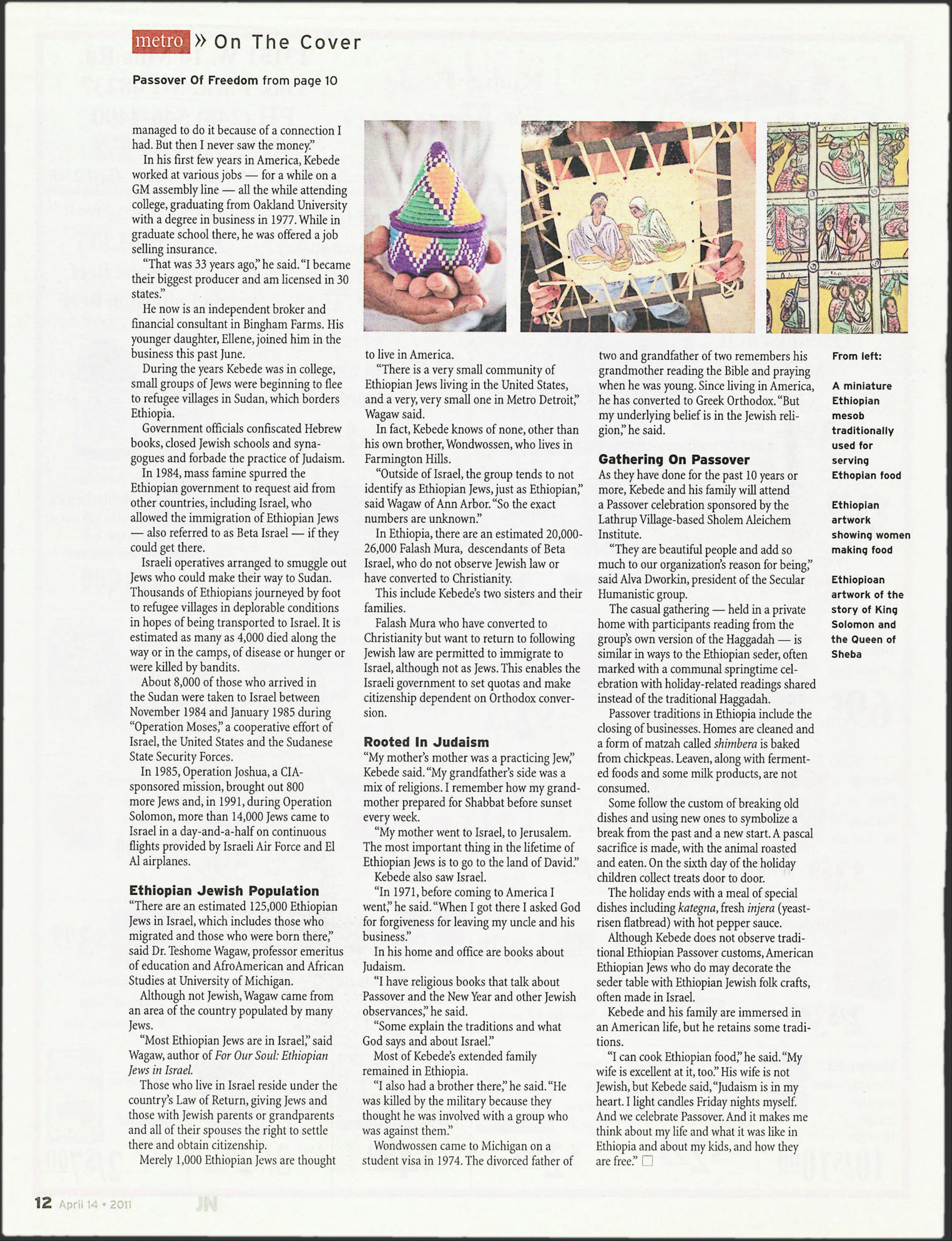
From left:
A miniature
Ethiopian
mesob
traditionally
used for
serving
Ethopian food
Ethiopian
artwork
showing women
making food
Ethiopioan
artwork of the
story of King
Solomon and
the Queen of
Sheba