
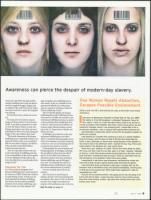

TRAFFICKING
Awareness can pierce the despair of modern-day slavery.
many years ago. When the girl's mother
sensed something was wrong, she discov-
ered her daughter drugged, wigged and
re-clothed in the mall restroom, all within
the time it took her to notice her daughter
was missing.
It's that easy to lose a loved one to slav-
ery.
For many, the word slavery conjures
images of African slaves in the American
South. To put that in perspective, a statis-
tic from the Polaris Project, an anti-traf-
ficking organization, says there are more
individuals in slavery now than during the
height of the trans-Atlantic slave trade.
"The Jewish dimension of the human
trafficking issue is especially evident as we
approach Pesach, when we are reminded
that we were slaves in Egypt:' said Robert
Cohen, Jewish Community Relation
Council executive director.
"Jews are especially sensitive not only
to the inhumanity of trafficking, but also
of our responsibility to take action against
it. We are obligated to help redeem cap-
tives who, like all of us, are all made in the
image of God."
Stemming The Tide
At U-M Law School, Bridgette Carr's
Human Trafficking Clinic, which started in
the summer of 2009, involves law students
in representing victims. In February, the
clinic launched the Human Trafficking
Law Project, the first publicly available
database of U.S. human trafficking cases.
Hopes are that use of the database will
help strengthen anti-trafficking laws in
this country. It also is a valuable tool for
government officials, law enforcement
agencies and those working on behalf of
human trafficking victims.
The U.S. law that guides anti-human
trafficking efforts, the Trafficking Victims
Protection Act of 2000, was enacted to pre-
vent human trafficking overseas, to protect
victims and help them rebuild their lives
in the U.S. and to prosecute traffickers of
humans under federal penalties, accord-
ing to the U.S. Department of Health and
Human Services.
In Michigan, amendments to the exist-
ing human trafficking law took effect
April 1, essentially imposing longer prison
terms for involuntary servitude, involving
a minor in a sex act and obtaining labor or
services by force, fraud or coercion.
"Unfortunately, the current human traf-
ficking legislation in Michigan, including
the amendments [that went into effect]
April 1, do not reflect the wisdom nor
experience of those who have worked on
human trafficking cases in Michigan','
Carr said. "I am hopeful that reform of
Michigan's human trafficking law under
the current administration is possible!'
Carr has certainly spent time in the
trenches.
After two years in AmeriCorps in
Indiana, she knew she loved working with
immigrants. She came to U-M Law School
because of its refugee and asylum law
program. After graduation, she ran the Ave
One Woman Repels Abduction,
Escapes Possible Enslavement
Editor's note: The FBI is still working this case, so the writer must remain
anonymous.
was born at Beaumont Hospital in Royal Oak on Feb. 23, 1989.
My family is from Birmingham. I attended Tamarack Camp for
four years. I went to a local private school, where my extracur-
ricular activities were theater and choir. I have since grown up and
moved to Chicago, where I am studying film. I would like to be a
production designer. I was a typical half-Jewish Metro Detroit girl.
Last November, a typical day almost turned into the greatest tragedy my
family ever endured.
I was working on a student film, picking up a prop in a Jewish neighbor-
hood in Chicago. I left the store to walk to the bus that would take me
home. It was a Saturday, so stores were closed because of the Sabbath. It
was around 3:30 in the afternoon when I reached the bus stop. There were
some people in the distance, but I was mostly alone.
There was a van "waiting" at a light. I felt an arm move about my waist,
lift me up, and then I saw the van door open. In a flash, I reacted. I elbowed
as hard as I could, then swung around and punched him in the face. He fell
back and then I screamed as loud as could. I threw my stuff down and ran,
still screaming, in the direction I knew there were people.
I looked back to see that a lone storeowner had heard the ruckus and
came out to help. He got a partial license plate and called the police.
I was extremely lucky and blessed to get away. I escaped with my life
because I took a self-defense class and reacted immediately. Thinking back
on that day is the scariest part. What might have happened if I had not
responded how I did?
I did not tell my boyfriend where I was going and he was not going to be
home until late at night. I could have been gone for hours before anyone
knew that I was missing. Luckily, I got away with nothing more than a few
bruises and a scare.
Not For Sale on page 10
April 7 g 2011
9