

EDITORIAL BOARD:
Publisher: Arthur M. Horwitz
Chief Operating Officer: F. Kevin Browett
Interim Editor: Alan Hitsky
Contributing Editor: Robert Sklar
Points Of View
Send letters to: letters@thejewishnews.corn
Guest Columnist
Editorial
Make Sure Joy Of
TribeFest Lingers
A
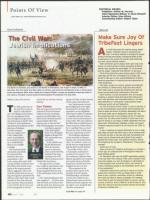
The Battle of Antietam, also known as the Battle of Sharpsburg, was fought on Sept. 17, 1862, in
Maryland. This first major Civil War battle on northern soil forced the Confederate Army to retreat back
across the Potomac River. With a death toll of about 23,000, it marks the bloodiest single-day battle in
U.S. history. President Lincoln issued the Emancipation Proclamation five days later.
Waltham, Mass./The Forward
T
he 150th anniversary of
the Civil War is upon us.
April 12 is the anniver-
sary of the firing on Fort Sumter,
the war's opening shot. From
then, through the sesquicenten-
nial anniversary on April 9, 2015,
of Robert E. Lee's surrender at
Appomattox Court House and five
days later of Abraham
Lincoln's assassina-
tion, every major event
in the "ordeal of the
union" seems likely to
be recounted, re-enact-
ed, re-analyzed and,
likely as not, verbally
re-fought.
The American Jewish
community, meanwhile,
has expressed little
interest in these com-
memorations. A few
books, a play, a film and a forth-
coming scholarly conference form
the totality of the Jewish contri-
bution to the sesquicentennial.
When I suggested a talk on the
Civil War and the Jews in one set-
ting, the organizers questioned the
relevance of the topic. Only a small
minority of Jews, they observed,
boast ancestors who participated
in the Civil War. By the time most
Jewish immigrants to America
arrived, the war was but a distant
memory.
Core Themes
Fifty years ago, for the Civil War
centennial, the level of interest
within the Jewish community
seemed noticeably higher. New
York's Jewish Museum mounted
a grand exhibit titled "The
American Jew in the Civil War."
Fully 260 photographs, documents
and objects appeared
in the multi-gallery
show. It was the largest
display of Jewish Civil
War memorabilia ever
assembled.
In the exhibit's cata-
log, the late Bertram
Korn, the foremost
expert on American
Jewry and the Civil War,
examined "the major
meaning of the Civil
War for American Jews."
He listed five key themes:
• The opportunity accorded
Jews to fight as equal citizens and
to rise through the ranks, some-
thing not granted them by most
of the world's great armies at that
time.
• Jews' "total identification with
their neighbors" — Northern Jews
with the North and Southern Jews
with the South. Jews demonstrated
their loyalty and patriotism dur-
ing the Civil War, and then boasted
of it for many years afterward.
• Jews' tenaciousness in coura-
geously fighting for their rights.
Soon after the war began, they
organized to correct legislation
restricting the military chaplaincy
to "regularly ordained ministers
of some Christian denomination."
In December 1862, they rushed to
the White House to fight Ulysses S.
Grant's notorious General Orders
No. 11 expelling "Jews as a class"
from his war zone. In both cases,
they won empowering victories.
• The forthright repudiation
of anti-Semitism by Abraham
Lincoln, who overturned Grant's
order ("to condemn a class is, to
say the least, to wrong the good
with the bad," Lincoln declared.
"I do not like to hear a class
or nationality condemned on
account of a few sinners."). In
the Confederacy, Jefferson Davis
likewise repudiated anti-Semitism
and worked closely with Judah
Benjamin, his Jewish and much-
maligned secretary of state.
• The acceptance by the
president and Congress of the
principle of Jewish equality.
Notwithstanding considerable
wartime anti-Semitism, Jews
achieved equal status on the bat-
tlefield and Jewish chaplains won
the right to serve alongside their
Christian counterparts.
Civil War on page 41
40 . kprd
7 2011
s a first-time event for aspiring young Jewish
leaders, TribeFest proved a successful pow-
wow. It certainly seemed to energize its largely
already involved participants, introducing them to like-
minded peers from around the country and reinforcing
why their Jewish identity matters.
Metro Detroiters got to display their spirit and pride
thanks to matching black T-shirts promoting a Detroit
rebirth; they sported the Old English "D" on the front
and the slogan "Imported from Detroit" on the back.
Thirty-three Detroiters were among nearly 1,300 young
Jews ages 22-45 who converged on Las Vegas last
month to take part in the Jewish Federations of North
America experiment in inspiring the next generation of
JFNA leadership.
Fest-goers sought to connect, explore and celebrate
the richness of Jewish music, food, arts and culture.
Their intent was to change the dynamic from less-hip
annual young leadership conferences of the past.
Much worked: a social atmosphere that encouraged
mingling, a speaker lineup that generated enthusiasm
and a new direction that stimulated interest. The take-
away definition of "community" embraced the larger
communal world, not just Federation.
As with all national events, there is room to improve. A
survey of participants would clarify which breakout ses-
sions to keep and which to jettison. Meanwhile, the March
6-8 event really wasn't designed to attract 20- and
30-somethings new to the strategic sector of organized
Jewish life. You likely were involved in some way to jus-
tify the airfare to Las Vegas, a $400 registration fee and
hotel costs. Philanthropic subsidies to lower next year's
TribeFest expense shouldn't be too hard for the JFNA to
muster.
It was a challenge to appeal effectively to such a wide
age range; 22-year-olds don't have a lot in common with
a 43-year-old who is married with kids. Fortunately, the
large turnout allowed each age bracket to be seeded
despite the broad scope. The question remains: Should
40-somethings be included in Federation's "Young Adult"
concept?
Follow-up is crucial.
When and how will TribeFest participants, so excited a
month ago, be contacted and re-energized to keep the
good feelings going?
For Detroiters who took the $400 registration subsidy
if this was their first national JFNA event, shouldn't they
have been asked, as a sort of payback, to participate in
a local program such as Entree, which, via a series of
events, introduces people to our Federation and its work
in the community?
Federation should move quickly to canvas our young
people who ventured to the Las Vegas desert. Invite
them to join a specific committee, project or initiative.
Don't just ask them to attend a program. For example,
invite them to join the planning team to assure a strong
turnout at Detroit Jewry's Walk for Israel on May 15. Give
them the chance to become involved without the burden
of having to initiate how. 1 1