

Arts & Entertainment
"Nothing I'd ever read revealed to me
my Jewish civilization as my great-
grandfather Jacob Levy's cane did."
- Elisa New
Jacob's
Cane
Reveals
The Past
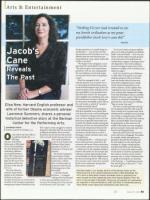
Elisa New, Harvard English professor and
wife of former Obama economic adviser
Lawrence Summers, shares a personal
historical detective story at the Berman
Center for the Performing Arts.
Jonathan Kirsch
Jewish Journal of Greater L.A.
0
n the wall of my home office is
an authentic family relic — a
tallis bag
that was carried from
Byelorussia to Ellis Island
by my wife's grandfather,
Ben Zion Benjamin. The
embroidery, elaborate
and colorful, features a
date: 1895. Today, the tal-
lis bag is framed under
glass, but the secret of its
provenance and the sig-
nificance of the date are
lost to us.
The same dilemma
confronts many Jewish
families in the Goldeneh
Medinah, as the prom-
ised land of America was referred to by
members of the immigrant generation
attempting to distance themselves from
their origins as they struggled to reinvent
themselves. But Elisa New has succeeded
in filling in the blanks of her own fam-
ily history, and the tale she tells in Jacob's
Cane: A Jewish Family's Journey From the
Four Lands of Lithuania
to the Ports of London and
Baltimore (Basic Books;
paperback, $16.99) is a
masterpiece of history and
memory.
The Jewish Community
Center's Henry & Delia
Meyers Library and Media
Center hosts a talk by
New on Sunday, April 10,
at Berman Center for the
Performing Arts in West
Bloomfield.
A cherished family
heirloom — an elegant
walking stick that belonged
to New's great-grandfather, Jacob Levy —
served as the starting point of her journey
of self-discovery. The cane itself — "its
foreign appearance, its careful design, its
Germanness" — was the first clue that
the experiences of her forebears were very
different from the ones that have been
immortalized in a pop-culture artifact like
Fiddler on the Roof
"We imagine every immigrant a trans-
plant from the rutted shtetl," writes New.
"But with our gaze on the impecunious
greenhorn, with our eyes straining after
the rural milkman turned cloak maker,
we may miss Tevye's more cosmopolitan
cousin:"
What New managed to find — and
what she presents to us in Jacob's Cane —
is a fascinating and illuminating variant
on the Jewish immigrant saga. At first, the
initials and place names inscribed on her
great-grandfather's cane provoked more
questions than answers. Her three great-
aunts supplied more tantalizing clues, and
New herself spent 10 years in teasing out
fact from fancy. Eventually, as New tells us,
the cane became a symbol of "veracity's
triumph over family legend."
Accompanied by her young daughter,
Yael, New embarked on an odyssey that
took them all over the world, including the
town of Shavli in Lithuania where Jacob
Levy was born. Along the way, we see how
Jacob Levy escaped the horrors that were
to befall other family members during the
Holocaust and how he turned himself and
his sons into entrepreneurs blessed with
social and financial success in England
and America. Jacob's Cane is, at once, a
travelogue, a family chronicle and a work
of social history.
It's fitting that New — a literature pro-
fessor at Harvard who is married to the
economist and former Obama administra-
tion economic adviser Lawrence Summers
— finds poetry in the mundane details of
business. She points out, for example, that
Lithuania may have figured importantly
in the Haskalah, the Jewish Enlightenment
that flowered during the late 18th century,
but it was also a place where Jews enriched
the life of the community through their
daily business endeavors.
"Fur, boar's bristles and goose feathers,
gloves of ox hide and pigskin and kidskin,
lambs' wool and lanolin — Jews were pro-
ficient at all the trades that took products
sticky with mud or hair and blood and
readied them to appear in drawing rooms;'
she rhapsodizes. "Jews built workshops
to turn wood pulp to paper, linen to lace,
beeswax to candles, cocoa to bonbons, and
tobacco to cigars:'
Jacob Levy made his way to Baltimore
in 1884, where he founded a successful
clothing enterprise of his own, but his
heart was broken when his sons were
lured away to England to join a family
friend named Bernhard Baron in the
tobacco industry. "Jacob," explains New,
"regarded his sons' name change from
Levy to Baron, their employment change
from cloth shrinking to tobacco, and their
departure from the country of their birth,
America, as a betrayal." Eventually, he
pronounced a curse on his own children:
"May you never have sons!"
The story of social aspiration and fam-
ily estrangement that New tells in Jacob's
Cane is worthy of a Victorian novel. Jacob
disinherited his unfaithful sons by leaving
two of them a nominal bequest of $100
and his eldest son "the sum of $10 and my
Moroccan Bound Bible." Down through
the generations, as New shows us, the
wealth of the family was never enough to
prevent moments of pain and regret, dys-
function and disappointment.
Above all, Jacob's Cane is the work of a
writer with a love of language. The author,
for example, clearly takes pleasure in
pausing to describe the rich objects of
the cane maker's art, the ways that the
workings of a Singer sewing machine
transform both fabric and recollection,
and the act of sorcery by which an archi-
val document is retrieved, translated and
thus made to reveal its secrets. At these
moments, New is a kind of alchemist who
is capable of turning the raw materials
of the historian — "wanderings, guesses,
luck and old glue as she puts it — into
the poet's gold. I 1
Elisa New speaks 7 p.m. Sunday, April 10, at the Berman Center for the
Performing Arts at the Jewish Community Center in West Bloomfield. The
JCC's Henry & Delia Meyers Library and Media Center is sponsoring the
event through the Delia Jampel and John Frank Special Speakers Fund. The
event is free and open to the public. Tickets are not required, but reservations
are requested to Francine Menken at (248) 432-5546 or fmenken@jccdet.org .
There will be a book signing and refreshments after New's talk.
March 31 • 2011
51