

feature
by Samantha Zwick and Gideon Levinson
a two-way meet
day schools' dual-curriculum means more work, longer hours and lasting rewards.
H
undreds of students in Met-
ro Detroit who attend Jewish
day schools have long days
and heaps of homework as they strive
to succeed in their dual-curriculum
schools.
These students not only learn sec-
ular studies courses like the rest of
American students, but they devote
part of each day to learning Hebrew
and about their heritage, whether in a
Jewish history or Bible class.
Some students from the Frankel
Jewish Academy in West Bloomfield,
Akiva Hebrew Day School in South-
field and Hillel Day School in Farm-
ington Hills were asked about the
effect of participating in a dual-curric-
ulum program; the consensus seems
to be that it benefits all their studies as
well as their everyday lives.
Akiva Hebrew Day School, a Mod-
ern Orthodox and Zionist school,
teaches its students a love for Judaic
studies by beginning each day with
davening and then transitioning to
talmudic and halachic classes. Having
Judaic classes first allows students to
take what they learned and apply it to
their secular studies later in the day.
Akiva junior liana Goldmeier ex-
plains, "Reading Jewish law enriches
our understanding of modern-day
morality and ethics. By looking back
through the history of the Western
world, we can see the profound im-
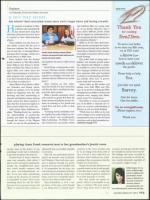
Frankel Jewish Academy students Gideon
Levinson and Samantha Zwick with books for
secular and Jewish studies
pact Judaism has had on other moral
codes."
David Zwick, a sixth-grader at Aki-
va, says, "Having a mixture of English
and Hebrew classes teaches us how to
organize our thoughts and make con-
nections between different but similar
topics."
Akiva students say they under-
stand the benefit of a dual curriculum
and that the idea is enriched and sup-
ported by their teachers.
Hillel, a Jewish community school
with students in grades K-8 from dif-
ferent streams of Judaism, focuses stu-
dents on learning to live Jewish and
moral lives and have pride in their
Judaism.
"Learning secular and Judaic stud-
ies together has really helped me suc-
ceed in school," says seventh-grader
Eden Lichteiinan. "At Hillel, I have
also learned how my Jewish studies
and traditions affect my secular stud-
ies. In my Jewish Lifecycles class, I
learn about different Jewish rituals
and it's helped me understand how I
can incorporate Jewish traditions into
my American lifestyle."
Hillel, as do the other dual-curric-
ulum schools, encourages the connec-
t tions between Jewish and secular life,
which allows students to feel a deeper,
meaningful connection with his or her
Jewish heritage.
FJA prides itself on being both a
halachic and Zionistic Jewish institu-
tion. Students take Talmud or rabbin-
ics and Bible as well as the spoken He-
brew language. Students say they find
these important skills quite beneficial
in relation to understanding and think-
ing critically about laws of govern-
ments, math and even science.
Amira Gaba, an FJA teacher and
alumna from both Hillel and FJA,
says, "I can see how studying the Bible
strengthened my ability to analyze and
interpret texts, ranging from Shake-
speare to the U.S. Constitution."
The ability to create an interpreta-
tion of the Bible or talmudic law re-
quires an accurate understanding of
Hebrew as well as critical thinking.
"While these two skills can be seen
in the writings of our medieval Jewish
commentators, they can also be found
elsewhere, such as the humanities sec-
'Thank You
for reading
Teen2Teen.
To serve you better
as we start our fifth year,
we at T2T want
to know how
best to meet your
needs and deliver
the goods.
Please help us help
You.
Just take our quick
Survey.
One for teens.
One for adults.
Go to www.jnt2t.com.
(Please register, too.)
Thank you.
continued on page TT4
playing Anne Frank connects teen to her grandmother's Jewish roots.
ing like Anne on the surface. It was
something I really had to internalize
to give her the justice she deserves.
Certain levels of Anne's character
came very naturally, while others I
had to work very hard to understand,
namely her straightforward open-
ness, which sharply contrasts with
my more non-confrontational na-
ture. It was also rather intimidating
to take on the character of someone
as remarkable as Anne. There is just
something about her and the battle
between her two personas (Anne and
"Kitty" to whom her diary entries are
addressed) that is incredibly relatable
to everyone.
This role was particularly interest-
ing for me because I am not Jewish,
but Christian. I have had some expo-
sure to Judaism through my grand-
parents, yet I am not too familiar with
it. In preparation for the play, our
cast took part in enrichment activities
to better understand the ideals of Ju-
daism, and it was a wonderful experi-
ence to learn about another faith.
Open-mindedness is such a ma-
jor theme of this play, and I thought
it was fitting that we should expose
ourselves to the views of others and
try to see things from their point of
view. Overall, I don't think that my
Christian status hindered my under-
standing of the circumstances that the
Franks were forced into.
Despite the fact the Holocaust was
a specific attack on the Jewish people,
I feel that Anne's story is really that
of a test of faith in general, whether it
be in God, humanity or oneself.
Her story speaks out against in-
justice, which is unacceptable in any
place or situation. The most extraor-
dinary thing about Anne is that she
was just a normal girl, and this makes
her relatable to anyone and everyone.
The feelings that Anne recorded in
her diary are ones that we all feel; her
story reaches all people, regardless of
race, gender, religion or age. t
Gillian Cooper, 17, is a
senior at Milford High
School in Highland. Her
grandmother, Harriet
Cooper of Waterford, is
the child of Holocaust
survivors; Gillian's
great-grandmother, sur-
vivor Edith Kuschner, will be 105 this May.
teen2teen March 24.2011 TT3