

Aid. missions
U.S. are
organiZed.
X'A
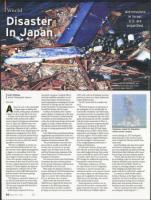
Debris-froM the earthquake and
4."
--V1155"diruent tsunami that struck
\northern Japan March 11.
Uriel Heilman
Jewish Telegraphic Agency
New York
A
lmost as soon as the catastrophe
in Japan began unfolding this
month, Jewish groups scrambled
to figure out how to get help to the area.
In Israel, search-and-rescue organiza-
tions like ZAKA and IsraAid readied
teams to head to the Japanese devastation
zone. In Tokyo, the Chabad center took
an accounting of local Jews and began
organizing a shipment of aid to stricken
cities to the north. In the United States, aid
organizations ranging from B'nai B'rith
International to local and national federa-
tion agencies launched campaigns to col-
lect money for rescue, relief and rebuild-
ing efforts in the Pacific.
"We have an obligation to care for our
own',' said David Frankel of the OU, "but
the enormity of the tragedy that happened
in Japan is so extraordinary that for the
Jewish community not to have an outpour-
ing of support would not only be a denial
of one of our primary obligations to care
for everyone in their time of need:' he said,
but also a missed opportunity to honor the
memory of Chiune Sugihara, the Japanese
consul general to Lithuania who in 1940
helped save at least 6,000 Lithuanian Jews
from the hands of the Nazis by getting
them transit visas to Japan.
"The Japanese community helped us in
our time of need; this is our way to help
them in their time of need:' Frankel said.
"We can never repay the debt, but this is
the right thing to do."
Israeli teams comprised of rescue
14 March 24 • 2011
personnel, emergency medical officers
and water pollution specialists are vol-
unteering in Japan. Several American
Jewish organizations, including the Jewish
federation in Chicago and the American
Jewish Committee, are funneling money to
IsraAid for disaster relief in Japan.
In Tokyo, the Chabad center commis-
sioned a bakery in Sendai, one of the cities
battered by the tsunami, to bake bread for
its residents and surrounding areas. The
center also trucked several tons of food and
supplies to Sendai, Chabad officials said.
The officials estimate that Chabad's relief
in Japan is costing approximately $25,000
per day.
In the United States, Jewish humanitarian
organizations reported that the money was
coming in fast for mailboxes set up to receive
donations for Japanese disaster relief.
"We are determined to provide emer-
gency relief as quickly as possible and
to work with our partners to provide
support over the longer term as well:
said Fred Zimmerman, chairman of the
Jewish Federations of North America's
Emergency Committee.
The American Jewish Joint Distribution
Committee, the main overseas partner
for the Jewish Federations, collected more
than $400,000 in the first week.
What makes the Japanese situation a
unique challenge for Jewish humanitarian
organizations is the absence of relation-
ships in a country that traditionally has
been an aid donor, not a recipient.
Indeed, when the American Jewish
World Service, which led the Jewish aid
response to the 2004 Asian tsunami,
was asked what its aid effort would be
for Japan, the answer was none, because
AJWS only works in developing countries
and has no partners in Japan, spokesman
Joshua Berkman said.
The JDC found itself in a similar situ-
ation.
"We had no programs in Japan prior to
the earthquake; we just worked with the
local Jewish community' said Will Recant,
an assistant executive vice president at JDC.
But almost immediately after the earth-
quake and tsunami hit, the JDC consulted
with the Jewish community in Tokyo to
identify local Japanese nongovernmental
organizations working in the affected
areas. Within five days, JDC had begun
funneling money to JEN, a Tokyo-based
organization specializing in shelter recon-
struction, support of the socially vulner-
able and emergency supply distribution
that had managed to send personnel
to the ravaged Japanese prefectures of
Miyagi and Fukushima.
As with other disasters, Recant said
JDC will stick around to help with long-
term relief, budget allowing. Only money
raised specifically for Japan will be spent
on disaster relief. There is no money in
JD C's budget for additional nonsectarian,
humanitarian work, Recant said.
While Japan continues to reel from
the triple disaster of an 8.9-magnitude
earthquake, a massive tsunami and a
subsequent nuclear crisis, experts in Israel
are trying to figure out what lessons from
Japan can be applied to the Jewish state,
which lies on two fault lines, the Carmel
fault and the Dead Sea fault.
Israel experiences tremors every so
often, but the last time a ruinous earth-
quake struck the area was in 1927, when
the West Bank city of Nablus suffered
Explosions rocked the Fukushima
Daiichi nuclear complex.
serious damage. An 1837 earthquake
destroyed much of the northern Israeli
cities of Safed and Tiberias and left thou-
sands dead.
Israeli building codes have been updat-
ed for better earthquake safety compli-
ance, but regulations and enforcement lag
behind places like California, which expe-
riences larger and more frequent quakes.
"There's still a lot that has to be done as
far as building codes are concerned:' said
Professor Michael Lazar, a tectonics expert
at the University of Haifa. "There's an
attempt to encourage people to renovate
older buildings and make them earth-
quake ready, but it really hasn't caught on."
A scenario in which Israel's nuclear
facility at Dimona, in the Negev Desert,
would face the kind of meltdown scenario
situation Japan is seeing now is much less
likely, Lazar said, because Dimona is far
from the tectonic lines that cross Israel.
"But," he cautioned, "it's hard to tell how
an earthquake would disperse