

Points Of View
Send letters to: letters@thejewishnews.com
Contributing Editor
Editorial
The
ilairench
nnect
oexistence, the noble idea
of nations inviting and
encouraging distinct cul-
tural religious immigrant groups,
is an abject failure in France. Enjoy
your ethnicity and pray religiously
there. Just don't do it in
public. There's no room
for an open display of
multiculturalism.
So said President
Nicolas Sarkozy in a
revealing interview on
French television. It's
an interview important
to Jews and others who
don't identify only as
French.
Free speech is part of
the mainstream in this European
democracy. But when the elected
leader applies the notion of nation-
alism to everyday life as opposed
to only government policy, Western
ears should perk up. It's undemo-
cratic, to say the least.
"If you come to France," Sarkozy
told TFI,"you accept to melt into
a single community, which is the
national community; and if you do
not want to accept that,
you cannot be welcome
in France."
Brazenly, he went on
to say the French nation-
al community would
not accept "a change in
lifestyle" — of any pro-
nounced sort.
"We have been too
concerned about the
identity of the person
who was arriving and
not enough about the identity of
the country that was receiving
him:' Sarkozy intoned.
Is Sarkozy wacky or what?
Is he saying that on public
streets,
Jews must
stop don-
ning kippot,
Muslims
must avoid
wearing
hijabs and
Christians
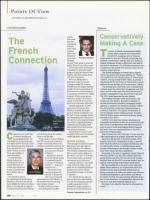
President Sarkozy
must cease
showing
crosses? Who's going to arrest the
guilty: The just-one-culture cops?
I don't understand Sarkozy. Jews
or Muslims, in particular, aren't
going to be any less French if they
identify with their culture along
with their nationality.
We're not talking about a
backwater country: France is
a European pillar. It's home to
600,000 Jews, the largest anywhere
outside of America and Israel. It's
also home to 6.2 million Muslims,
or 10 percent of France's 62 million
residents. What's wrong anyway
with a Jew saying,"I'm a French
citizen, and proud of it; but I'm a
Jew first, so why must I hide that?"
Limited integration of immi-
grants has fed Sarkozy's folly.
Muslims comprise the largest
group of French immigrants over
the past 10 years; younger Muslim
men emigrating from radical soci-
eties have, in turn, targeted French
Jews. Better integrating Muslims,
religiously and secularly, would
help combat French-bred extrem-
ism among immigrants.
Clearly, France would be wiser
to promote democratic ideals than
curtail legitimate freedoms.
Muslim Bashinp
The real target of Sarkozy's nation-
alist vision came clear when he
told his February TV audience,
"Our Muslim compatriots must be
able to practice their religion, as
any citizen can',' but "we in France
do not want people to pray in an
ostentatious way in the street."
Last year, Marine Le Pen, leader
of the French far right, roused
public ire for comparing Muslims
praying in the streets outside
overcrowded mosques to the Nazi
occupation.
Jews should take no solace in
France's obsession with Muslims.
Not only is stereotyping a people
morally wrong, but an Anti-
Defamation League analysis of
French acts of anti-Semitism in
French Connection on 25
24
March 17 • 201
Conservatively
Making A Case
o assure a vibrant congregational middle
ground within Judaism, the Conservative
movement's synagogue arm is trying to
recast what it is and does through a promising new
initiative. Conservative Judaism was once America's
largest synagogue stream, a distinction now held by
the Reform movement. The Orthodox movement also
is growing as the pursuit of a bold new vision for the
religious center goes on.
The United Synagogue of Conservative Judaism
(USCJ) has joined with Hayom (Hebrew for "Today"):
The Coalition for the Transformation of Conservative
Judaism, a group of high-profile rabbis, to propose a
consensus plan for the future of Conservative congre-
gational life and perhaps all of Conservative Judaism.
The strategic plan, more than year in development,
is timely given the outcry from synagogues over their
return on USCJ dues paid. Over the past nine years,
member congregations have declined by 14 percent.
The USCJ board approved the plan Sunday.
The strategy includes leaner governance, new
bylaws and new leaders. Outreach to kehillot, or
sacred communities (including synagogue congre-
gations), is reflective of changing American Jewish
life. Each kehillah would send representatives to
a General Assembly. This signals the prospect of
non-synagogue Jewish religious groups, including
informal Jewish prayer and learning groups, being
welcome to join USCJ.
Another core objective involves developing an
integrated educational system for preschool through
high school in collaboration with other movement
arms (a smart move) and regional district councils
that elect their own representatives to the USCJ
board (an intriguing idea).
Hayom knows the USCJ will have to team with the
right organizations to actually implement the plan.
More than 80 percent of the $10.5 million UCSJ
budget comes from congregational dues. Lowered
dues would be offset by increased philanthropy and
so-called profit centers. A reshaped board would
include philanthropists and thought leaders to help
raise more money for USCJ operations.
Promising as the plan is, questions remain: How will
the USCJ deliver? Can the USCJ attract more new
young families and stem the loss of current member
families? How will the USCJ view key matters such as
kashrut, intermarriage and Shabbat observance?
We have confidence in the plan's chief advocate
(Rabbi Steven Wernick, the inspired executive vice
president of the USCJ) and who influenced it (a
strong contingent of rabbis, lay leaders and advisers,
including demographers Jacob Ukeles and Steven
M. Cohen). Further, the plan is being vetted by every
part of the movement. All stakeholders will have the
chance to read and comment publicly on it.
Too much is at stake for the plan to ultimately be
a bust.