

World
Communicating
For deaf Jews, Jewish community slowly opening up.
Sue Fishkoff
Jewish Telegraphic Agency
White Plains, N. Y
A
lexis Kashar was listening
intently to the speaker at a
recent Jewish federation event in
this New York City suburb.
A closer look revealed that her eyes
were trained not on the podium but on
Naomi Brunnlehrman, who was seated in
front of the speaker and translating the
lecture into American Sign Language.
Kashar, 43, a longtime civil rights law-
yer, has been deaf since birth. Five years
ago, she and Brunnlehrman, co-founder of
the Jewish Deaf Resource Center, asked the
UJA-Federation of New York to subsidize
ASL interpreters so Kashar and other deaf
Jews in the New York area could take part
in Jewish communal events.
In 2009, the federation began granting
$5,000 a year to the center.
"I was ready to quit the Jewish com-
munity when I met Naomi," said Kashar,
who lip reads and speaks but works with
an interpreter.
Kashar is involved with the Jewish fed-
eration, she says, in an effort to increase
services for the Jewish deaf and hard of
hearing.
Kashar has three hearing children and
was concerned about their Jewish future.
"I realized if I don't have access, my chil-
dren won't either," she said. "Why would I
take them to synagogue when I have to sit
there and have no idea what's going on?"
An estimated 50,000 deaf Jews live in
the United States, according to advocacy
groups. Insiders say most are not involved
in Jewish life, mainly because it's just too
difficult. There are a handful of syna-
gogues for the deaf, half a dozen deaf rab-
bis, and several national and local social
and cultural organizations.
In the past decade, however, main-
stream Jewish institutions and synagogues
have begun providing ASL interpreters
and/or assistive listening devices, allowing
deaf and hard-of-hearing Jews to take part
in mainstream Jewish life instead of being
segregated. The numbers of such pioneer-
ing institutions, however, remain quite
small, experts say.
"You can count them on one hand," said
Jeffrey Lichtman, director of Yachad, the
22
March 10 • 2011
National Jewish Council for Disabilities,
which operates under the auspices of the
Orthodox Union.
Traditionally, the Jewish deaf were not
treated as full members of the community.
Their testimony was not accepted in reli-
gious courts, and they were exempt from
commandments that involve listening,
which means they were not called to the
Torah or even taught Hebrew.
That is changing, experts say, but very
slowly.
"We don't expect all synagogues to
have all their services interpreted, but
maybe once a month or for the holidays;'
Lichtman said. "It's no different from
making accommodations for the physi-
cally challenged or the blind. If you don't,
you are effectively saying these people are
not welcome."
Funding for inclusion is increasing
mainly because the Jewish deaf commu-
nity, like the American deaf community in
general, is in transition. There is a growing
divide between those who are more com-
fortable in deaf-only settings — usually
older people who grew up signing and
comprise the bulk of membership in deaf
congregations — and younger deaf Jews
who are more at ease in hearing society.
The change is largely due to technol-
ogy, especially the prevalence of cochlear
implants that permit limited hearing,
according to Lichtman.
"Ten years ago, the deaf community
had a strong component that did not want
inclusion. They wanted their own separate
community," he said. "Today, people who
were not interested in inclusion in the past
are now much more interested, especially
for their children."
Avi Jacob, 21, wears hearing aids and
does not sign. "We wanted to get him
to speak, so he could be included in the
typical Jewish world," said his mother,
Batya Jacob, program director at Our Way,
Yachad's department for the Jewish deaf.
Avi attended Jewish day school and is
now a senior at Yeshiva University, where
a note-taker helps him in secular classes.
In his Jewish courses, Batya says, public
funding is not available, so he borrows
friends' notes.
"He does not consider himself disabled;'
she said.
Congregation Bene Shalom in Skokie,
Ill., is among a handful of synagogues
founded to serve deaf Jews and their fami-
lies. Rabbi Douglas Goldhamer says that
services, meetings and his counseling ses-
sions are voiced and signed.
When the cantor sings in Hebrew, a
choir "translates" the prayers into ASL.
Clergy don't face the ark during prayers
when it is customary to do so because
deaf congregants would be unable to
see what they are saying. Some liberal
synagogues flash lights on and off to
signal certain parts of the service, but
Bene Shalom does not use electricity on
Shabbat.
Goldhamer says that more young deaf
Jews attend hearing synagogues than
their parents did. If there is no interpreter,
they may go with hearing friends. Or they
might get together with a few other deaf
Jews and hire their own interpreter.
"They're asserting their rights more
Goldhamer said.
The Columbus, Ohio, Jewish federa-
tion gives $3,000 a year for deaf services,
with interpreted High Holidays services
rotating to different synagogues each year.
The federations in New York, Boston and
Washington also give money for interpret-
ers.
At Temple Israel in Columbus, which
has eight or nine deaf regulars, a deaf
member in his 80s celebrated his bar
mitzvah seven years ago. The ceremony
was interpreted into ASL.
"He told me that when he was growing
up, there wasn't a place for
him in the Jewish world:'
said the synagogue's
executive director, Elaine
Tenenbuam. "There are
deaf people in every Jewish
community, but they don't
participate. They've stepped
away from the community
because it doesn't provide
for them."
It's not always a young
vs. old scenario. In many
cases, older deaf Jews had
parents who insisted on
mainstreaming them.
Sharon Ann Dror, the
founder and president of
the Jewish Deaf Community
Center in Los Angeles,
grew up oral;' with hearing
parents who didn't want her
or her hard-of-hearing sister segregated.
But when she went to college and
learned ASL, Dror suddenly realized how
much she'd been missing.
"Instead of getting a few sentences in
the hearing world from my friends, I can
have a real meaningful dialogue with my
deaf community," she said.
Dror reads lips and speaks well, but
her three deaf children don't speak at
all, relying instead on signing. Her old-
est, 19-year-old Joshua Soudakoff, is a
Lubavitcher who teaches Torah to other
deaf Jews using ASL. Videos of his weekly
Torah lessons, conducted in sign, are at
Jewishdeafmm.org.
Soudakoff writes that he feels more
comfortable within the deaf community,
and that hearing people often don't under-
stand what he's trying to say and just nod
along. He finds it frustrating.
"They don't understand that deafness is
a physical condition, not a mental issue
he said.
In November, the Jewish Federations
of North America paid for Alexis Kashar
and Naomi Brunnlehrman to address the
International Lions of Judah conference
in New Orleans, held immediately after
the federations' General Assembly. Kashar
says that's good, but much more needs to
be done.
"It's our mission to take this nationally,"
she said. "We need to bring the deaf Jews
back home."
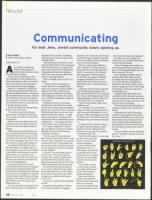
Alphabet Manuel LSF
"
Dessin : Alhert . FABACYI ( Sourd )