

such as installing and maintaining the new,
and sometimes controversial, scanning and
screening devices at airports for the U.S.
Transportation Security Administration.
"We're outfitting the Philadelphia airport now,
and we've also done LaGuardia in New York,
Logan in Boston, Hopkins in Cleveland and the
Newark (N.J.) airport," Sachse said. "We have
the expertise to bid on and handle projects
anywhere."
Agree Realty Corp. of Farmington Hills
has been working on commercial real estate
deals with Sachse for the past 12 years and is
involved in about 20 projects now, including
Chase banks and Walgreen drug stores in sev-
eral regions.
"We have a great relationship with Todd
and his people said Rick Agree of West
Bloomfield, who is chairman and CEO of the
company. "They do excellent work and they're
always on time and on budget. You couldn't ask
for anything more."
Jewish Projects
Sachse Construction is well known in the
Jewish community for building the Friendship
Circle in West Bloomfield, plus a recent
gymnasium addition there; the three-story
Frankel Jewish Academy addition to the Jewish
Community Center; Young Israel of Oak Park;
an addition to Congregation Beth Shalom in
Oak Park and other synagogue projects.
In Detroit, Sachse Construction handled
reconstruction of interior space on 16 floors
of the venerable Guardian Building downtown
to accommodate Wayne County employees
moving from the old City-County Building.
The company built the high-profile Ellington
residential project at Woodward and Mack
avenues and did condo conversions at the
Riverfront Apartments as well as other down-
town condo projects.
When Quicken Loans announced it was
delaying building a new downtown headquar-
ters, but moving 1,700 employees from Livonia
to rental space downtown instead, Sachse
Construction jumped into the proceedings
by outfitting four floors of the Compuware
Building on Woodward for the Quicken con-
tingent.
"Our timeline was challenging, but Sachse
Construction worked tirelessly, at times
around the clock, to meet it," said Melissa
Price, Quicken Loans' facilities director. "They
helped create a collaborative work space unlike
anything else in Detroit."
Sachse calls himself a "big fan of what's hap-
pening in Detroit:' and says the "perception
that it's difficult to work down there is just not
true." In fact, Sachse Construction is planning
to open a small office downtown in the next
few months with the hopes of obtaining more
work in the area.
He added, "The economic times still are
challenging, but I feel the recession is over and
I'm very optimistic about the future?'
A look behind the
scenes at the
almost-completed
Berman Center.
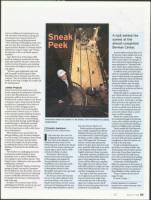
Construction began last summer on the theater, which will feature two seating
configurations.
Elizabeth Applebaum
Special to the Jewish News
I
n the early days, there was a lot
of digging and steel and concrete.
Now, work on the Mandell L. and
Madeleine Berman Center for the
Performing Arts is all about the delicate
touches: the last-minute painting, put-
ting up signs, a quick check to make
certain everything is in place.
The Berman Center, built by
Sachse Construction & Development
of Birmingham and designed by
Neumann/Smith Architecture of
Southfield, is set to open this month
at the Jewish Community Center
of Metropolitan Detroit in West
Bloomfield. And when it does, get ready
for all fun to break loose.
The Berman Center will "stimulate
the arts in the entire Oakland County
area by providing a truly unique set-
ting for performances, lectures, movies
and concerts?' beginning with the very
first guest, Marvin Hamlisch, said JCC
Executive Director Mark A. Lit.
Funded entirely with private dona-
tions, notably a large gift from Bill and
Madeleine Berman, and with a perma-
nent endowment for continued support,
the theater cost $6.7 million and mea-
sures 15,000 square feet. The exterior
features a semicircular stairway that
leads to two glass doors. Even from a dis-
tance, passersby will be able to see inside
to the marquees, lit from behind with
brightly colored and vibrant art posters.
Step inside. A glorious chandelier (once
at home in the Bonwit Teller department
store in Troy) hangs from the ceiling.
There's a full box office and a coatroom,
then a slight curve in a walkway whose
walls will be painted an orange-rust color.
Guests' shoes still tap-tap-tap on the con-
crete floor (carpeting is on its way).
The stage is what first catches your
eye. It's glamorous and fresh and new.
And just behind: three bright white
walls envelop the back of the facility,
topped by a ceiling covered with all
kinds of construction pieces that to the
uneducated are inexplicable.
But Eric Maher, technical director of
the Berman Center, explains that every-
thing here has its purpose — helping
with acoustic balance, for example, so
that sound doesn't simply disappear or
seem unbalanced or "inundated with
echo." There's also a unique feature: a
sound system for the hearing impaired.
In addition to the permanent seats,
which are wonderfully comfortable and
many of which already bear permanent
plaques with donor names, the Berman
features expandable seating, which
means the audience area can easily
be made larger or smaller, as well as
accommodate an orchestra, and there is
room for wheelchairs.
Behind the stage is a complex fly sys-
tem. It looks like just a lot of wires, but
their existence is critical to maneuver-
ing the curtains. There's also a winding
black staircase on the right that won't
be visible to the audience, but allows
workers to quickly move all about the
Berman Center, doing the behind-the-
scenes jobs without which no perfor-
mance could be managed.
Behind the curtain is also where
the enchantment begins: the dressing
rooms, where ordinary mortals put on
costumes and can become anything: a
princess, a brilliant artist, a president.
There's another bit of the extraordi-
nary at the back where the audience
sits: In a matter of minutes, the area can
be rearranged to create an entirely sepa-
rate room, with each space completely
soundproof, so that two activities can
be held at the same time.
It's still not finished, but already
the facility is in demand, Maher says.
Various groups want to rent it, and stu-
dents want to learn there (what better
way to understand the trade than to
serve with a professional team building
theater sets or managing the lighting?).
A University of Detroit graduate,
Maher has experience in every aspect of
the theater, from acting to technical skills
to design, but even he is not immune to
the possibilities of what could be here.
"I have a fondness for the idea of
magic," he says.
It's about to begin. I I
Elizabeth Applebaum is a marketing
specialist at the Jewish Community Center
of Metropolitan Detroit.
JN
March 3 , 20,
23