

i
Sp Jciait
ME D C
5,4 kt.
A Heartbeat Away from page 11
Because one of Folberg's specialties is
ophthalmology, Rich asked if he knew Dr.
Daniel Briscoe, who had become chair-
man and head of Emek's ophthalmology
department in June 2009. While Folberg
didn't know him, it turned out a close
friend at Hadassah Hospital in Jerusalem
had been one of Briscoe's mentors and
spoke highly of him and Emek.
Another close friend, Ido Perlman, then
dean of the Rappaport Faculty of Medicine
at Technion-Israel Institute of Technology
in Haifa, also knew Briscoe because Emek
is one of Technion's teaching hospitals.
These connections led Folberg to begin
corresponding directly with Briscoe.
At the same time, it turned out that
because of Detroit's strong support for
Technion, Perlman had been asked to visit
Detroit. While here, he met with Folberg,
Oakland University President Gary Russi
and Provost Virinder Moudgil.
"Ido Perlman said, You must go to this
hospital in Afula; it is a wonderful hospi-
tal:" Folberg recalled." (Andwhat I would
really like is to have some kind of col-
laboration, a link, between your medical
school and the hospital in Afula:"
Things continued to build from there.
Shortly afterward, Folberg, Russi, Moudgil
and other OU leaders were invited by the
Michigan-Israel Business Bridge (MIBB)
to travel to Israel, and they asked to visit
Emek. When Briscoe learned of the visit,
he jumped at the chance to organize a
symposium featuring Folberg.
Zionism compelled Briscoe to move to
Israel in 1988 from Dublin, Ireland, where,
in a curious bit of Jewish history, both
his grandfather and father had served as
Lord Mayor. Briscoe trained as a general
ophthalmologist at Soroka Hospital in
Beersheva and remembered very well a
lecture during his residency that Folberg
had given there in 1991.
"It was engraved in my memory because
it taught me so much',' he said. "It gave me
a great interest in clinical pathology"
Upping Ernek's Status
So during the MIBB trip last May, Emek
hosted northern Israel's first Ophthalmic
Pathology Symposium, with Folberg as its
guest lecturer. Some 140 ophthalmology
specialists and residents from across Israel
attended, which was unique for Emek. A
few Israeli medical schools even canceled
classes so students and faculty could attend.
"We are a little bit off the beaten path','
Briscoe said. "We're seen as less attrac-
tive than all the other university hospitals
because we're outside of the starry lights
of Tel Aviv and Jerusalem. The whole
northeast of Israel is coming on, but it
needs to be developed. It's one of the
major challenges in Israel today, especially
in the medical field.
"But when Bob came, it changed the
perception," Briscoe continued. "Now we
don't have enough residencies to fill all the
applications. We had to turn away some
very outstanding people."
Briscoe candidly admits that the popu-
lation of the north is "medically under-
served:' While in Tel Aviv it might take
10-14 days to be admitted to a hospital or
clinic, in the north it can take twice as long.
Established in 1924, today Emek is a
community hospital with 500 beds, 60
outpatient clinics and 25 medical depart-
ments serving a culturally rich popula-
tion of more than 500,000 people almost
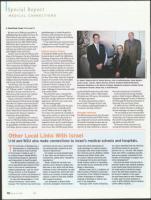
Dr. Robert Folberg with Dr. Daniel Briscoe, chair of ophthalmology, Emek Medical
Center, Israel, and Dr. Jeffrey Devries, director, Graduate Medical Education,
Beaumont Hospitals, in the Marcia & Eugene Applebaum Surgical Learning Center
at Beaumont Hospital, Royal Oak, in mid-February.
equally divided between Jews and Arabs.
The multi-ethnic staff of 1,900 includes
300 physicians, 700 nurses, 100 academics
and support personnel.
Its unique characteristics make it
known as the "Hospital of Peace,' and
it has adopted a guiding philosophy of
"coexistence through medicine:'
Valuable Partners
The official announcement says the agree-
ment between Emek and OUWB "encour-
ages collaborative research and the sharing
of scientific knowledge between the two
institutions and leveraging the medical
expertise of both institutions to advance
the science and practice of medicine."
Each institution also brings valuable
partners: Emek brings its affiliation with
Technion's Rappaport Faculty of Medicine.
OUWB brings the Beaumont Hospitals in
Royal Oak, Troy and Grosse Pointe.
Dr. Jeffrey Devries, OUWB's associate
dean for medical education, is looking at
how the exchange can improve teaching.
"We are looking at how training differs
between the two countries, comparing and
contrasting, and at doing research projects
that involve trying different ways and see-
ing which are most effective
He foresees Emek researchers con-
necting electronically with Beaumont
Other Local Links With Israel
U-M and WSU also make connections to Israel's medical schools and hospitals.
he University of Michigan has a
Memorandum of Understanding
with Technion-Israel Institute
of Technology in Haifa as part of
its medical school's Global REACH
(International Research, Education
and Cooperation in Health) project.
"The Memorandum essentially con-
cerns educational and research initia-
tives in the area of cardiovascular
medical engineering," says Dr. David
Pinsky, director of U-M Hospital's
Cardiovascular Center and professor in
the Department of Internal Medicine.
He says the Memorandum is "very
research intensive," which works
because "the Technion has world-class
12
i y
scientists and we have a world-lead-
ing cardiovascular engineering and
research department."
He singled out local philanthropist
D. Dan Kahn and his family for their
involvement, calling them "wonderful
benefactors."
Pinsky visited the Technion last
summer, and a Technion medical stu-
dent was in Ann Arbor last fall doing
rotations at the U-M Hospital. He says
teams of researchers from both insti-
tutions are currently reviewing appli-
cations in order to fund and conduct
joint research projects.
Last November, a Wayne State
University delegation returned from
Israel with initial memoranda of
understandings for medical student
exchanges with three Israeli universi-
ties: Technion and its affiliates, Haifa's
Rambam and Afula's Emek medi-
cal centers; Hebrew University and
its Hadassah Ein Kerem and Shaare
Zedek medical centers in Jerusalem;
and the Ben-Gurion University of the
Negev in Beersheva.
William Lyman, Ph.D., a professor at
WSU's School of Medicine and found-
ing director of the Children's Research
Center of Michigan at Children's
Hospital of Michigan in Detroit, was
part of the delegation.
"Amongst other Israeli institutions,
we clearly identified that the Technion
and Hebrew University are great
partners for us," he said. "We comple-
ment each other's academic pursuits,
and we are equally committed to the
transfer of technology to support eco-
nomic development."
Until just last week, the plan was to
send four fourth-year medical students
to do month-long clinical electives at
its Israeli partner institutions begin-
ning in the 2011-2012 academic year,
but current volatility in the region
has put those plans on hold. Planning
is under way for Israeli students to
come to WSU-affiliated Detroit Medical
Center (DMC) hospitals.