

Special Report
EYES
ID y OPEN
Poverty Crisis from page 13
Jewish Population Study. Perry Ohren says
those numbers are certainly profoundly
worse today.
"The new Jewish poor are you and
me. They're college educated profession-
als; they're victims of a downturn in the
economy:' he told the crowd. "The families
who are coming to Jewish Family Service
are not just coming to us for dollars to
help make ends meet: They're struggling
in many ways."
A recent report from the Michigan
League for Human Services and
Michigan's Children found the poverty rate
for children younger than 18 jumped from
14 percent in 2000 to 23 percent in 2009.
The percentage of children who depend on
food assistance programs or food stamps
nearly tripled, from 10 percent in 2000
to 28 percent in 2009. To make matters
worse, our state is facing a $1.8 billion
budget shortfall. Although new Republican
Gov. Rick Snyder has said one of his goals
is to reduce the number of children liv-
ing in poverty, his bombshell budget
plan unveiled last week would eliminate
the Earned Income Tax Credit that helps
low-income families stay afloat. The plan
would also eliminate tax breaks for seniors
and low-income workers. Lawmakers have
been asked to approve the budget by May
31.
"The Department of Human Services
has cut its budget for 10 years in a row
and they're looking at a $120-$180 million
cut:' Ahmed explained. "There's no place
left to go except the central programs
that feed people, that make sure children
are safe and that make sure people have
decent healthcare. The decisions about
this are being made today. I implore you,
I beg you, to mobilize yourselves, to call
your representatives and act. The thing
about poor people is they don't have a big
advocacy group; they need you to stand
up for them."
One Man's Story
A 46-year-old, Jewish, single man (who
declined to give his name) tells a tragic
story of a long and winding road that
ultimately led him to poverty. He currently
lives in Southfield in an apartment that
costs $499 per month. He receives $665
per month in Social Security disability
benefits and $29/month in SSI (Federal
Supplemental Security Income). He has no
other income. But, he says it wasn't always
that way.
"I started out doing well:' he recalled. "I
was going to school, working on a degree
in Jewish studies, and working for a Jewish
nonprofit agency. I once had a full-time
job as an accounts payable representa-
tive for an auto glass company in Ohio. I
decided to move to Israel when I was 29
14
February 24 • 2011
get that you can be educated, just a typical
middle-class Jewish American, and end up
in poverty."
Making A Difference
Mary Ellen Gurewitz of Detroit, an attor-
ney representing labor unions and the
Democratic Party, agrees there's a great
deal people don't know and she's work-
ing to change that. Gurewitz serves on
the Jewish Community Relations Council
board of directors and chairs the group's
4 Poverty Task Force. Their goal is to get
the organized Jewish community more
N focused on the problem of poverty and
72' finding solutions. The task force was
established about 11/2 years ago. One ini-
tiative called "Project Paperwork" matches
volunteers with clients who need help
filling out online applications for the Food
Assistance Program, State Emergency
Relief, and children's health insurance
such as MiChild and Healthy Kids. (See
sidebar to learn how to get involved.)
"I think that as Jews, we have to be
concerned about everyone, not simply
about ourselves:' Gurewitz said. "The
Jewish message is that we shall not turn
away. Addressing broader societal issues,
particularly turning to those who are most
needy among us, I think is one of the chief
messages of Judaism."
While many of us have come to accept
poverty as an unpleasant reality in our
society, Ahmed believes it can be defeated.
The solution, he says, is to effect change,
push for systemic reform and help people
one by one.
That's exactly what the Jewish
Federation of Metropolitan Detroit is
doing through the Jewish Assistance
Project. The initiative combines the
strengths of Federation's partner agen-
cies and offers a coordinated system of
services from transportation and school
scholarships to assistance with clothing,
employment services, health care, housing
and more.
"We can't work miracles:' Ohren said.
"But we can hold a family's hand, one
family at a time; and we can try to find a
unique way to cobble together resources
to help individuals reemerge from poverty
and try to get new jobs and a living wage."
Another program called Project Chessed
is a referral network of healthcare provid-
ers and groups that partner with Jewish
Family Service to arrange for pro-bono
medical, dental and pharmaceutical care
for Jewish adults with no insurance. Ohren
says there are more than 1,000 local peo-
ple enrolled in the program right now. The
Jewish Housing Association helps with
mortgage payment assistance, interest-free
loans, loan modifications and foreclosure
prevention, JVS provides career develop:
-
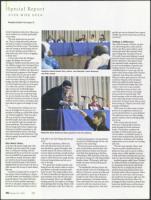
Panelists Ismael Ahmed, Perry Ohren, Jane Marshall, Jessie Rossman
and Gilda Jacobs
Moderator Brian Dickerson takes questions from the audience.
and while I was there things started to go
awry.
He says his roommate, a fellow stu-
dent, stole all of his money. He says he
was attacked by a gang of teenagers and
severely injured. He says he witnessed a
terrorist attack involving a suicide bomber
on a bus. Since he returned to the United
States in 1995, life has been rough. He says
he has no living relatives and no one to
turn to for help.
"I've spent years mainly homeless and
living all over the country either in tempo-
rary shelters or horrific roommate situa-
tions," he said. "The whole problem since
I've been on disability [for depression and
post traumatic stress disorder] all comes
down to housing. There is no affordable
housing anymore. You might as well forget
about getting public housing. Women with
children and seniors come first. There are
certain housing projects and apartments
set aside for disabled people but the wait-
ing list is over a year long."
Because he has no transportation, he
relies on the Berkley-based kosher food
pantry Yad Ezra to deliver food that pre-
vents him from going hungry. Yad Ezra,
celebrating its 20th anniversary this year,
provides an average of 1,600 impoverished
families (about 3,300 people) with food,
health care items and household goods
every month.
"I'm thankful for Yad Ezra; they're the
only food bank I know of in Michigan that
delivers. They have a system of points, and
you're allowed to spend up to 60 points a
month:' he said. "Most of the American
Jewish community is absolutely clueless.
They really think that most Jews are never
in poverty, with the exception of immi-
grants or ultra-religious Jews. They don't