

Metro
AFTER DEATH? / ON TH
co v y
Frozen In Time
Wishing to be revived in the future, the hopeful sign on at local cryonics center.
young teenager. For 15 years, he has been
a board member of the Cryonics Institute
(CI) in Clinton Township, where bodies are
cryopreserved. For several years, he has
served as vice president and has funding
in place to be cryopreserved himself.
Above: Cryonics Institute President
Shelli Liebman Dorfman
Senior Writer
oseph Kowalsky plans to live a
long life — a really long life.
"I have paperwork and fund-
ing in place to be cryopreserved — frozen
after I die — and later revived," said the
46-year-old suburban Detroiter.
A proponent of cryonics, he will join
others whose bodies will be cooled to the
temperature where physical decay stops.
They hope future technologically advanced
scientific procedures will revive them and
restore them to youth and good health.
Raised in an Orthodox
home as a member
of Young Israel of
Southfield and a student
at Akiva Hebrew Day
School, Kowalsky is
aware of Jewish law that
states burial must take
Joseph
place as soon as possible
Kowalsky
following death.
"But a person who
is cryopreserved is not necessarily dead
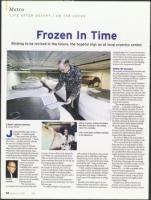
Ben Best standing on the catwalk
above the cryostats.
Left: An old photo of Robert Ettinger
in his laboratory.
j
14
February 17 • 2011
in terms of what will be in the future," he
said. "What was considered 'dead' in the
19th or even the 20th century isn't neces-
sarily considered dead now. So I do not see
this as going against Judaism.
(( And I know that Jewish law prohibits
desecration of the body, but I don't see
cryonics as doing that. Organ transplants
were once thought to desecrate bodies;
now removing an organ or blood to save a
life is permissible in Judaism!'
He likens cryonics to what would have
been if modern-day technology were used
200 years ago.
"If a fellow dropped to the ground in
1800 and had no heartbeat, and someone
appeared with a defibrillator and began
administering electric shocks, he or she
would have been arrested for desecrating
the body:' he said. "Today, we know that
the person might not really be dead.
"I think someday bringing people back
via cryonics will be just another medical
technique, and then the halachic (Jewish
law) position will change. It follows the
Jewish tenet of the importance of saving
a life."
Kowalsky, who holds degrees in eco-
nomics and law and works as a financial
consultant, first read about cryonics as a
Father Of Cryonics
The cryonics movement was launched with
the 1962 publication of The Prospect of
Immortality by Robert Ettinger, in which he
said future technological advances could be
used to bring people back to life.
Ettinger's interest in cryonics stemmed
from childhood reading of science fiction.
When he was 12, he read the 1931 Neil R.
Jones story "The Jameson Satellite." The
main character's corpse was sent into orbit
with the expectation that it would remain
preserved indefinitely at frozen tempera-
tures. But millions of years later, it was
revived and repaired.
"The concept simply struck me —
instantly — as plausible said Ettinger, 92,
who lives in Clinton Township. "Part of it
=>. is i very simple. If you can be cooled to very
>c".. low temperature with limited damage, then
that limited damage might be reversible
{,2, by future technology. In practice, of course,
the whole enterprise is much more compli-
cated; but when I finally applied probable
theory, the result was encouraging:'
With publication of his book, Ettinger
became a media celebrity and appeared
on television with David Frost, Johnny
Carson, Steve Allen and others.
He said it is difficult for most people to
accept the fact that they do not have to die.
"Few can avoid the fear of death, and
fewer can face a re-examination of their
world views, and are, therefore, chained by
cultural inertia," he said. "In simple words,
you usually believe what you have been
taught, and those habits are hard to break!'
In 1976, Ettinger, who is known as "the
father of cryonics," founded the nonprofit
CI with three other people. He was among
those who also started the Cryonics Society
of Michigan — now the Immortalist
Society (IS) — in 1966, a nonprofit educa-
tion and research organization.
He is retired from a career as a physics
and mathematics teacher at Wayne State
University in Detroit and Highland Park
Community College.
Ettinger's son, David, a Detroit-area
attorney, serves as legal counsel to the
Institute and IS and gave his first cryonics