

Special Report
COMMENTARY
Peace Talks
Are At Stake
Robert Sklar
Editor
gypt's new official ruler, the Armed
Forces Supreme Council, has
assured major-ally America that the
post-Mubarek government will "abide by
all regional and international treaties and
agreements, and commitments" – mean-
ing Egypt's 1979 peace agreement with
Israel is secure, for now.
Israeli Prime Minister Benjamin
Netanyahu applauded that Feb.12 assur-
ance, underscoring that the pact "has
greatly contributed to both countries,
and is the cornerstone for peace and sta-
bility in the entire Middle East."
The military is an ally of the people
who gave Tahrir Square, the epicenter of
the freedom fight, world stature. While it
appears committed to a peaceful transi-
tion of power in pursuit of a free and
democratic nation, the military must
further commit to the Israeli-Palestinian
peace process – fragile as negotiations
are.
Egypt may not share the terrorist
mentality of Hamas, which rules the
Gaza Strip. But Hamas is philosophically
aligned with the Muslim Brotherhood,
which commands the support of at least
a fifth of the Egyptian people.
It's little known, but even as Hamas
sends rockets into southern Israel and
holds in its charter Israel's destruction,
the Islamic Resistance Movement seems
to be engaged in under-the-radar talks
with Israel. Hamas may finally under-
stand Israel isn't going away – and that
a cold peace might be better than a con-
stant state of war.
By affirming support for peace
between the Israelis and Palestinians,
Egypt's military would pressure Mahmoud
Abbas, whose Fatah party governs the
West Bank, to quit making a mockery
of the stymied talks. Abbas still says
in English he'd never resort to violence
against Israel (while not denouncing it
as a tool); but in Arabic, he says he'd join
Arab states in a war against Israel. That
wordplay is in step with the strategy of
his predecessor, Yasser Arafat.
The JN stands strong with the principle
that how the new government of Egypt
unfolds in the months ahead will signifi-
cantly affect the face of any new talks
between Israel and not just the West
Bank, but also perhaps even Hamas. 11
E
12
February 17 - 2011
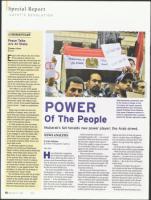
POWER
Of The People
Anti-government protesters took
to the streets in Egypt on Feb.
4 in angry, but largely peaceful
demonstrations that eventually
toppled President Hosni Mubarak
from power. Protestors minced no
words in expressing their revulsion
toward the 30-year autocratic leader.
Mubarak's fall heralds new power player: the Arab street.
NEWS ANALYSIS
Uriel Heilman
Jewish Telegraphic Agency
New York
H
osni Mubarak's resignation
last Friday from Egypt's presi-
dency following three weeks of
intense street demonstrations raises a
host of questions not just for the future
of Egypt and its peace treaty with Israel,
but for the entire Middle East.
The most remarkable feature of the
developments in Egypt — and several
weeks before it, the ouster of the long-
time dictator of Tunisia amid similar
protests — is the introduction of a
major new power player in the Middle
East: the Arab street. Included in the
fray are also non-Arab, Muslim dictator-
ships like Iran.
Until recently the Arab street —
essentially, popular will — was viewed
typically as little more than an irritant
by autocratic regimes from Cairo to
Tehran that sought to repress its power
or, occasionally, redirect its anger
against some outside foe such as Israel
or the United States.
When massive street protests
greeted the dubious re-election in June
2009 of Iranian President Mahmoud
Ahmadinejad, the government's deadly
security tactics repressed popular will,
and the Persian street eventually was
rendered irrelevant.
But the success of the Arab street in
Egypt and Tunisia raises the prospect that
Arabs elsewhere in the autocratic Middle
East will feel emboldened to rise up and
seek to overthrow their unelected leaders.
Protesters in Yemen and Jordan
already have staged massive demonstra-
tions against their governments; and
smaller protests have taken place in
Algeria and Syria. In Iran, the govern-
ment is trying to keep a budding pro-
test movement in check for fear it will
redirect its rage toward the regime in
Tehran.
For Israel and its allies, the ascendancy
of the Arab street could be a game changer.
While Israel has cultivated relation-
ships with the leaders of many of these
countries — in some cases, as in Saudi
Arabia, with Washington as an inter-
mediary — the Arab street still largely
reviles Israel.
In Egypt and Jordan, the only two
Arab countries that have full diplomatic
ties with the Jewish state, professional
unions still maintain a boycott against
any interaction with Israeli colleagues. A
2009 Pew Research Center survey con-
ducted in Egypt, Jordan and Lebanon
showed unfavorable views of Jews at
95 percent, 97 percent and 98 percent,
respectively.
So if the Arab street becomes more