

Entertain
crocr
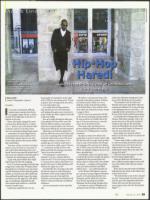
The rapper Shyne, shown
leaning against a pillar in the
Old City of Jerusalem, says
the tenets of Judaism help
him become closer to the kind
of person he strives to be.
Dina Kraft
Jewish Telegraphic Agency
Jerusalem
I
t was early on during his difficult,
isolated years in prison that the for-
mer gangsta rapper known as Shyne
decided to formally take on the laws of
Judaism as his own.
Shyne, who legally changed his name
in prison from Jamaal Barrow to Moses
Levi — Moses is one of his favorite bibli-
cal heroes, and Levi is for the Levites
who were musicians during Temple times
— remembers the initial skepticism he
encountered from prison rabbis at New
York's Bikers Island, where he was first
incarcerated, and the other prison rabbis
that would follow.
"In prison culture, everyone is trying to
make a scam, everyone is a con artist, so
who is this dark-skinned guy they won-
dered? Does he just want the Jewish food?"
asks Levi, now cloaked in the black garb of
a Chasidic Jew and living in Jerusalem.
"A guy with payos? Maybe they might
believe him," he tells JTA, laughing.
Levi, 32, a former protege of the hip-hop
mogul Sean Combs (aka P Diddy), found
himself drawn to Judaism ever since hear-
ing Old Testament stories from his grand-
mother as a boy. He was with Combs and
then-girlfriend Jennifer Lopez, the singer
and movie star, the night of a 1999 shoot-
ing at a Manhattan nightclub that left
three injured and resulted in a trial that
became a media circus.
Combs was acquitted, but Levi was
Gangsta rapper Shyne, now an orthodox Jew,
plans comeback.
found guilty of opening fire in the night-
club. In 2001, he was sentenced to 10 years
in prison. After serving nearly nine years,
he was released last year.
Levi credits Harvard law professor
Alan Dershowitz, one of his attorneys,
with helping him gain access in prison to
prayer books and other religious items like
a tallit and tefillin.
Now, as he walks through the alleyways
of Jerusalem's Old City on his way to the
Western Wall, he clutches a worn prayer
book whose maroon leather cover was torn
off by prison officials for security purposes.
Adhering to an Orthodox approach to
Judaism made the most sense to him, said
Levi, who is studying with several haredi
Orthodox rabbis from some of the most
stringent yeshivas in Jerusalem. A few
months ago, Levi said, he underwent a
type of conversion called a giyur l'chumra
— a conversion usually for those who
likely are Jewish but undergo conversion
"just to be on the safe side."
"I'm looking for a connection to
Hashem," Levi says, using the Hebrew
name for God. "I am not trying to weaken
it. I want to know what is done then I can
decide if I'm up to it. What did Moses do?
What do the sages say to do?"
Levi feels like he's returning to the fold.
His days are spent in study and prayer.
Reminders of his newly acquired Jewish
education come out in his rapid fire,
Brooklyn-accented speech smattered with
Hebrew words and talmudic and biblical
references.
Levi is an anomaly in more ways than
one.
His father is a prosperous lawyer who
currently is the prime minister of Belize,
in Central America. When Levi was a
child, his mother took him from Belize
to the United States. They settled in New
York, where she worked as a house cleaner
to support them.
But Levi soon was enamored with life
on the streets, becoming a gang member.
He was in and out of trouble, and at the
age of 13 he was sent away to a juvenile
center. By 15 he had been shot.
These days, after spending time in
prison, adopting Judaism and moving
to Israel, Levi is talking about a musical
comeback.
He plans to release two albums this
spring that are part of a joint venture with
Def Jam Records, the major hip-hop label.
Gone is some of the harsher and misogy-
nist language of his previous two albums,
one of which came out while he was in jail.
While not explicitly religious, the lyrics do
have a spiritual bent.
In Jerusalem, where Levi says he plans
to stay for the next few months, he appears
nonplussed by the second glances he
attracts. But as a black man in the clothes
of a haredi — complete with long black
wool coat, fedora, knickers and black
ribbed socks — Levi indeed stands out.
At the Western Wall plaza he encoun-
ters a group of young, religious Ethiopian
Israelis. Levi's great-grandmother was
Ethiopian, and he thinks she may have
been Jewish. Exploring his possible
Ethiopian Jewish heritage intrigues him.
Levi plans to travel to Ethiopia in the
spring and says he'd like to help fund a
yeshiva for Ethiopian immigrants in the
town of Beit Shemesh, near Jerusalem.
"The Israelites won't be whole and
Messiah won't come until all the tribes are
connected to Hashem," Levi says, referring
to the Ethiopian Jews as a lost tribe — an
originally Jewish community cut off from
the rest of the Jewish world for generations.
Levi finishes his evening prayers at the
Western Wall before paying a visit to the
protest tent next to the prime minister's
residence that calls for the immediate
release of Gilad Shalit, the Israeli soldier
who has been held captive by Hamas in
Gaza for more than four years.
Noam Shalit, the captured soldier's
father, is in the tent, and Levi is anxious to
speak with him.
"I know what it's like to suffer and not
be with your family, and heaven knows
what kind of pain and torture they are
doing to him:' Levi says after the two
shake hands and sit down. He adds, "All
we can do is pray."
"We need more than prayers:' a polite
but terse Noam Shalit replies.
From the Shalit tent, Levi heads out
into a chilly Jerusalem night to meet with
one of the rabbis with whom he studies
regularly.
Every day, he says, the tenets of Judaism
help him become closer to the kind of per-
son he strives to be.
"The bottom line is not to be a Chasid,"
he says. "Some people can dress up and
look the part, but sometimes they don't
behave that way and the person you
never expect turns out to be the mentsh.
Right?" Li
iN
February 3 g 2011
35