
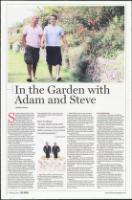

In the Garden with
Adam and Steve
By Robin Schwartz
omehow they just knew. The
kids in Joe Kort's class at Oak
Park High School seemed to
see right through him — and
they were brutal. The year
was 1979 and Joe, then 15,
was the eldest of two children growing up
in a Reform Jewish household where the
word "gay" was never uttered. He was very
much "in the closet," careful to avoid the
openly gay students at his school who were
seen as "misfits" or social outcasts; but his
classmates could tell he wasn't straight.
"I was bullied a lot. I was spit on; I
was beaten up," Joe recalls. "It was a very
hostile environment. I didn't play sports,
I was around girls all the time and [the
kids] used it against me as much as they
could. It was awful."
Joe says he first started to become aware
of his sexuality at the young age of 8,
when he consciously found himself more
attracted to boys than girls. As a teen, he
was ashamed and depressed, carrying
around this monumental secret and trying
to find a way to blend in. His mother sent
him to Jewish Family Service for outpa-
tient psychotherapy.
"My mom was afraid I was going to
harm myself," he says. "I think she knew
I was gay, but she didn't know what to do
about it. The therapist tried to talk me out
of it. I tried dating girls, but it didn't help.
When I went away to college, I was finally
able to come out. But when I did, all of my
Jewish friends abandoned me."
Now a Ph.D. who is a board certified
sexologist and psychotherapist, with a
private practice in Royal Oak, Kort, 47,
says he intimately understands the pain
that's led to a recent series of gay teen sui-
cides. In one of the many cases that made
national headlines, a Rutgers University
freshman (who was not Jewish) jumped
to his death from the George Washing-
ton Bridge after his roommate allegedly
S
22 February 2011
I RED TilltrAD
videotaped him with a man in his dorm
room and then streamed the footage on
the Internet.
While Miller believes the aforemen-
tioned passage from Leviticus is open
to interpretation, most members of the
Orthodox community do not. In the 2001
documentary Trembling Before G d, the
audience follows several gay and lesbian
Orthodox Jews and their struggle to rec-
oncile faith and sexuality.
Rabbi Michael Cohen, the pulpit rabbi
at Young Israel of Oak Park, an Orthodox
synagogue on the same block as Miller's,
believes the argument for gay marriage is
inherently flawed.
"Orthodox Judaism does not provide for
the marriage of two men or two women,"
Cohen says. "The Torah definitely does not
read that one can have what we call today
a gay lifestyle."
Young Israel of Oak Park was confront-
ed with a related issue when a gay couple
from Huntington Woods applied for a
family membership. The application went
to both the synagogue's board and the
Young Israel national council; the request
was denied. Cohen says the men were of-
fered membership as individuals, not as a
couple; they declined.
'All synagogues want to be welcoming
to every Jew," he says. "At the same time,
the Torah deals with the issue of two men
cohabitating together and having a sexual
relationship — and it's not an accepted
lifestyle."
In a March 2009 Detroit News article,
Rabbi Alon Tolwin, founder of Aish
HaTorah Detroit, was more direct: "It's
a prohibition like any other prohibition,"
Tolwin is quoted as saying. "It's danger-
ous because as a banner issue, it attacks
the essence of the morality we're trying to
maintain."
Rabbi Miller, however, believes because
our understanding of homosexuality in
the 21st century is different from previous
generations, we must yield to the value of
human dignity.
-
GOD'S PLAYBOOK
!A man shall not lie with
another man as The would]
with a woman, it is a to'eva
(an abomination)."
—
Leviticus 18:22
Rabbi Jason Miller, spiritual leader of
the Reconstructionist synagogue Con-
gregation T'chiyah in Oak Park, calls for
respect and inclusion.
"It's incumbent upon rabbis and Jew-
ish communal leaders to treat gays and
lesbians with dignity and as full-fledged
members of our synagogues and institu-
tions," he says.
GAY MARRIAGE
According to advocates, the Reform
movement has worked for years to include
and embrace the lesbian, gay, bisexual
and transgender (LGBT) community. The
ordination of gays and lesbians as rabbis
and cantors is permitted in the Reform
movement, and many clergy members of-
ficiate at same-sex unions.
Rabbi Daniel Nevins, former spiritual
leader of Adat Shalom synagogue in Farm-
ington Hills and the current dean of the
Rabbinical School of the Jewish Theologi-
cal Seminary of America, co-authored a
legal opinion that paved the way for both
same-sex commitment ceremonies as
well as ordination of gay rabbis within the
Conservative movement.
That opinion may have removed techni-
cal roadblocks for clerics to officiate at
marriage-like commitment ceremonies,
but support for actual marriage within the
movement is tacit, at best.
The 2006 decision by the Committee of
Jewish Law and Standards, which deter-
mines the official positions of Conserva-
tive Judaism, allowed rabbis permission
to officiate at commitment ceremonies for
same-sex couples with sole discretion left
to either the seminary or the individual
rabbi.
In 2000, Joe Kort married his long-
time partner, Mike Cramer, in a Reform
wedding ceremony at Congregation Shir
Tikvah in Troy (they later got married in
Massachusetts, one of the few states where
gay marriage is legal).
But when Joe and Mike submitted a
wedding announcement to the Detroit
Jewish News, the announcement was
returned without being published. That
sparked a debate and discussion that ulti-
mately led to the JN's decision in Septem-
ber 2004 to print same-sex engagement,
union, anniversary and birth announce-
ments.
www.redthreadmagazine.com
•