

4
Hit Or Miss?
State of Union speech missed some Jewish priorities.
Ron Kampeas
Jewish Telegraphic Agency
Washington
p
resident Barack Obama's State of
the Union speech on Jan. 25 was
as notable for what it excluded as
what made it in.
Obama abjured the traditional check-
list and delivered a speech centered on
a grand theme, American renewal, after
an election that left government splin-
tered, with a Democratic White House
and Senate and a Republican House of
Representatives.
"What comes of this moment will be
determined not by whether we can sit
together tonight, but whether we can work
together tomorrow," the president said.
"We will move forward together, or not at
all, for the challenges we face are bigger
than party and bigger than politics."
That was a recipe for stirring rhetoric,
but it left out the manna for groups that
watch the speech to cheer on their special
interests.
"What NCJW missed?" the National
Council of Jewish Women tweeted on the
Internet within seconds of the speech's
conclusion. "Mention of poor, middle class,
reproductive rights, gun violence preven-
tion — to name some."
The absences were telling. Obama
focused on areas where he might per-
suade the Republican-controlled House to
join him. The missing pieces all portend
clashes with the Republicans: There are
increased demands to tighten regulations
on automatic weapons in the wake of
the shooting in Tucson. Democrats want
Obama to push back against a national
Republican campaign to further restrict
abortion rights. House Republicans have
vowed to slash funding to the Palestinian
Authority, a key element of Obama's efforts
to prop up moderates in the region.
Instead, Obama used the speech to
emphasize bipartisan consensus issues,
some of which are Jewish community
priorities, too. He outlined a plan to boost
education, including preparing 100,000
new teachers of science and technology
and making a $10,000 tuition tax credit
permanent. He called for 80 percent of
electricity to be powered by "clean energy"
by 2035 and for a million electric vehicles
to be on the roads by 2015.
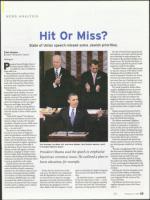
Vice President Joe Biden, left, and House Speaker John Boehner applaud a point
in President Obama's speech.
President Obama used the speech to emphasize
bipartisan consensus issues. He outlined a plan to
boost education, for example.
Obama did not entirely leave out lib-
eral causes. He offered some compromise
with the Republicans on health care, but
he vowed to leave in place the coverage
guarantees for people with preconditions,
which became law with last year's reform
bill. Obama also pledged to revive his
effort, failed in the last Congress, to create
paths to citizenship for illegal immigrants
who arrived in the United States as chil-
dren.
He noted the success — spearheaded
by Sen. Joe Lieberman, I-Conn. — in the
final hours of the last Congress repealing
the "Don't Ask, Don't Tell" rule that kept
gays from serving openly in the military.
The slew of brief Jewish organizational
news releases praised the speech's general
tone. What they're really waiting for are
the details of the president's budget, to be
released soon. The Jewish Federations of
North America pleaded for special consid-
eration for needs for the elderly.
"President Obama is right when he says
we must be cautious of the deficit',' JFNWs
Washington director, William Daroff,
said in a statement. "But there are certain
social services that must be preserved
now more than ever. Creating more crises
for our seniors and poor is not the way to
stop the crisis facing our nation."
The Jewish Council for Public Affairs
sought to highlight the issue of poverty.
"With the President's budget forthcom-
ing, we are anxious to see that he follows
through on his call not to balance the
budget on the backs of our most vulner-
able,' JCPA said in a statement. "President
Obama must listen to his own advice and
avoid a hatchet where a scalpel is called
for."
Obama reassured Americans that he
would not touch Social Security except
to "strengthen" it, which got him plaudits
from B'nai B'rith International.
The Reform movement's Religious
Action Center set up a checklist on its
website to comment on 10 signature
issues as they came up in the speech. On
at least five of them, including Israel, gun
control and Gulf Coast recovery, the RAC
ended up regurgitating its past statements
because they did not get a mention.
Israel was missing in his speech, but
Obama noted his success in an area that
pro-Israel groups consider key: isolating
Iran.
"Because of a diplomatic effort to insist
that Iran meet its obligations, the Iranian
government now faces tougher and tighter
sanctions than ever before,' he said.
Obama started his speech by noting
the empty seat of Rep. Gabrielle Giffords,
D-Ariz., recovering from being shot in the
head in the Jan. 8 Tucson shooting that left
six dead.
Marking the civil tone, lawmakers wore
black and white ribbons, traditionally
used to protest gun violence and in this
case designated for the victims of the
Tucson shooting.
Republicans and Democrats also sat
together during the State of the Union
address.
February 3 • 2011
23