

M e trO
GRATITUDE
cOD
Sacred Art from page 16
had to do everything with our hands!'
Because Jewish children were not
allowed toys, Lowenberg also recalls mak-
ing animals and houses out of plywood.
Soon matters grew worse for the Jews.
In the fall of 1939, at the beginning of
World War II, non-Jewish merchants in
Fulda stopped selling food and other
goods to Jews. In September 1941, Jews
were required to wear yellow stars. By the
end of that year, the Lowenberg family —
minus older siblings Hans and Berti, who
left for Palestine, and Margot, who went
to America as an au pair — were sent by
train to the ghetto in Riga, Latvia. Nazi-
occupied Riga was infamous for slaughter-
ing its Jews in the forest.
The family shared one bug- and rat-
infested room with another couple.
Lowenberg's older sister, Eva, was taken
to a slave labor camp first; then on Aug.
16, 1943, 15-year-old Martin was sent to
Kaiserwald concentration camp in Riga.
The Riga ghetto was liquidated less than
three months later. His parents and his
younger twin brothers, Fritz and Kurt, were
taken to Auschwitz, Poland, where they
were killed. To this day, Lowenberg says he
hopes his brothers were never subjected to
any of Dr. Josef Mengele's experiments on
young twins.
In Kaiserwald, Lowenberg labored in
machine shops, using a vise, file and other
equipment to make metal military parts
for the Germans.
"I became in love with metals, though
I had to make things for the Germans:' he
said.
It was a love that only would surface
again much later in his life.
After being caught trying to bribe his
way into seeing Eva at her job in the nearby
army clothing office, the overworked and
undernourished Lowenberg was severely
punished by being forced to squat with his
arms outstretched for 24 hours. Eventually,
the sister and brother worked together in
the clothing office.
In September 1944, they were taken to a
camp in Libau, Latvia. A few months later,
they boarded a ship to Hamburg, Germany,
where they were put into Fuhlsbuettel pris-
on, with political dissenters and foreigners.
In April 1945, the Jewish prisoners were
forced on a death march to Kiel, 70 miles
away. To sustain themselves, they ate beets
torn from the fields.
In Kiel's labor camp, the siblings sorted
bricks from bombed buildings and stayed
alive by scavenging food from the camp
garbage.
The week before the war ended,
Lowenberg and his sister were among
truckloads of Jewish prisoners taken to
Malmo, Sweden, in exchange for the safety
of SS Chief Henrich Himmler and his
18 January 13 . 2011
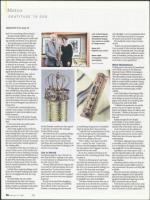
Left: Artists Martin
Lowenberg and Gail
Rosenbloom Kaplan
have works on exhibit
at Temple Israel.
Below left:
Megillah case crown
Below right:
A mezuzah of brass
and niobium
Photos by Brett Mountain
family. Himmler would never have agreed
to save Jews; he believed the exchange
involved Polish women.
After liberation, the Lowenberg siblings
spent nearly a year recovering in three
Swedish displaced persons camps. They
later were reunited in the United States
with Hans, Berti and Margot. Today, Eva is
87 and lives in New York; and Margot is 90
and lives in San Diego.
Life In Detroit
Lowenberg made his way to Detroit via
New York and Ohio, working in the ready-
to-wear business or selling textiles. He met
his wife, Carol, in Ohio.
"Dayton didn't provide the religious life
I was used to:' said Lowenberg, who is an
observant Jew."I took a job as a travel-
ing salesmen with Continental Textiles
and moved to Detroit in 1964. It sounded
good, with more Jews and more religious
[options]!'
He and Carol raised three daughters,
Cheryl, Anita and Sandra, in Southfield.
They still live in the same house on
Potomac. Lowenberg was instrumental
in establishing Young Israel of Southfield,
where he davens three times each day.
"I uphold God's commandments; it's the
way I was brought up:' he said simply.
After heart surgery in 1984, Lowenberg
retired from selling on the road.
"After a while, I went back to my first
love — metals:' he said. "I took a few
classes at the Birmingham Bloomfield
Art Association, then I figured I can do it
myself with my own tools."
He set up a compact workshop in his
basement, with everything precisely where
he wants it.
"He lives in the basement:' said Carol,
who takes her knitting down to keep him
company. "It's his second career. He's not
the type to sit around and do nothing; nei-
ther am I. He's busy and very happy."
Lowenberg, now 82, focuses on creating
Jewish religious objects — mezuzot, yads,
menorahs, decorations for the back of tal-
lit, megillah cases and eternal lights.
"I do these mostly because there are so
many items in our Jewish lives and these
pieces have more meaning to me he said.
"I work by instinct, by love, from my cre-
ative thoughts. I am very passionate about
this. I have done some pieces in memory
of my past and in honor of my family."
But mostly, his work is done in honor
of God.
"It gives me personal satisfaction, and
I am so proud of what God has bestowed
upon me Lowenberg said. "Even though
my hands and feet have suffered so many
years of hardship, God has given me the
strength to use my brain, hands and feet
to do work I can be grateful for!'
Metal Masterpieces
It's likely you've seen some of Lowenberg's
work. All the mezuzot at the Holocaust
Memorial Center (HMC) in Farmington
Hills and at Hechtman II Apartments in
West Bloomfield, recently restored after a
fire, are by Lowenberg. A ner tamid (eternal
light) he created will be installed at Young
Israel in Southfield in a few weeks. And he
made most of the metal work, including
the Auschwitz workman's gate, in HMC
exhibits.
Artist Gail Kaplan of Farmington Hills,
who is involved at the HMC and also con-
ducts Judaica art projects for local syna-
gogues and schools, met Lowenberg after
learning of his work in the HMC.
"I related to his passion for art and the
power of his art to express our Jewish
legacy:' said Kaplan, whose art reflects simi-
lar passion. "I believe in the power of art to
heal; and his personal story spoke to me in
that way!'
Kaplan arranged for the Temple
Israel exhibit so more people could see
Lowenberg's work. She was invited to
include some of her Judaic work as well.
Look at the pieces in the exhibit and
you can see the evolution of a craftsman.
Though the earlier pieces are less embel-
lished, they show the same impeccable
craftsmanship.
The Hebrew calligraphy, done freehand,
is incredibly precise. The well-formed let-
ters are homage to the elderly man in Fulda
who taught the 10-year-old Lowenberg.
Typically, he can create a piece a day — a
day that typically begins in the workshop
after morning services and breakfast and
lasts until after 10 p.m. He works every day
except Shabbat.
Lowenberg sells his work at art fairs, by
word of mouth and also fulfills many pri-
vate commissions. His pieces cost from $80
to $6,000.
When he's not in the workshop or visit-
ing his three daughters and 14 grandchil-
dren, he's busy educating others by speak-
ing about his Holocaust experiences at the
HMC, around the state or abroad.
"I live for love and live with love for what
I'm doing:' Lowenberg said. "I am thanking
God every day for so much satisfaction!'