

Metro
COVER I GRATITUDE TO GOD
Keri Guten Cohen
Story Development Editor
artin Lowenberg is a perfection-
ist. He attributes the trait to his
German upbringing and to his
desire not to make mistakes, to have all go
properly. The characteristic can be seen
clearly in his artwork — sacred Jewish
objects painstakingly wrought from ster-
ling silver, brass and niobium.
Twenty or so of his pieces are exhib-
ited in the Goodman Family Judaica and
Archival Museum at Temple Israel in West
Bloomfield through May.
Like his metal works, Lowenberg, too,
has been through fire — the hell of the
Holocaust — and emerged with a patina
that shows itself in his gratitude to God.
Born in 1928 in Schenklengsfeld,
Germany, Lowenberg grew up with his
parents, Sally and Klara, and six siblings
in a rapidly changing Germany. When he
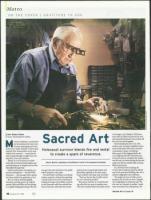
Sacred Art
Holocaust survivor blends fire and metal
to create a spark of reverence.
Above: Martin Lowenberg of Southfield at work in his basement workshop
was age 8, the anti-Semitism in his public
school reached a crisis point.
On Adolf Hitler's birthday, Lowenberg's
teacher wanted to celebrate by punishing
a Jewish child. He accused Lowenberg of
sticking his tongue out at Hitler's portrait
on the classroom wall, then ordered four
boys to beat him. Afterward, the teacher
picked up his young Jewish student and
placed him squarely on his chair, atop a
board studded with sharp nails and tacks.
"That was the last day of public school
for me',' Lowenberg recalled.
His parents sent him to a Jewish board-
ing school for two years in another town.
They were reunited when the family moved
to the larger city of Fulda in 1938, three
years after his father's license for his seed
and animal feed business was revoked. All
the city's Jews lived together.
After Kristallnacht, Nov. 9-10, 1938,
teachers were no longer available because
most Jewish males were sent to German
concentration camps. Lowenberg's
father spent all day digging ditches for
a new highway that later would become
Germany's famous autobahn. His mother
was the only one home during the day and
made sure Martin studied math, German,
Hebrew and poetry.
As a diversion from studying, the
10-year-old Lowenberg visited an elderly
man in his apartment building who was a
talented calligrapher and craftsman.
"He taught me how to hold a pencil
properly and to write; he was a magnifi-
cent calligrapher," Lowenberg said. "He
also was very talented in metals. I made
some mezuzahs, but nothing fancy. We
Sacred Art on page 18
16 January 13 2011