

World
Changing Mentality
Katsav rape conviction hailed as watershed moment.
Dina Kraft
Jewish Telegraphic Agency
Tel Aviv
F
or years, it was considered an
open secret in Israeli political and
media circles that Moshe Katsav
had a habit of sexually harassing women
who worked for him.
In a nation at arms ,with a decidedly
machismo bent, sexual encounters between
powerful male politicians and military
officers and their female staff often were
seen as a perk of the job and such behavior
quietly was accepted as part of the culture,
if unhappily by many women.
But then came last week's "earthquake
as Israeli newspapers described it: Katsav,
Israel's president from 2000 to 2007, was
convicted of rape, sexual assault and
harassment.
Walking out of the crowded Tel Aviv
courtroom where Katsav had just been
convicted on Dec. 30, Merav Michaeli, a
leading Israeli feminist and well-known
television personality, hailed what she
hoped signaled a cultural shift.
"I wish I could tell you this will change
the face of Israeli society, but even if it does
not it is another step, a sign of change she
said. "The judges believed the women and
understood and recognized the impossible
position women are often placed in when
working for such powerful men."
Katsav's conviction, handed down in a
scathing ruling by a panel of three judges
who called the former president a liar and
expressly stated that when a woman says
"no" she means it, was hailed as a historic
day for women's rights and even for Israeli
democracy.
Many Israelis say the conviction repre-
sents a watershed moment in Israel's tran-
sition to a new set of societal rules about
what is considered acceptable — and legal
— behavior when it comes to relations
between men and women, particularly in
the workplace.
Moshe Negbi, a legal analyst for Israel
Radio, said the verdict may come to sym-
bolize "a mortal blow to the macho culture
that turns women into an object of despi-
cable sexual exploitation."
The transition began years ago. In
1998, the Knesset passed a groundbreak-
ing sexual harassment law. An important
test case soon followed when Yitzhak
Mordechai, a former general and defense
26 January 6 2011
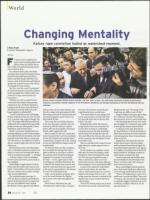
Former Israeli President Moshe Katsav outside a Tel Aviv court on Dec. 30, after being convicted of raping a government
employee, assaulting a female employee of the President's Residence and sexually harassing an 18-year-old National Service
volunteer.
minister who ran for prime minister, was
forced to resign from government in 2001
after being convicted of sexual assault and
harassment against several women who
had worked for him.
Then came the case of Haim Ramon,
at the time the justice minister, who was
indicted in 2006 for indecent conduct
and in 2007 was found guilty of kissing a
female soldier against her will.
Most recently, Uri Bar-Lev, a major gen-
eral in the police force and a top contender
for the job of Israel's next national police
commissioner, dropped out of the running
for the post last fall after being accused of
sexual assault.
"In the past, there was this conception
that we should not damage the respect
given to officers or any man in a power-
ful position, and if [sexual harassment]
happened to a woman it was probably
her fault — it was a great way to hush
everything up:' said Efrat Nachmany Bar,
a colonel in the Israeli army reserves who
until her retirement four years ago served
as the army's representative to the Knesset
on issues of sexual harassment.
In her current position as deputy direc-
tor of the Israeli Institute for Dignity,
she lectures on the topic throughout the
country.
About Katsav, Nachmany Bar said,
"Everyone knew and everyone was quiet.
But now it has become not just his per-
sonal business but a societal issue.
"The Israeli public is now saying, 'Let's
not be quiet anymore, but let's talk. And
let's also talk about why we did not talk
before," she said.
Nachmany Bar credits the army for
being ahead of the curve of Israeli civil
society when it comes to confronting
sexual harassment. She held workshops
and lectures, and ran help lines for sol-
diers and officers for 16 years. She also sat
on the committee that disciplined sexual
harassment cases.
That era coincided with women increas-
ingly taking on combat support roles in
the army.
Israel's existence as a military society
often gets the blame for forging a male-
dominated culture, Nachmany Bar said,
but "the issue goes beyond the army. I
think a militaristic culture is not one
borne from security risks alone, although
that strengthens it, but of patriarchy itself."
As part of the context for understand-
ing the Israeli culture, she and other
experts cited Israel's history as a country
forged on the image of the new Jew — the
strong, muscular contrast to notions of the
diaspora Jew as pale, stooped and decid-
edly unmanly.
"Part of the Zionist project was to prove
that Israeli men are the real Jewish men:'
Nachmany Bar said. "The image of the
Israeli man as soldier is part of this."
Using the Hebrew term gever gever, slang
for a "real man',' she said, "Part of being
this real man is to be in control all the time
— the idea being that if we are to be a real
man in regards to a woman, the man needs
to lead and the woman needs to follow."
A national survey done this year by
the Israel Ministry of Trade and Industry
found that 40 percent of women reported
experiencing some form of sexual harass-
ment on the job.
Avigail Moor, who heads the women's
studies department at Tel Chai College,
said her research found that the figure for
actual harassment, reported or not, appears
to be higher: some 60 percent of the Israeli
female workforce. The figure is similar to
other Western countries, she said.
Sexual assault and rape hotlines have
been overloaded in the aftermath of the
Katsav conviction with calls coming in
from across the country.
Moor, a psychologist, said the question
now is how much Israeli men will internal-
ize the message handed down by the court.
"If this is the beginning of a new era, it
could have a spectacular effect:' Moor said.
"If women come forward in large numbers
it could also trigger a backlash. Any social
revolution, and this is what it is, has its
ups and downs."