
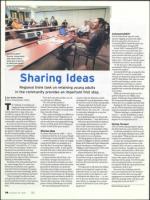

CommunityNEXT
Director Jordan Wolfe
talks about what is
being done in Detroit
to retain and attract
young Je
a.
Sharing Ideas
Regional think tank on retaining young adults
in the community provides an important first step.
Keri Guten Cohen
Story Development Editor
T
he challenge of retaining and
engaging young Jewish adults in
their home communities rather
than losing them to large urban cen-
ters like Los Angeles, New York, Atlanta,
Boston, Chicago and Washington, D.C.,
looms large for many dwindling Jewish
communities, especially in the Midwest.
In a move to pool resources and brain-
power, Scott Kaufman, Jewish Federation
of Metropolitan Detroit CFEO, proposed
the idea of a "think tank" session at
the fall General Assembly of the Jewish
Federations of North America (JFNA).
Cosponsored by Detroit's Federation
and JFNA, the session ("Rebuilding Jewish
Communities by Attracting and Retaining
Young Adults") was held Dec. 12-13 and
drew about 45 participants. Winter's first
big snowstorm prevented some from
joining in person, yet technology allowed
participation in the full day of discus-
sions held at the Max M. Fisher Federation
Building in Bloomfield Township.
The group of lay and professional lead-
ers, most younger than 35, came from
federations, foundations and organiza-
tions from Detroit, Cleveland, Cincinnati,
Columbus, Ann Arbor, Pittsburgh, Toledo,
St. Louis, Kansas City, Montreal and Israel.
"There's strength in collective, frank
and open discussion of what works and
doesn't:' said Alice Viroslav of San Antonio,
Texas, JFNA national young leadership
chair.
14
December 30 • 2010
iN
"If we don't solve this problem, our cit-
ies will look very different.
"We will solve this problem:"
At dinner Sunday, David Egner of
Detroit's New Economy Initiative gave his
perspective on the exodus of young adults
from cities like Detroit.
"Place means something very different to
younger adults:' he said. "Migration is not
to suburbs, but to other cities; and jobs are
not the only driver of young people leaving.
Its not one thing. Some of it is timing, and
we have to have all the pieces in place?'
Sharing Ideas
No matter what they are called — Gen J
in Montreal, Next Dor in St. Louis, J'Burgh
in Pittsburgh, CommunityNEXT in Detroit
— creative programs to retain and engage
young Jewish adults are springing up to
stem the flood of young Jews migrating
to bustling urban centers. A main goal of
the think tank was to share ideas and best
practices so each city would not have to
reinvent the wheel.
As representatives shared ideas, com-
mon themes emerged. Increased entry
points to the Jewish community are need-
ed. Grassroots initiatives rather than those
generated by federations are preferred.
Innovative partnerships are encouraged.
Technology and social networking should
be harnessed. Opportunities for deepening
Jewish experiences and identity should be
provided. Job creation is important; so is a
vibrant urban experience. And transition
points to future philanthropy are needed.
One issue that generated much dis-
cussion is that the federation model,
unchanged for several generations, proba-
bly does not work for today's young adults.
"Young people don't feel guilty about
not being involved in federation:' said
JFNNs Virsolay. "It's a turn-off ... We need
to reintroduce federation in a way that
resonates with people'
An underlying thought was that people
don't hate federation — they don't know it.
Still, most agreed federation's emphasis
on campaign and donations to care for
those in the community, fund educa-
tion and more are not immediate selling
points. Most of the programs designed to
retain and attract young adults that were
cited avoid a focus on donations.
"For this generation, it does not work to say
you have an obligation to donate" said Roben
Kantor of the Charles and Lynn Schusterman
Family Foundation in Washington, D.C.
"Allegiances don't hold anymore. What works
are relationships and peers?'
Aharon Horowitz of New York and
Jerusalem, co-founder and director of the
PresenTense Group, an organization that
energizes and trains young Jewish entre-
preneurs, felt some historical connection
was needed.
"It's important to talk about the welfare
system as an important creation to take
inspiration from:' he said. "It's important
to expose people to the elderly, etc., and
to federation and what it does — to con-
nect to the past and the future. Federation
must deliver on campaign, but a certain
amount of dissonance is part of the grow-
ing process:'
CommunityNEXT
Detroit Federation's hope for retain-
ing and engaging young Jewish adults
has been pinned for the last year to
CommunityNEXT, funded through a pri-
vate $100,000 grant through 2010.
Jordan Wolfe, CommunityNEXT direc-
tor, says a key to success has been real
empowerment, resulting in several grass-
roots initiatives that have paid off. Come
Play Detroit, a primarily Jewish sports
league, drew 1,200 people. Pitch for Israel,
a baseball tournament, raised $50,000.
"In the first year, 2,200 young adults
participated:' Wolfe said, "and 64 jobs were
created and retained."
CommunityNEXT also arranged for free
office space for a year for young adults
trying to get businesses going, and worked
with JVS and Hebrew Free Loan on career
searches and funding. a website (www.
communitynxt.com) hopes to connect
young people online, and the Torah on Tap
program and community Birthright trips
were started.
Wolfe says next year's goal is an inte-
grated strategy for area Hillels, syna-
gogues, Federation's Young Adult Division,
the community Birthright and young
Detroit Jews in Los Angeles and New York.
Funding for 2011 has not been secured
yet, but Detroit Federation CEO Kaufman
says he's committed to CommunityNEXT.
"Whether funding is a combination of
sources — private, foundations or some
Federation contributions — we'll make it
happen. It's too important not to:"
Moving Forward
After an intense day, participants agreed
the think tank was a successful first step.
"Look how powerful we can be as a col-
lective," said Becky Sobelman-Stern, JFNA
vice president. "What are the next steps to
continue the conversation?"
As hosts, the CommunityNEXT staff is
preparing notes from discussions to dis-
seminate. JFNA will revive a national best
practices database. Thoughts also surfaced
about more communication, a JFNA inno-
vation fund and ways to measure success.
"There was an energy to the conver-
sation, with creative, practical ideas:'
Kaufman told the group. "For JFNA to play
a key role going forward is very positive.
I'm impressed with the talent, passion and
commitment of all of you."
Two weeks later, Kaufman says he's
even more impressed that the inventors
of these innovative labs of young adult
engagement are communicating with each
other after putting names with faces, and
sharing ideas back and forth."
❑
Related editorial: page 30.