

Arts & Entertainment
MAKING HISTORY / ON THE COVER
Let
Freedom
Ring
Photos courtesy of National Museum of American Jewish History
Philadelphia's new National Museum of
American Jewish History offers a look
at the double-edged story it's telling.
Steve Lipman
New York Jewish Week
Philadelphia
acts, courtesy of Natio na l Muse um of Ame rican Jew is
H
e was a prominent city official in
Richmond two centuries ago, but
he is a minor figure in American
history. Solomon Jacobs, in a portrait that
displays well his serious mien and full
sideburns, makes a silent statement here
about the lives that American Jews once
led and still do.
The 1811 oil painting of Jacobs, who
served as city recorder and acting mayor
of Virginia's capital in the second decade
of the 1800s, is mounted on a fourth-floor
wall of the National Museum of American
Jewish History, a glass-facade edifice that
has risen over the last few years at the
corner of Fifth and Market streets, across
from the Independence Mall.
The institution, arguably the most
prominent Jewish museum to open in
the United States since the U.S. Holocaust
Memorial Museum on Washington's
National Mall in 1993 and the Museum
of Jewish Heritage-A Living Memorial to
the Holocaust in lower Manhattan in 1997,
held its official unveiling the weekend of
Nov. 12-14. The opening ceremonies fea-
tured a keynote speech by Vice President
Joseph Biden, performances by Jerry
Seinfeld and Bette Midler, a symposium
and VIP tours of the 100,000-square-foot
site.
The museum opened to the general
public on Nov. 26.
On the walls and inside display cases of
the five-story building — which is a block
south of the National Constitution Center
and a block north of Independence Hall,
an area the museum calls "the nation's
most historic square mile" — are more
than 1,000 artifacts, from the mundane
to the exceptional. Among them: hand-
written letters and yellowing receipts, pho-
tographs and books, posters and patches,
greeting cards and boxing trunks, suitcas-
es and a stagecoach, a Yiddish-language
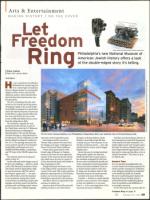
The five-story museum building is on Philadelphia's Independence Mall, near landmark sites of the Revolutionary War.
typewriter and Irving Berlin's piano.
And Solomon Jacobs' portrait, by
Thomas Sully, a painter who drew, from
live sittings, such major world figures as
Queen Victoria and Thomas Jefferson.
A three-times grand master of the
Grand Lodge of Masonry in Virginia,
Jacobs was far from the most important
member of the American Jewish commu-
nity, which traces its roots to a group of
23 Jews from Recife, Brazil, who landed at
New Amsterdam in 1654.
Though Richmond was home to one
of the largest Jewish communities in this
country in the early 19th century, and Jews
played an important role in civic life there,
Jacobs is not even the most important
Jewish figure represented in the museum.
And that is why he is represented in the
museum, its leaders say.
American Jewish history, the museum's
exhibits proclaim, is more than Henry
Kissinger or Hyman Rickover, Sandy
Koufax or Jonas Salk. People like that
certainly are part of the museum. So are
the likes of Solomon Jacobs — Jews who
quietly built the country and are largely
forgotten now
Jacobs, the son of a roving, horseback-
riding mohel, typifies the American
Jewish narrative that in many respects
has remained unchanged for 200 years.
He was active in Richmond's Jewish and
wider communities, but his descendants
intermarried and assimilated. There are
no known Jewish members of his fam-
ily today, says the Judaica collector who
loaned the museum the Jacobs portrait.
And that is the price of freedom.
Freedom — freedom to openly identify
oneself as a Jew, to practice one's religion,
to deny one's Judaism or to run away
from it — is the connecting theme of the
museum's permanent exhibition.
Freedom, says Steven Bayme, director of
the Contemporary Jewish Life Department
of the American Jewish Committee, "is a
double-edged sword" and "unequivocally a
blessing;' one that has afforded American
Jewry unprecedented opportunities. But it
also may be a trap, one that allows a Jew to
shed his Jewishness."The choice is up to
us," Bayme says.
Neutral Tone
In a non-preachy, nonjudgmental, easy-
to-miss manner, the museum presents the
choices and the consequences of freedom,
never obliquely stating that an individual
or his family had opted out of Jewish
life, never condemning one's choices, but
depicting, between the lines of text, a
national Jewish life weakened by genera-
tions of assimilation and indifference if
not outright conversion.
On the other hand, the museum tells the
Freedom Ring on page 31
December 23 • 2010
29