

Arts & Entertainment
The New Clergy from page 39
denominations will be able to
identify with the characters and
their struggles:' Alpert declares.
"These are more human stories
than denominational stories:'
Rabbi Shapiro, a big, somewhat
awkward, guy with a framed
photo of Jerry Garcia, accepts
a post with a small, older New
Jersey congregation. His enthusi-
asm, palpable in the first Shabbat
dinner he prepares with his preg-
nant wife, proves as valuable as his
knowledge of prayer and scripture.
"Yerachmiel's story is almost a
coming-of-age story:' says Alpert,
who lived in Israel from ages
15-30 and majored in film at Tel
Aviv Uthversity. "He's heimish, and
you want to reach out and pinch
his cheek. He's just a nice Jewish
boy trying to do the right thing.
"Shmuly's story is about a
religious leader trying to define
a new path that combines social
justice and traditional rabbinic
roles."
Shmuly Yanklowitz, a year or
two behind Yerachmiel in school,
goes to Postville, Iowa, in the
middle of the Agriprocessors
scandal to help the illegal immi-
grants employed by the kosher
meatpacker. He later heads to
Southern California to assist
with a wildfire relief effort.
"One of the main themes of
The Calling is modernity and
faith, and how these two things
The Three Faiths from page 39
co-exist in American society:'
Alpert says. "Chovevei Torah, to
my mind, is the most interesting
place. They're trying to bring
the 'modern back into Modern
Orthodoxy."
One of the most compelling
aspects of the series is the way it
shifts between characters, invit-
ing us to witness the hurdles,
real-world problems and self-
doubts that each of the seven
men and women encounters.
We may not be familiar with the
details and rituals of every reli-
gion, but we come to respect each
individual's urge to serve and
their extraordinary humanity.
Alpert reveals that one docu-
mentary funder proposed sepa-
rating the denominations into
different hours instead of one
integrated whole. The advantage
of Alpert's approach is that audi-
ences are exposed to a range of
religions rather than just tuning
in to see their own.
"I fought back pretty rigor-
ously against that [suggestion];'
Alpert says. "It's about the inter-
weaving of the different faiths.
How much is the Catholic com-
munity going to be interested in
Orthodox Jewry?
"These are American stories.
Keeping what is meaningful in
the traditional ways and fully
embracing the modern world is a
tension we can all relate to:'
❑
The Calling airs 9-11 p.m. Monday and Tuesday, Dec. 20-21, on
Detroit Public Television-Channel 56. To learn more about the
film and outreach activities, go to pbs.org/the-calling.
is why the Ethiopian gospels will
grab your attention — they're
like nothing else around them.
Completed in 1722, the
Ethiopian Christian bible fea-
tures a darker-skinned Jesus
and his disciples, clad in ruby
red robes, as Jesus preaches to
onlookers. A mustard sky melt-
ing into orange surrounds them,
while a verdant green tree sits
behind them, just off a cliff.
It seems to capture what every-
thing in this section, and this
show, is about: All three faiths are
dependent on divine revelation,
expressed through their prophets.
And yet it is through the spread-
ing of these godly words that
diversity begins.
Many of the texts on display
also are revered ones. But it's
worth noting that "revered;' in this
exhibit, has no clear meaning.
For believers, a book's rever-
ence stems from its connection
to the Divine; but for secularists,
it's based in the rarity of the
text itself. Still, whatever point
of view you take, many of these
texts are downright magnificent.
There is a copy of a Bomberg
Talmud from 16th-century
Venice, historic for standardizing
the commentaries that are still in
use today. Then there is the entire
eight-foot-long Scroll of Esther
from Amsterdam, completed in
1686; its display at the New York
Public Library is one of the only
times that all the fragments have
been united in recent history. And
last, there is the Gutenberg Bible,
from 1455. If there is an item that
stands as the symbol of the infor-
mation revolution, it is this. Hard
drives be damned.
But the curators, mostly
scholars, missed a real opportu-
nity. The four themes that they
chose to highlight as points of
convergence are crucial ones.
But many more are left out, and
had only a few more challenging
ones been included, the hoped-
for effect of mutual understand-
ing might have been more likely
to have been achieved.
It is not about stirring the pot,
either. It is about being honest.
Each religion's canonical books
contain passages, for instance,
that are doctrinaire and draco-
nian. Many riff on the theme of
religious supremacy: Jews with
their "chosen-ness," Christians
with their saved-and-damned,
Muslims with their jihads against
all non-believing infidels.
Though this point is not
mentioned in the exhibit, there
should have been room made
for it. Or, for that matter, there
should have been space for the
larger argument that monothe-
isms of any kind can be perfect
ballast for extremism: If there is
only one God — Elohim, Jesus,
Allah or what have you — and
yours is not mine, that can be a
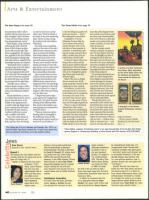
A portion of a New Testament
from Rome, 1560, illustrated
by the artist Guilio Clovio and
his followers and depicting
Jesus giving his Sermon on
the Mount
A biography of the Muslim
prophet Muhammad, Istanbul,
1594
recipe for disaster.
We have much to thank
Abraham for, but also much
not to.
❑
"Three Faiths: Judaism, Christianity, Islam" is on view through Feb. 27 at the New York Public
Library, Stephen A. Schwarzman Building, at 42nd Street and Fifth Avenue. (212) 930-0825.
Jews
ow-
01211 . 111
I
Nate Bloom
Special to the Jewish News
his Round 1
The boxing film The Fighter and the
.12
cl) comedy How Do You Know are set to
111111111 11
open on Friday, Dec.17.
Fighter is based on the true story
of Mickey "Irish"
Ward, a poor Boston
boy who won the
welterweight title in
1997 and had some
incredible come-
backs from injuries.
Mark Wahlberg
plays Ward. Amy
David Russell
Adams plays
40 December 16 ' 2010
Mickey's strong-willed girlfriend,
with Christian Bale as Mickey's
brother/trainer. The film is directed
by David 0. Russell, 52, whose most
successful film was Three Kings
(1999). My favorite Russell film,
however, is the 1996 comedy Flirting
With Disaster in which Ben Stiller
played the adopted son of a Jewish
couple looking for his birth par-
ents. Russell is the secular son of a
Jewish father and an Italian Catholic
mother.
Intelligent Comedies
For more than 40 years, director/
writer James L. Brooks has set
the standard for the best in intel-
ligent comedy –
although sometimes
he doesn't rise to
his own standard.
Brooks, 70, began in
TV, creating Room
222, The Mary Tyler
Moore Show, Rhoda,
James Brooks
Lou Grant and Taxi.
In 1987, he made
his first of his six films to date –
three have been huge hits: Terms of
Endearment, Broadcast News and As
Good as It Gets.
In 2004, he stumbled with the
so-so Spanglish starring Adam
Sandler. For years, most critics said
that director/writer Nancy Meyers,
61, (Something's Gotta Give, It's
Complicated) made "Brooks-like"
romantic comedies that were good
– but didn't quite match Brooks' wit
or profundity. However, in the last
decade, Meyers has had four hits
in a row and the question, now, is
whether Brooks can rise again over
"the Meyer."
Brooks' How Do You Know cer-
tainly has "hit" star power, and we'll
just have to see if it is a return to
form. Reese Witherspoon plays a pro
softball player involved in a roman-
tic triangle. Her suitors are a major
league pitcher (Owen Wilson) and a
corporate exec (Paul Rudd, 41). Jack
Nicholson plays Rudd's father. E.